


Will AI Replace Google Ads Managers? The Uncomfortable Truth After 8 Years in the Trenches
April 10, 2026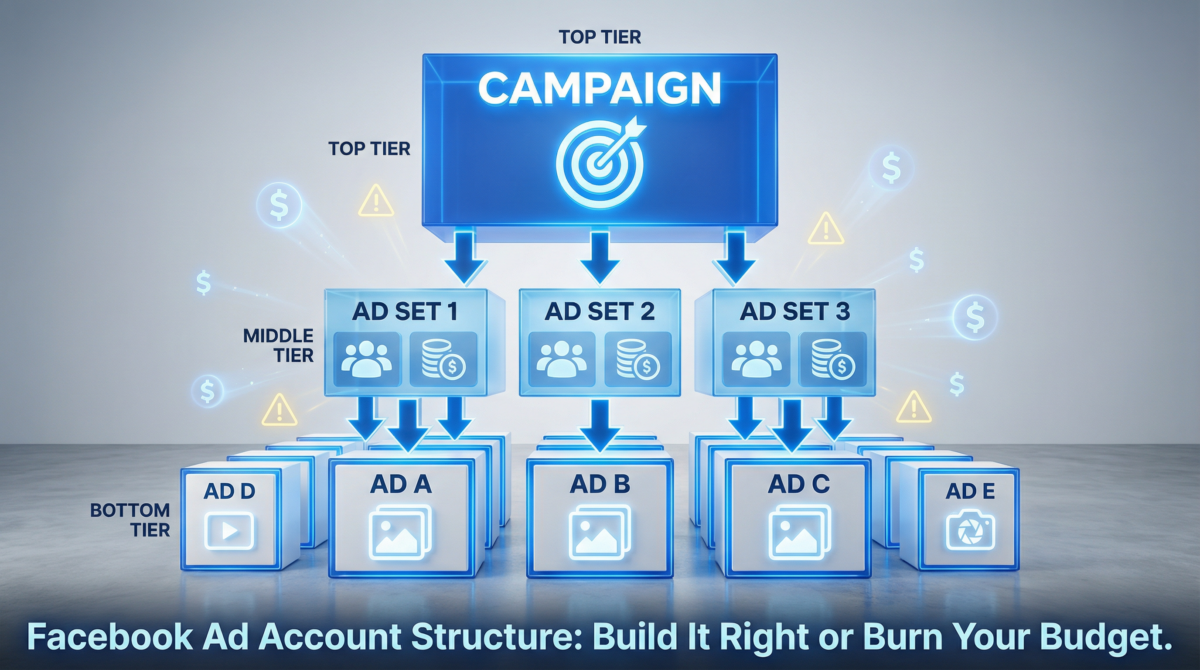
I have audited dozens of Meta Ads accounts over the years, and the story is almost always the exact same.
A business owner or a junior marketer will hand over the keys to their ad account, completely frustrated. They have spent weeks refining their audience targeting. They have hired a videographer to shoot beautiful creative. They have rewritten their ad copy five times. And yet, the results are wildly inconsistent. One day they get three cheap leads; the next three days they get nothing, but the daily budget still vanishes.
They always ask me the same question: “What is wrong with my ads?”
And almost every single time, I have to give them the exact same uncomfortable answer:
“Your ads are fine. Your account structure is a disaster.”
If your Facebook Ads are not performing the way you expect them to, you need to stop tweaking your ad copy and start looking at how your account is actually built. Meta’s advertising platform is not just a place where you “pick an audience and run a post.” It is a highly sophisticated, algorithmic machine. And like any machine, if you build the foundation incorrectly, everything built on top of it will eventually collapse.
Here is the truth about Facebook Ad account structure, why getting it wrong is silently draining your budget, and exactly how to fix it.
The 3-Level Hierarchy: How Meta Actually Thinks
To fix your account, you have to understand how Meta’s algorithm processes information. The entire advertising system is built on a strict, three-level hierarchy: Campaigns, Ad Sets, and Ads.
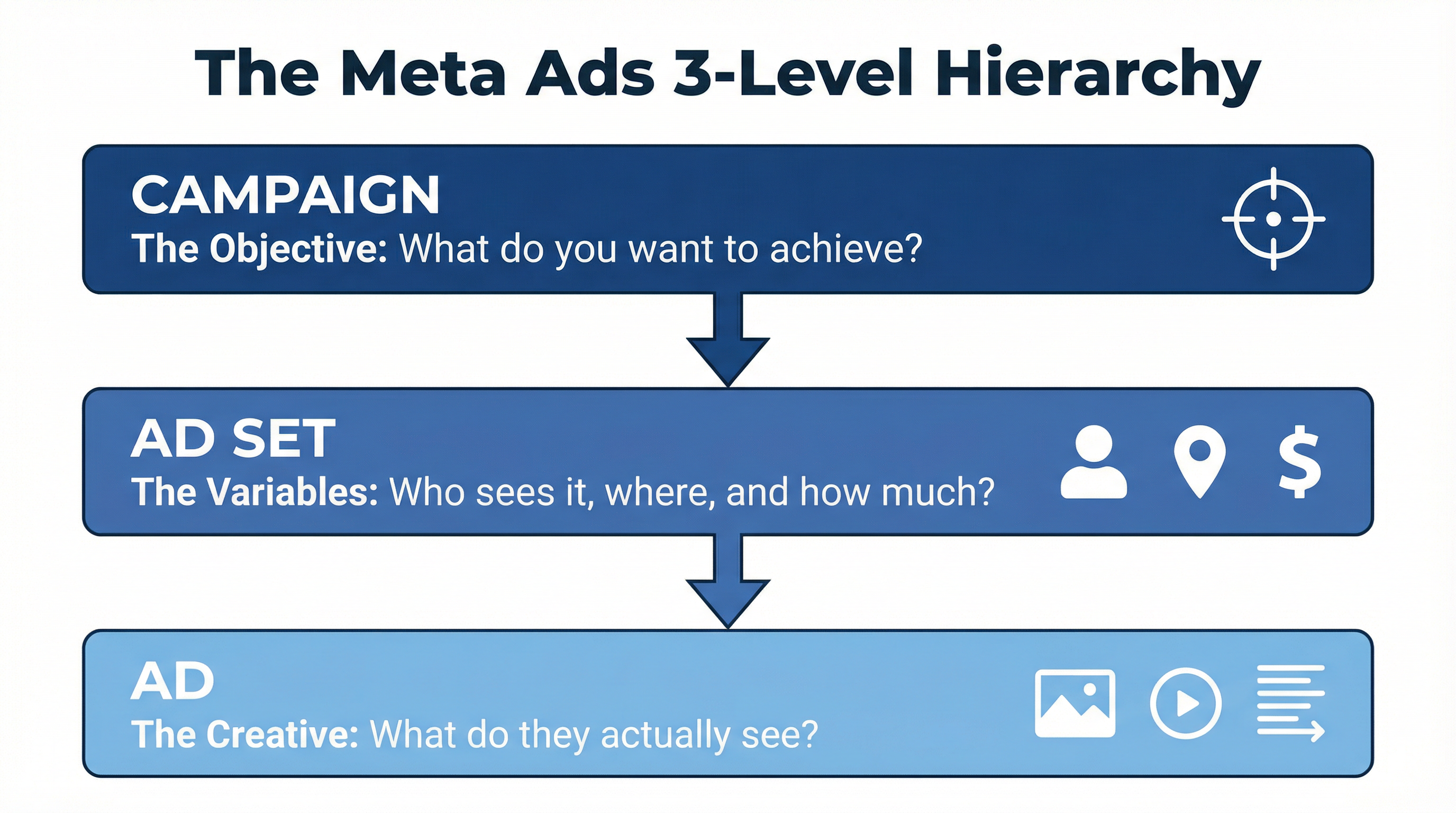
Each of these levels has a very specific, non-negotiable job. If you skip the logic of any one of them, you are not just limiting your performance—you are actively blinding the algorithm. You are making it mathematically impossible for Meta to know what is actually working.
Let’s break down exactly what each level does, and more importantly, where most advertisers completely ruin it.
Level 1: The Campaign (The Objective)
The Campaign is the roof of the house. It is the top of the structure, and it exists for one reason and one reason only: to define your objective.
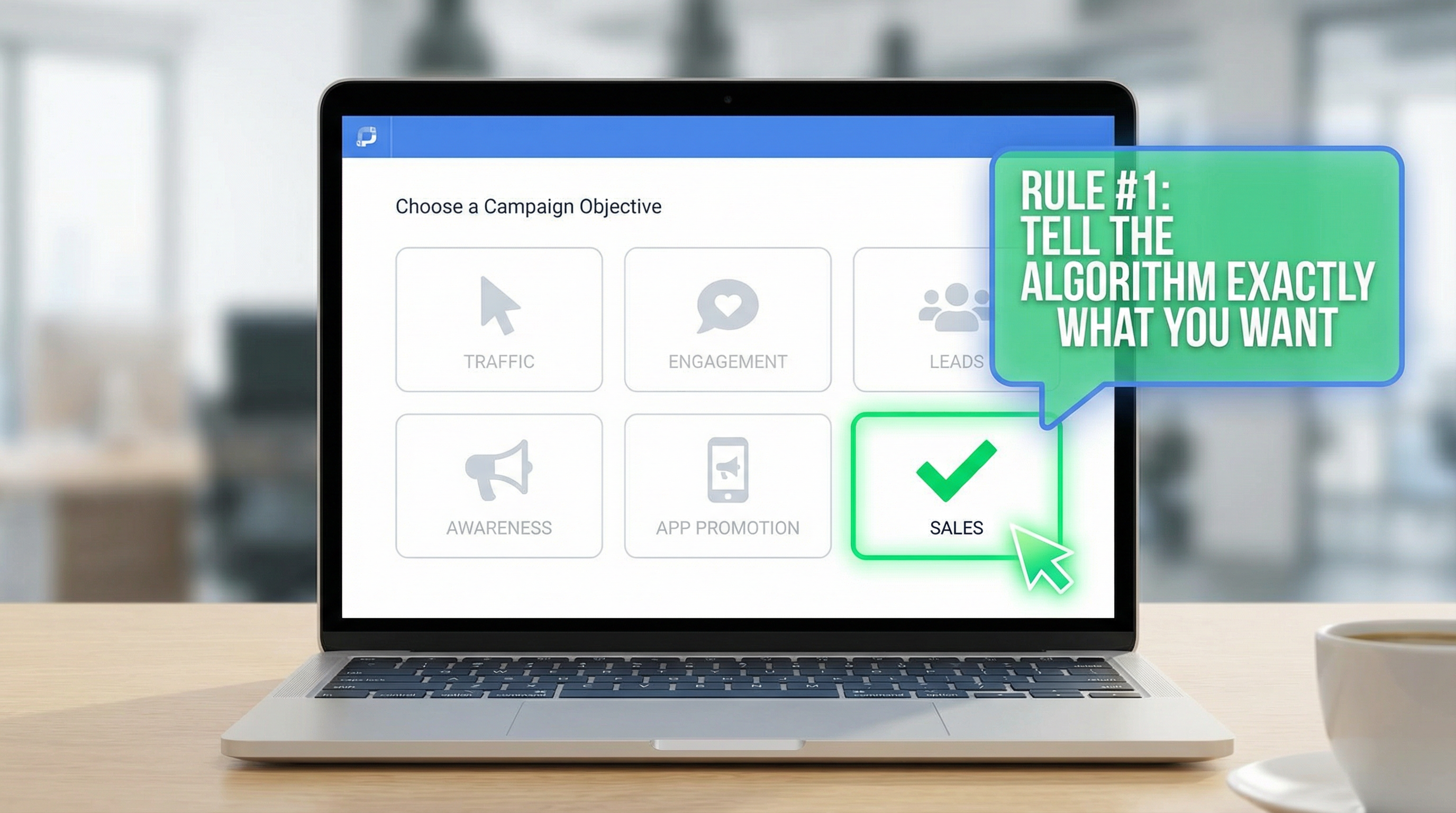
When you create a new campaign, Meta asks you what you want. Do you want traffic to your website? Do you want engagement on a post? Do you want lead form submissions? Do you want actual purchases on your Shopify store?
You must pick one—and only one—objective per campaign.
This matters infinitely more than most people realize. When you select a campaign objective, you are not just organizing your dashboard. You are giving Meta’s artificial intelligence its marching orders. You are telling the algorithm exactly what “success” looks like, so it can go out into its massive user base and find the people most likely to take that specific action.
The Fatal Mistake at the Campaign Level
The most common mistake I see here is mixed signaling.
Advertisers will create a campaign optimized for “Traffic” (link clicks), but then they will get angry when nobody buys their product.
Meta’s algorithm is incredibly literal. If you tell it to find people who click links, it will find the cheapest, most click-happy users on the internet. It does not care if those people bounce off your website three seconds later. It did exactly what you asked it to do at the Campaign level.
If you want purchases, you must choose the “Sales” objective. If you want leads, you must choose the “Leads” objective.
The Rule: One campaign. One objective. No exceptions. If you have two different goals, you need two different campaigns.
Level 2: The Ad Set (The Variables)
If the Campaign is the roof, the Ad Sets are the walls. This is where the actual mechanics of your advertising live. And frankly, this is where 90% of accounts fall apart and where the vast majority of silent budget waste occurs.
Ad Sets live inside your Campaign, and they control three critical variables:
- Your Audience Targeting (Who is seeing the ads?)
- Your Budget and Schedule (How much are you spending, and when?)
- Your Placements (Where are the ads showing up? Instagram Reels? Facebook Feed? Audience Network?)
Think of each Ad Set as a controlled scientific experiment. You define the variables, and the algorithm runs the test.
The Fatal Mistake at the Ad Set Level
The single most destructive mistake I see in Facebook Ads is audience stacking.
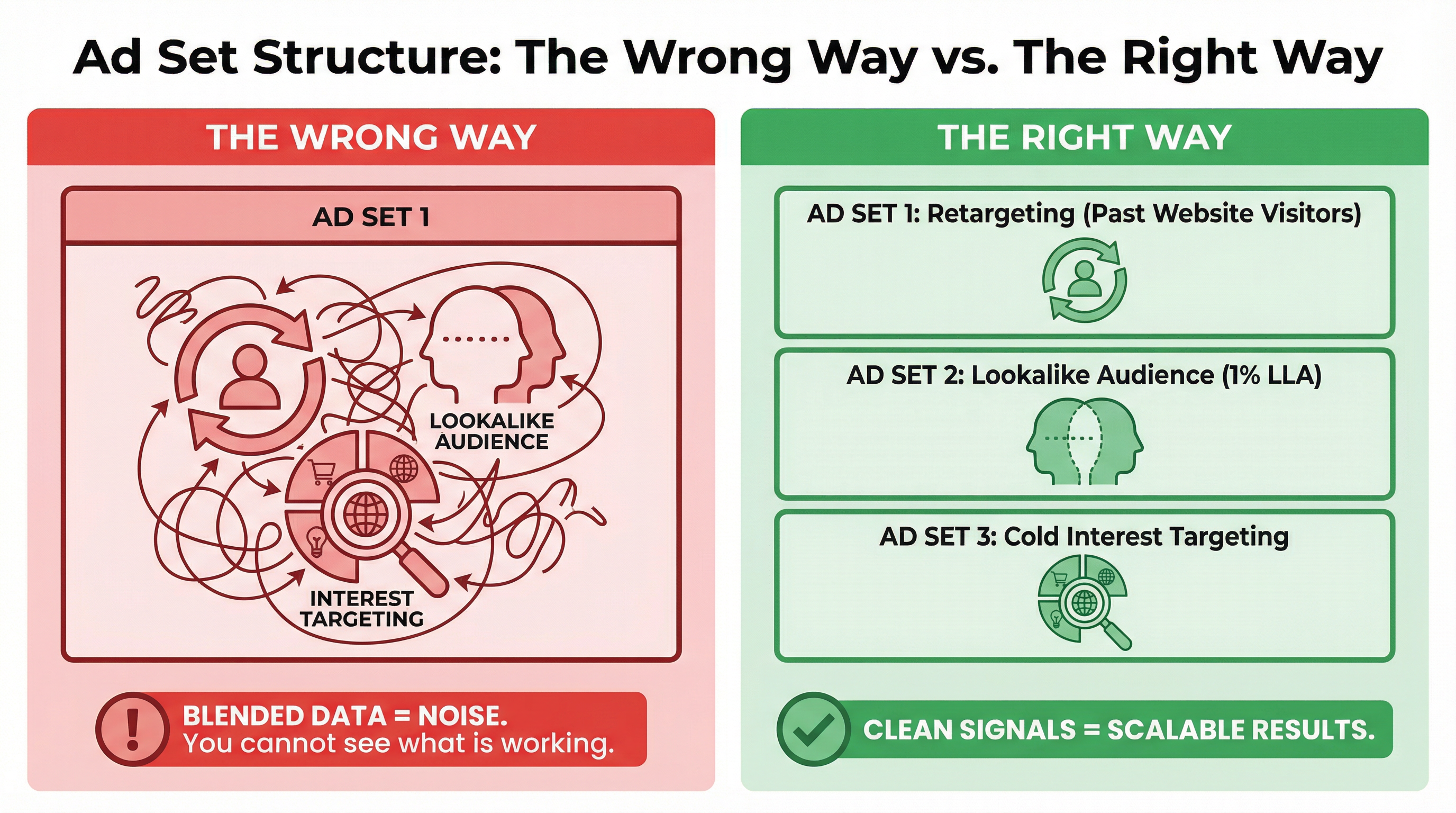
Advertisers will create one Ad Set and throw every single audience they can think of into it. They will combine a warm retargeting list of past website visitors, a Lookalike audience, and a cold interest-based audience (like “people interested in fitness”) all into the exact same Ad Set.
It feels efficient. It feels like you are casting a wide net. In reality, it is algorithmic sabotage.
When you blend audiences inside a single Ad Set, your data becomes completely muddy. If that Ad Set generates three sales, you have absolutely no way of knowing which audience actually bought. Was it the warm retargeting list? Was it the cold interest audience? You don’t know. And worse, the algorithm doesn’t have clean signals to optimize from. You end up optimizing toward noise instead of real, scalable performance.
The Rule: One distinct audience category per Ad Set.
If you want to test a Lookalike audience and an Interest audience, they must be in two separate Ad Sets. This simple structural rule immediately gives you cleaner data, crystal-clear insights, and a foundation that you can actually scale when you find a winner.
Level 3: The Ad (The Creative)
Finally, we reach the floor of the house: The Ad level.
This is where your creative lives—your images, your videos, your primary text, your headlines, and your calls to action.

Ironically, this is the layer that most business owners obsess over first. They will spend weeks agonizing over the perfect headline or the exact shade of blue in their graphic. But as we have just established, if your Campaign objective is wrong, or your Ad Set targeting is blended into noise, the world’s greatest ad creative will still fail. The Ad level should be your focus only after the structure above it is rock solid.
The Fatal Mistake at the Ad Level
The biggest mistake at the Ad level is arrogance.
Advertisers will create exactly one ad, put it inside an Ad Set, and assume it will work. When it fails, they assume the audience is bad or the platform is broken.
You do not know what is going to perform. I have been doing this for years, and I still do not know what is going to perform until the data comes back.
The Rule: Inside every active Ad Set, you should be running three to five ad variations.
Test a video against a static image. Test a long-form, story-based copy against a short, punchy, benefit-driven copy. Let the algorithm serve these variations to the audience in that Ad Set. The AI will quickly identify which version resonates the most, and it will automatically consolidate your budget toward the winning ad.
Do not guess. Test. That is literally what the structure is designed to support.
The “Boost Post” Button: The Ultimate Structure Killer
I cannot write an article about Facebook Ad structure without addressing the elephant in the room: The “Boost Post” button.

Facebook makes it incredibly easy to spend money. They put a bright blue “Boost Post” button under every single organic post on your business page. It is tempting. It is fast. It feels like advertising.
It is not. It is a trap.
When you click “Boost Post,” you are entirely bypassing the 3-level account structure we just discussed.
- You get almost zero objective alignment (Facebook defaults to “Engagement,” meaning it just finds people who will like the post, not buy your product).
- You get severely limited audience control at the Ad Set level.
- You get absolutely zero creative testing at the Ad level, because you are only allowed to promote that one specific post.
You get no structure. You get no data clarity. You just get spend.
If you are serious about generating a return on your investment, you must never use the Boost Post button again. You must build your campaigns inside the Meta Ads Manager, respecting the Campaign, Ad Set, and Ad hierarchy.
Clean Structure = Clean Data = Scalable Results
Campaign → Ad Set → Ad.
Three levels. Each one building logically on the last. It sounds simple, and structurally, it is. But the discipline required to maintain this logic is what separates a Meta Ads account that scales profitably from one that constantly bleeds money.
When your structure is clean, your data is clean. When your data is clean, the algorithm can actually do its job. And when the algorithm has clear, uncontaminated signals to work from, your results will improve—often drastically—without you having to change a single word of your ad copy.
Before you touch your targeting, before you hire a new video editor, and before you rewrite your headlines—audit your account structure. Nine times out of ten, that is exactly where the real answer is hiding.
Are you running Meta Ads but aren’t sure if your account structure is actually built to perform? I manage paid advertising campaigns for businesses that are ready to stop guessing and start scaling. Let’s get your foundation right.
👉 Work with Naz Diocampo on Upwork
