

Google Ads for Moving Companies: The 3-Part Setup That Actually Works
April 9, 2026
The Silent Killer of Facebook Ad Budgets: Why Your Account Structure Is Sabotaging Your Results
April 11, 2026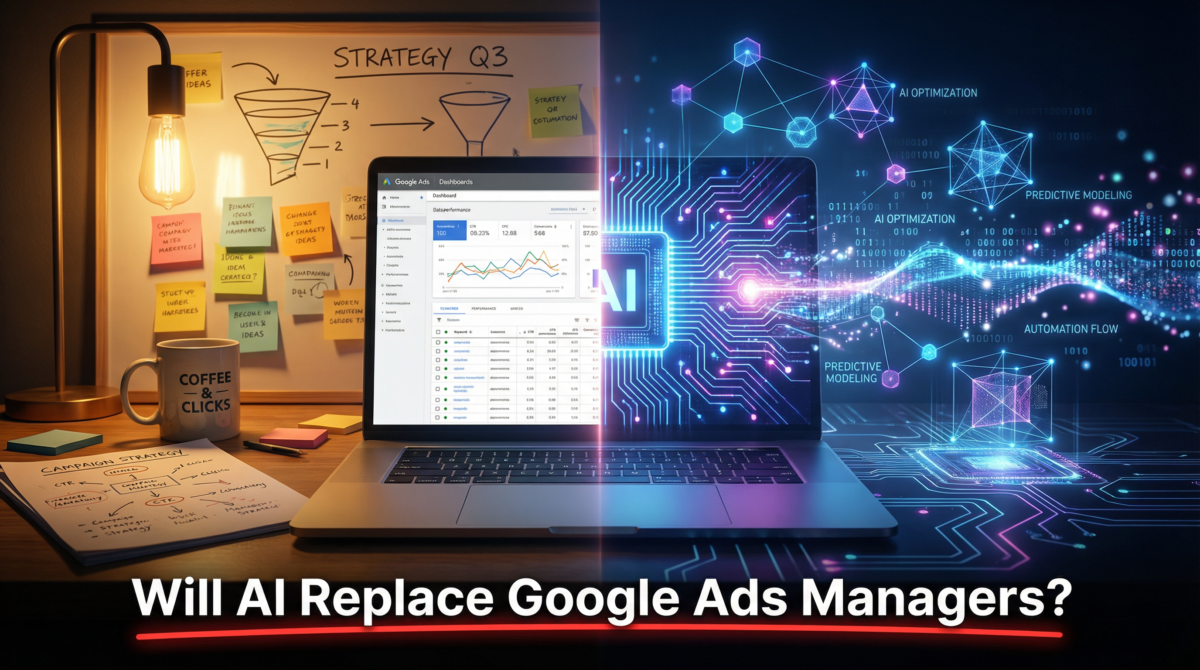
I get asked the same question almost every week by nervous agency owners, junior media buyers, and business owners looking to cut overhead: “Is AI going to replace Google Ads managers?”
Let me give you the direct answer right out of the gate.
No, AI is not replacing Google Ads managers.
But it is absolutely, ruthlessly replacing the managers who never learned how to think past the dashboard. And frankly, there is a massive difference between the two.
I have been managing Google Ads campaigns for eight years. I was there when we had to manually adjust bids by a few cents every Tuesday morning based on spreadsheet data. I watched the platform evolve through the introduction of Smart Bidding, the shift to Responsive Search Ads, the rollout of Performance Max, and now the integration of generative AI for ad copy and assets.
Through all of those massive, platform-altering changes, I have never once felt like my job was disappearing. What I have seen—and what we are all living through right now—is the baseline expectation of what “doing your job well” actually means getting significantly higher.
If you are a business owner wondering if you still need to pay an expert, or a marketer wondering if you need to switch careers, here is what is actually happening on the front lines of Google Ads right now.
AI Is Incredibly Good at Its Job. That Is Not the Problem.
Before we talk about what AI cannot do, we have to respect what it can do. The machine learning capabilities inside Google Ads right now are genuinely staggering.
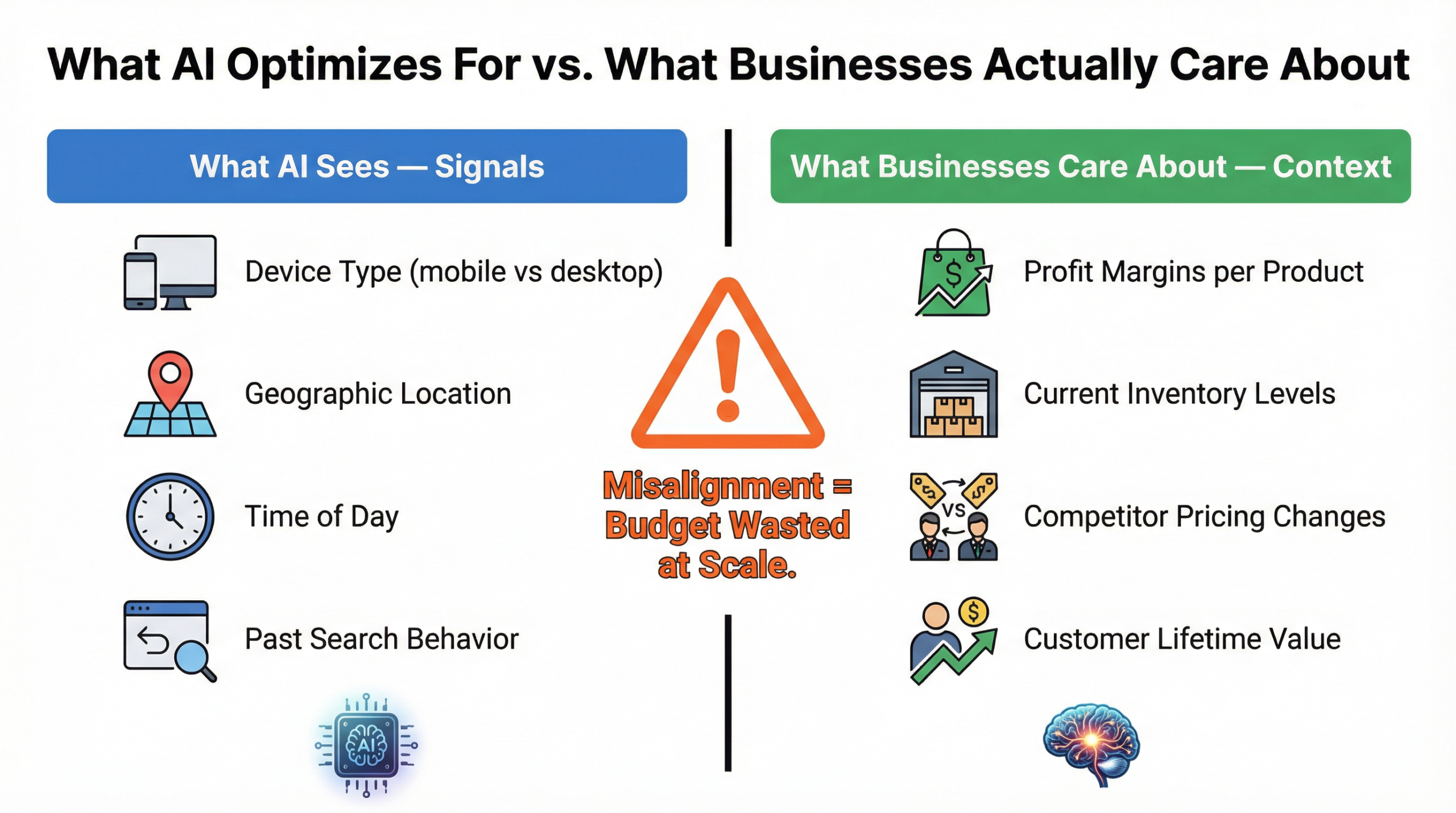
Smart Bidding algorithms can adjust bids in real-time across millions of individual auctions. They process signals that no human could ever calculate manually—the user’s exact location, the device they are holding, the time of day, their past search history, and their immediate intent.
Performance Max campaigns can take a handful of images, videos, and text assets, mix them into thousands of combinations, and serve them across YouTube, Gmail, Search, and Display simultaneously to find the exact combination that drives a click.
This technology works. I use it every single day across all of my clients’ accounts. Anyone who tells you that manual bidding is universally better than Smart Bidding in 2026 is either lying to you or holding onto the past out of stubbornness.
But here is the critical piece of context that gets completely ignored in every sensational “AI is taking over marketing” think piece on LinkedIn:
AI does not optimize for business results. It optimizes for signals.
And if those signals are misconfigured—if your conversion tracking is slightly broken, if your data is dirty, or if the goal you told Google to hit does not actually align with how your business makes money—the AI will confidently, efficiently, and relentlessly scale the wrong thing.
I recently audited an account where a company had watched a five-figure monthly budget completely evaporate. The algorithm was performing perfectly. It was getting them thousands of conversions at an incredibly low cost. The problem? The account was optimizing toward “time on site” instead of “completed purchases.”
The AI did exactly what it was told to do. It found the cheapest possible traffic that would sit on a webpage for three minutes without buying anything.
That is not an AI failure. That is a human strategy failure. And strategy is still very much a human job.
The Void: What AI Still Cannot Do (And Probably Never Will)
There is a tremendous amount of excitement—and an equal amount of fear—surrounding what AI can do. But there is not nearly enough conversation about the massive blind spots the algorithm has.
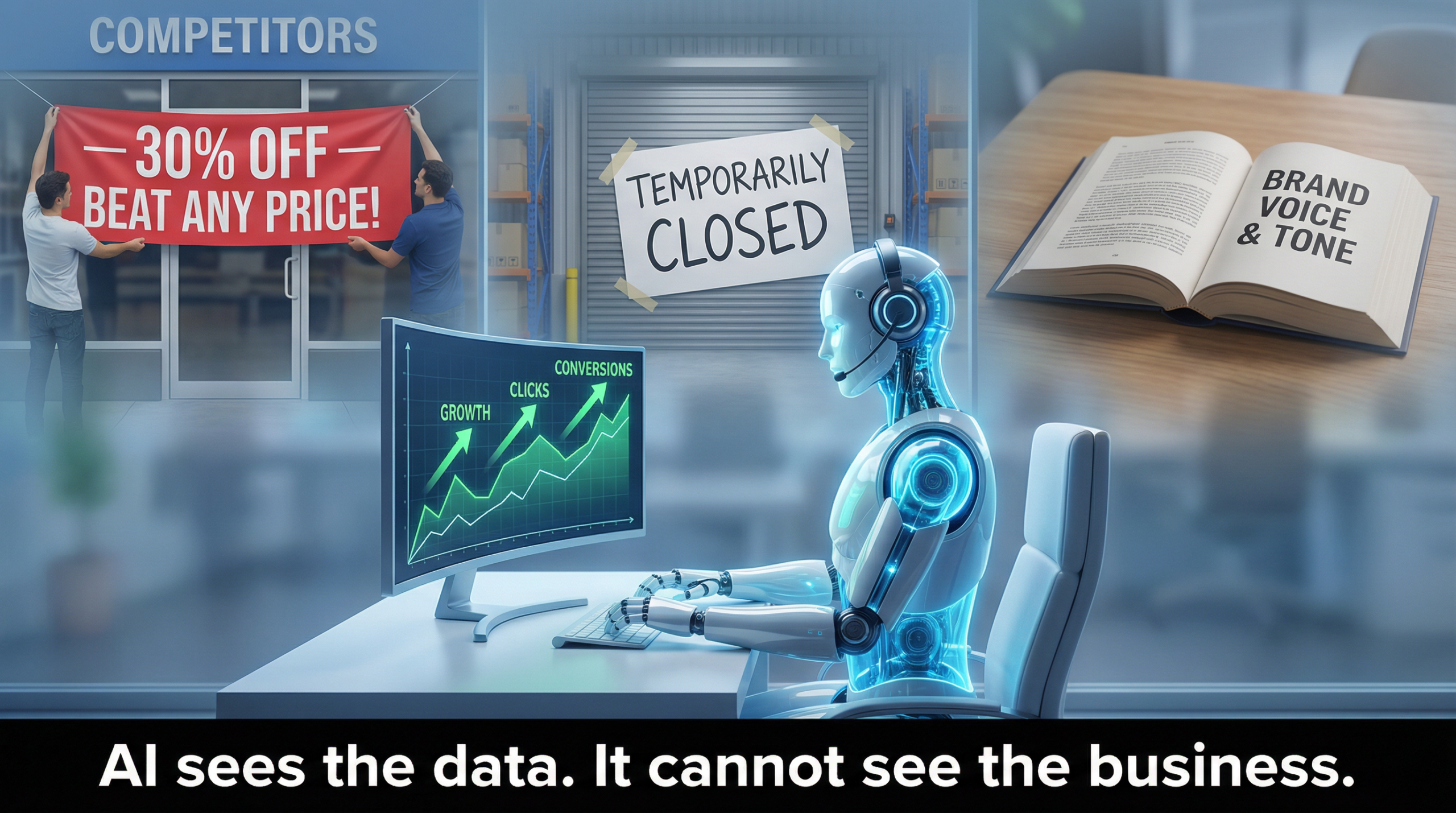
AI is entirely reactive. It looks at historical data and current signals to make mathematical predictions. It does not anticipate the future, and it has zero context about the real world outside of the Google Ads interface.
Consider these scenarios that happen constantly in the real world of digital marketing:
- Competitor Moves: AI does not know that your biggest competitor just dropped their pricing by 30% overnight, meaning your Return on Ad Spend (ROAS) is about to tank unless you manually adjust your bidding targets and update your ad copy to highlight your superior warranty.
- Operational Crises: AI cannot tell you that you need to pause your highest-performing campaign right now because your client’s warehouse just flooded and they literally cannot fulfill orders for the next two weeks.
- Brand Nuance: AI cannot read a client’s brand guidelines and understand that while a certain aggressive, sales-heavy headline might get a higher click-through rate, it completely violates the premium, luxury positioning the brand has spent millions of dollars building.
That is judgment. That is context. That is the kind of nuanced understanding that only comes from knowing a business deeply—not from processing data signals.
The role of a Google Ads manager is not disappearing. It is shifting. We are spending significantly less time on manual, repetitive tasks like bid adjustments and keyword grouping. We are spending significantly more time on strategic architecture, ensuring conversion tracking integrity, aligning campaigns with actual profit margins, and knowing exactly when to step in and override what the algorithm wants to do.
The Managers Getting Replaced (And Why They Deserve It)
Here is the uncomfortable truth that a lot of media buyers do not want to hear: The Google Ads managers who are struggling in the era of AI are not struggling because of the technology. They are struggling because they built their entire career and value proposition around tasks that automation was always destined to absorb.
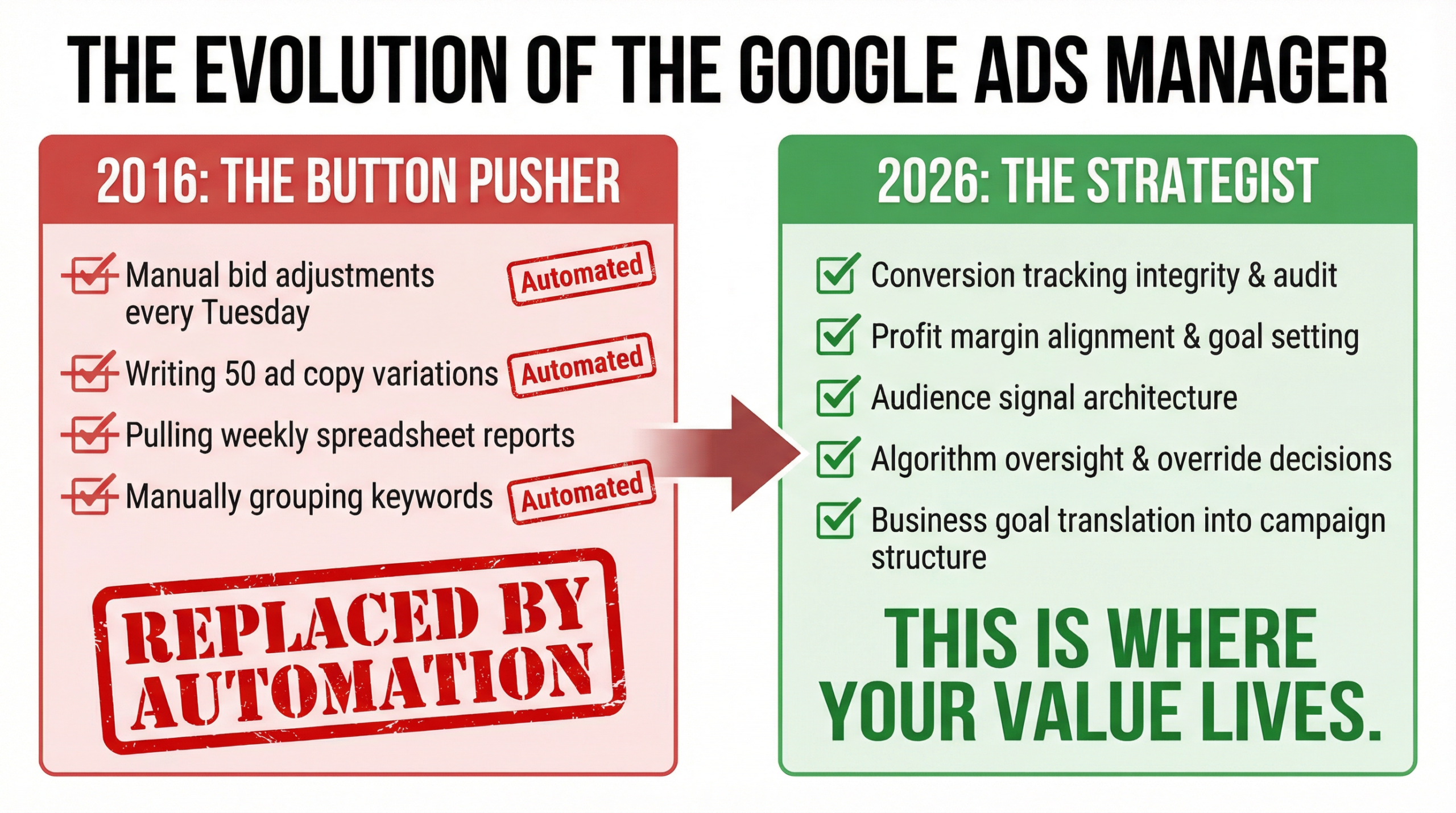
If your primary value to a client is, “I log in every Tuesday and set bids manually,” your job is gone.
If your value is, “I write three variations of ad copy,” an AI can draft thirty variations in the time it takes you to open a Google Doc.
If your value is, “I pull a weekly report and put the numbers in a spreadsheet,” there are a dozen cheap software tools that handle that automatically.
Those are button-pushing jobs. And the robots are exceptionally good at pushing buttons.
But if your value is, “I ensure the AI is optimizing toward your most profitable products, I catch data anomalies before they waste your budget, and I bring a strategic, holistic marketing perspective that no algorithm possesses,” your value is only going up.
The managers who are getting replaced right now are not actually being replaced by AI. They are being replaced by other managers who learned how to leverage AI instead of pretending it wasn’t happening.
How I Actually Use AI in Google Ads (Without Letting It Drive the Car)
My approach to managing campaigns in 2026 is straightforward: I use AI for execution, but I provide the strategy and the guardrails.
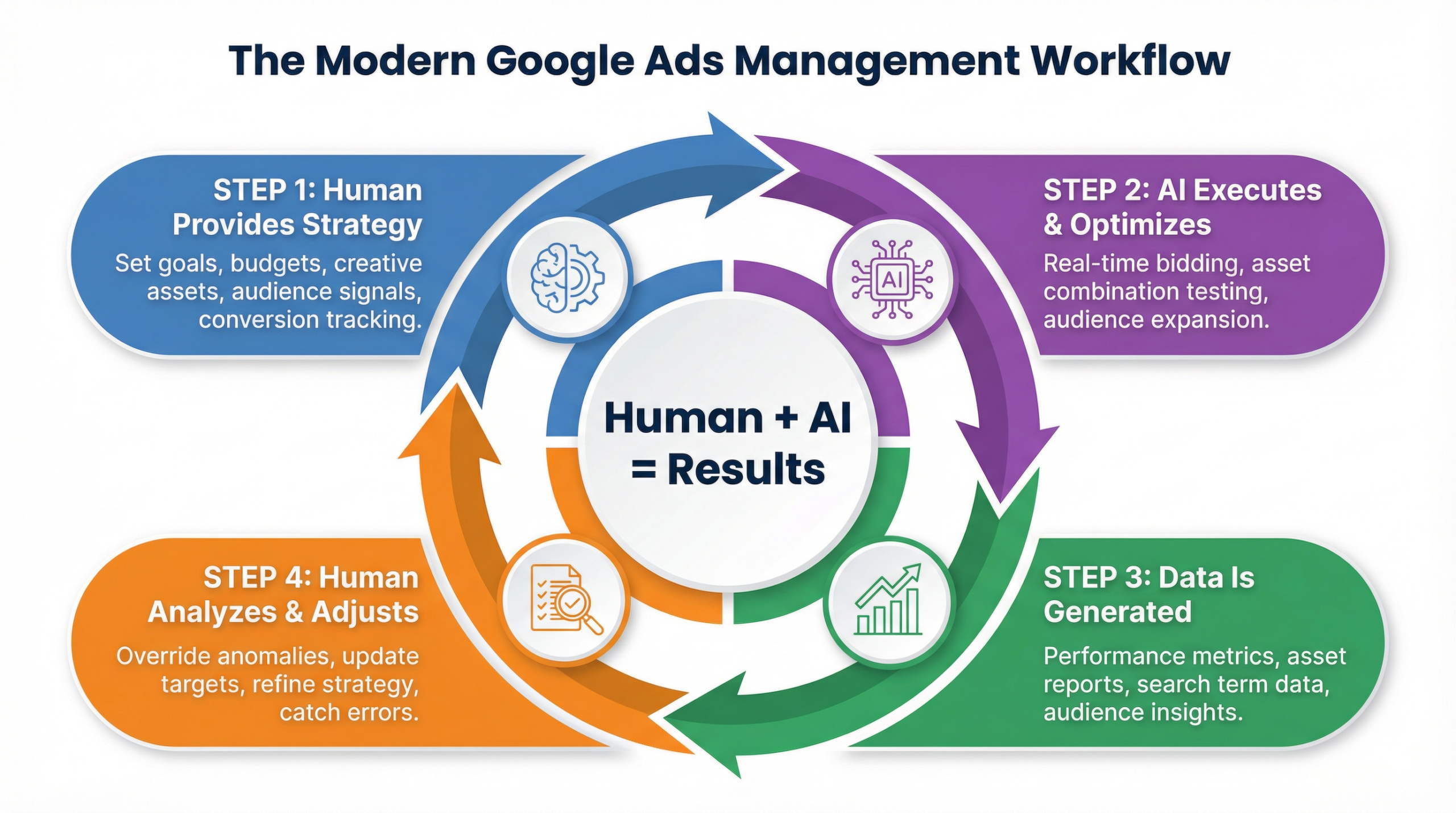
When I use Smart Bidding, I do not just turn it on and walk away. I set the target based on the client’s actual profit margins, I monitor the learning phase closely, and I adjust the targets when performance begins to drift or when seasonality hits. I manage the machine; I don’t let it run unchecked.
When I run Performance Max, I do not let Google scrape the client’s website for random images. I supply high-quality, custom creative assets. I build tight, highly researched audience signals to point the algorithm in the right direction. I set crystal-clear conversion goals. Then, I review the asset performance data weekly and swap out what is underperforming.
When Google suggests AI-generated ad copy, I never just click “Apply All.” I treat those suggestions as a starting draft. I review them, inject the client’s unique selling propositions, ensure the brand voice is correct, and then push them live.
The key mindset shift for any modern media buyer is this: You are not competing with the AI. You are directing it.
Your job is to ensure the machine is pointed at the correct target, fed with the correct inputs, and optimizing toward the actual business outcomes your client cares about—not just the vanity metrics that look good on a dashboard. That is what eight years in this industry teaches you. It teaches you how to know when to trust the machine, and more importantly, when to override it.
The Real Question You Need to Ask Yourself
If you are a business owner trying to decide whether to hire a professional Google Ads manager or just let Google’s automated campaigns run themselves, here is the honest answer:
AI without strategic, human oversight is just a very expensive, very efficient way to optimize toward the wrong thing faster. You will spend money, you will get clicks, but you will likely not see the return on investment you need to grow your business.
If you are a digital marketer worried about whether AI is coming for your career, you need to realize that the threat is not the technology. The threat is staying static while the requirements of your role evolve.
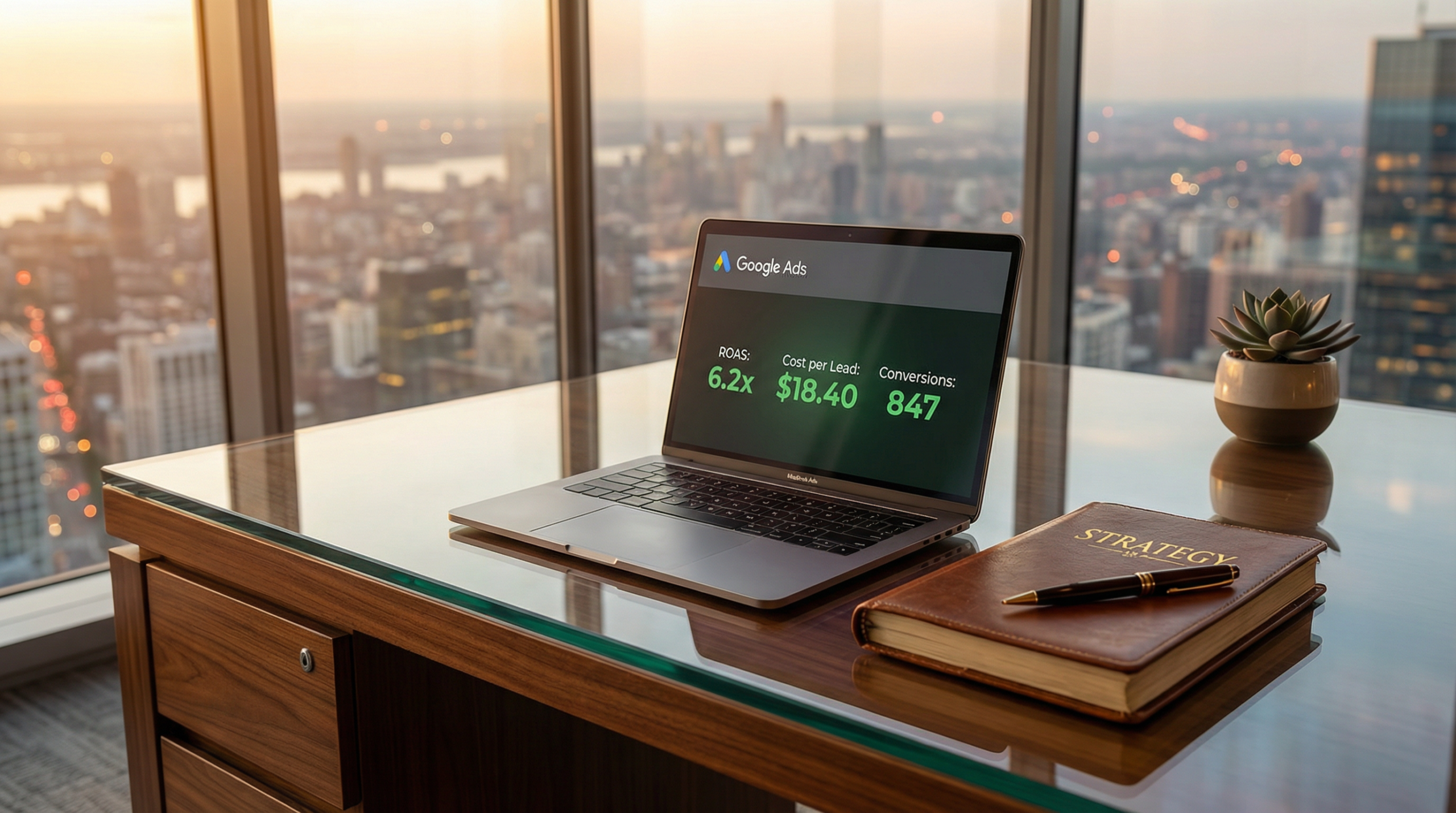
The question is not whether AI will replace Google Ads managers. The question is whether you are actively building the kind of strategic depth, business acumen, and analytical skills that make you irreplaceable in the age of automation—or whether you are just sitting there, hoping the dashboard does the thinking for you.
One of those paths leads to a highly lucrative, secure career. The other path leads to obsolescence. Choose wisely.
Looking for a Google Ads manager who knows exactly how to pair human strategy with AI execution to drive real, measurable results? I manage campaigns full-time and work directly with clients to scale their businesses. You can view my portfolio, read client reviews, and book a consultation through my Upwork profile:
👉 Work with Naz Diocampo on Upwork

2 Comments
This was a very honest take. AI can definitely speed things up and automate parts of the work, but strategy, judgment, and understanding the business side still matter a lot. I like that this article brings balance to the discussion instead of making it sound black and white.
Hi Marshall, thank you for your thoughtful comment. I agree completely. AI is a powerful tool, but it still does not replace strategic thinking, experience, and business judgment. The goal is really to use AI to improve execution, not to remove the need for real expertise.