


Google Ads for Real Estate Agents: Stop Waiting for Referrals
April 6, 2026
Why Your Insurance Google Ads Are Stalling (And How to Fix Your Setup)
April 8, 2026
You’re putting budget into Google Ads. You can see the clicks registering in your dashboard. You might even be getting some traffic to your website. But the phone isn’t ringing, and the booking calendar is looking suspiciously empty.
So, what do most clinic owners do? They assume they just aren’t spending enough to compete. They bump the daily budget up by 20%, cross their fingers, and wait. And still, nothing changes.
I’ve audited countless Google Ads accounts for aesthetic clinics and med spas, and I can tell you right now: your budget is rarely the problem. The issue almost always lies in the foundation of how your campaigns are built. If the foundation is cracked, pouring more money into the account is like pouring water into a bucket with a hole in it.
Let’s walk through the five most common structural failures I see in med spa Google Ads accounts, why they destroy your return on investment, and exactly how you can fix them today.
1. The Trap of the “All-in-One” Campaign
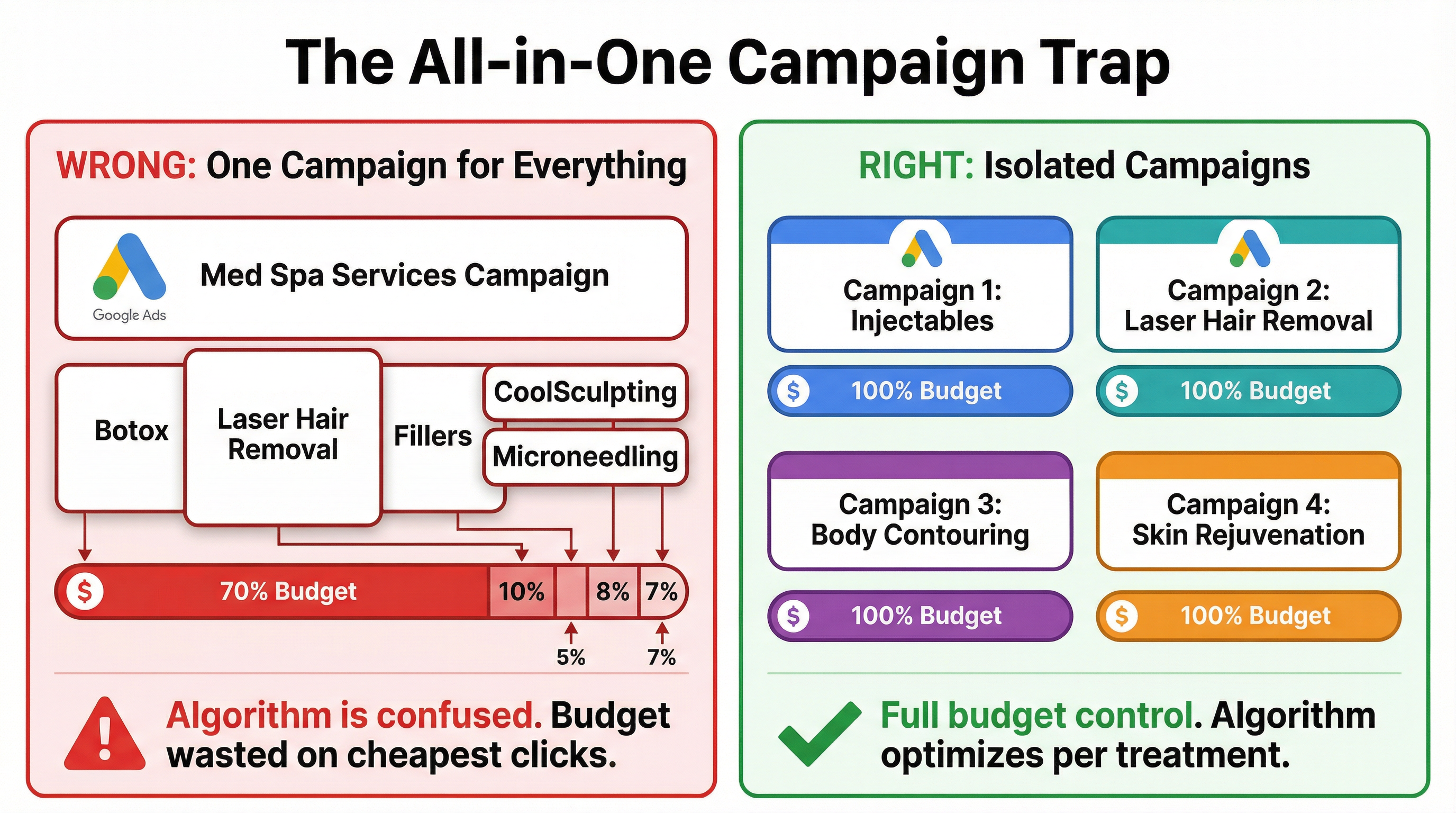
This is the single most common mistake I see when taking over a new med spa account. It usually happens when an owner or a generalist marketing agency sets up the ads for the first time. They create one campaign, call it “Med Spa Services,” and dump every single treatment into it.
Botox, laser hair removal, dermal fillers, CoolSculpting, microneedling — all crammed into one campaign, sharing the same budget, and often sitting in the same ad group.
Why This Destroys Your Performance
Google’s algorithm relies on clear, consistent signals to figure out who to show your ads to. When you lump completely different treatments together, you confuse the system.
Think about the search intent. Someone typing in “laser hair removal cost” is in a completely different headspace than someone searching for “preventative Botox near me.” The CPC for these services is different. The conversion rate is different. The decision-making timeline is different.
When you force them to share a budget, Google tends to favor the service that gets the cheapest clicks or the highest search volume — often laser hair removal — starving your high-margin treatments like injectables or body contouring. You end up blowing your entire daily budget on low-value clicks while your most profitable services get zero visibility.
The Fix: Granular Campaign Isolation
The solution is simple but requires a bit of elbow grease: isolate your treatments.
Every core service you offer needs its own dedicated campaign. Think of it this way:
| Campaign | Services Included | Why Separate? |
|---|---|---|
| Campaign 1: Injectables | Botox, Dysport, Fillers | High CPC, high margin, policy-sensitive |
| Campaign 2: Laser Hair Removal | All body areas | High volume, lower CPC, competitive |
| Campaign 3: Body Contouring | CoolSculpting, Emsculpt | Long sales cycle, high ticket |
| Campaign 4: Skin Rejuvenation | Microneedling, Chemical Peels | Mid-range, high repeat purchase |
By breaking them out, you regain full control. You can assign specific budgets based on profitability. If Botox drives 60% of your revenue, you can ensure it gets 60% of your ad spend. You also give Google’s algorithm the clear, focused data it needs to optimize for bookings, rather than just cheap clicks.
2. The Silent Killer: Google’s Healthcare Policy Restrictions
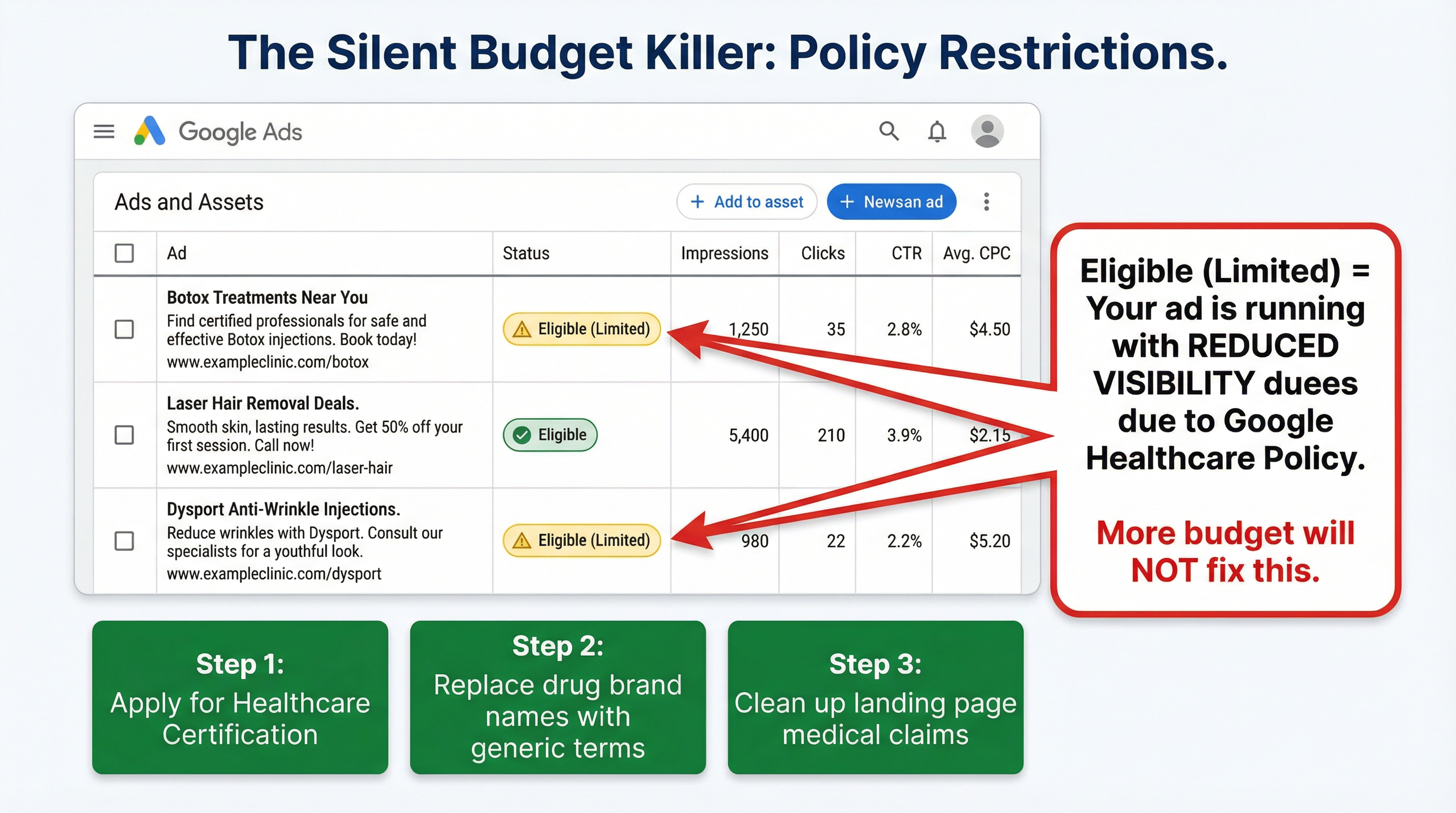
Here is something that frustrates almost every med spa owner eventually: the dreaded “Eligible (Limited)” status.
Google has strict policies around healthcare and medicines. While a med spa isn’t a hospital, many of the treatments you offer — specifically injectables like Botox, prescription-strength topicals, and certain weight-loss or body contouring procedures — fall under these restrictions.
How Policy Flags Choke Your Account
When an ad gets flagged as “Eligible (Limited)” due to healthcare policies, it doesn’t mean your ad is disapproved. It means it is running, but with handcuffs on.
Google restricts where these ads can show and who can see them. Your impressions drop. Your ad might not show up for users who aren’t logged in, or it might be restricted in certain geographic areas.
The worst part? Most clinic owners don’t even realize it’s happening. They see the word “Eligible,” assume everything is fine, and wonder why their impression share is so abysmal. When the leads don’t come in, they increase the bids. But you cannot out-bid a policy restriction.
The Fix: Navigating the Policy Maze
First, audit your account to see exactly which ads are limited. Go to your “Ads & Assets” tab and check the status column. If you see “Eligible (Limited),” hover over it to read the specific policy violation.
To fix it, you have a few options depending on the severity:
- Apply for Healthcare Certification. If you have a licensed medical director, you can apply for Google’s healthcare and medicines certification. This won’t clear all restrictions (Botox is still heavily regulated), but it can lift some geographic and targeting limits.
- Clean Up Your Ad Copy. Avoid using prescription drug names like Botox or Latisse directly in the ad headlines if they keep getting flagged. Instead, use terms like “Wrinkle Relaxers,” “Neuromodulators,” or “Anti-Aging Injectables.”
- Audit Your Landing Pages. Google’s bots crawl the page your ad points to. If your landing page makes unverified medical claims or heavily promotes restricted prescription drugs without proper disclaimers, the ad will get flagged. Keep the copy focused on the aesthetic benefits and the consultation process.
3. The Homepage Black Hole
Let’s say you’ve fixed your campaign structure. You’ve navigated the policy restrictions. Your ad copy is dialed in, and someone clicks on your ad for “lip fillers near me.”
Where do you send them?
If your answer is “my homepage,” you are actively burning money.
Why Homepages Kill Conversions
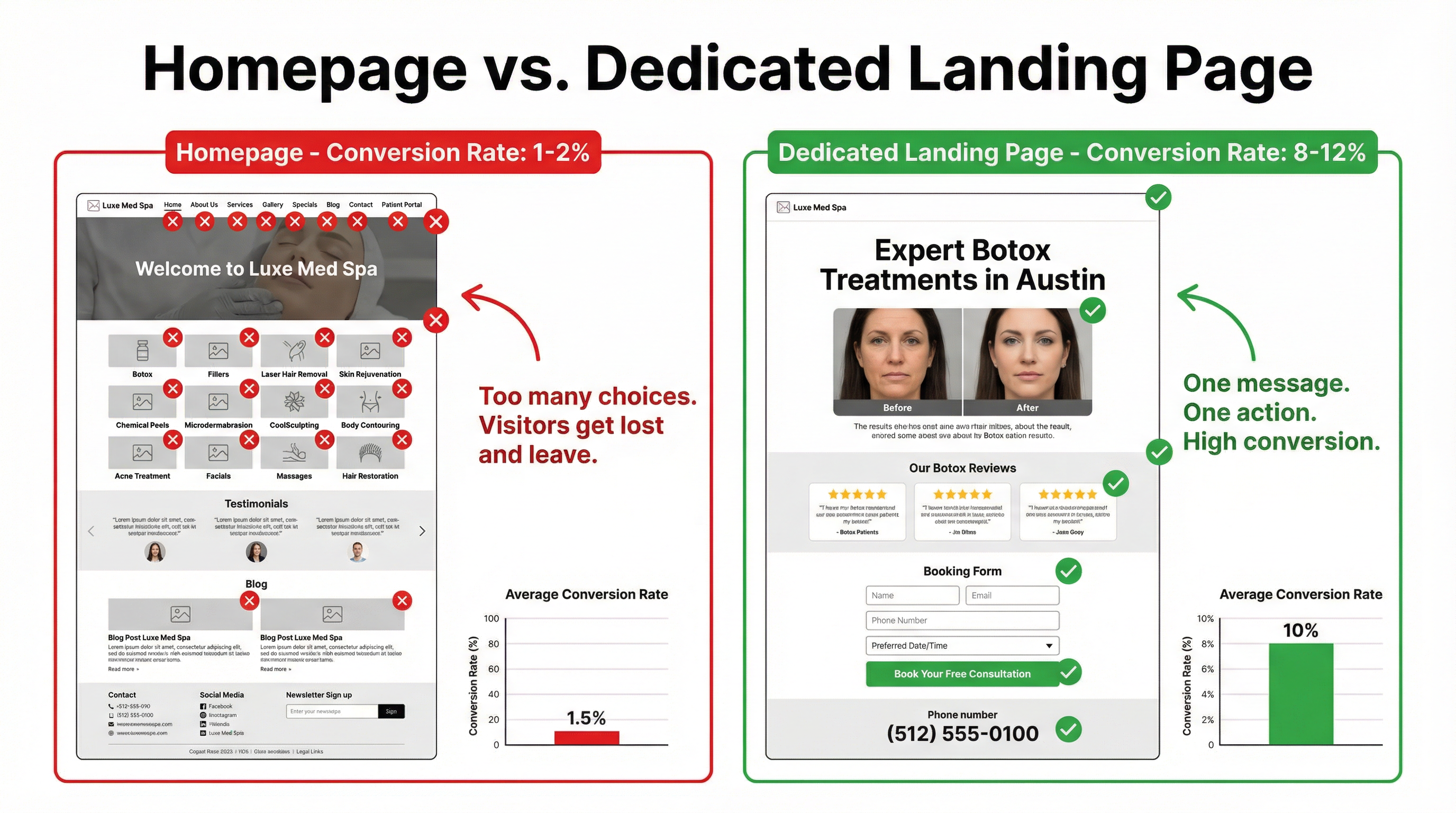
Your homepage is a digital brochure. It’s designed to introduce your brand, showcase your team, list all 25 of your services, link to your Instagram, and maybe share a few blog posts. It is full of distractions.
When a user clicks an ad for lip fillers, they have high intent. They want to know three things: Do you do lip fillers? Are you any good at it? How do I book? If they land on a homepage, they have to hunt for that information. They have to navigate your menu, find the “Injectables” tab, click “Dermal Fillers,” and scroll past the information about cheek fillers just to find what they want.
Most people won’t do that work. They will hit the back button and click on your competitor’s ad instead.
The Fix: Dedicated, High-Converting Landing Pages
Every single campaign you run needs a dedicated landing page tailored specifically to the search intent of the user. If the ad is about Botox, the landing page should be 100% about Botox.
- The Headline needs to match the ad copy exactly — for example, “Expert Botox Treatments in [Your City].”
- The Social Proof should show before-and-after photos specifically for Botox, with reviews from Botox patients.
- The Navigation should be removed entirely. You don’t want visitors wandering off to read your blog.
- The Call to Action should be painfully obvious: “Book Your Free Consultation” or “Claim Your $50 Off New Patient Special.” Put the form or the booking button above the fold, and repeat it at the bottom of the page.
A highly relevant, distraction-free landing page can easily double or triple your conversion rate without spending a single extra penny on clicks.
4. Ignoring the Power of Negative Keywords
When you set up a Google Ads campaign, you tell Google which keywords you want to show up for. But equally important — and often completely ignored — is telling Google what you don’t want to show up for.
These are called negative keywords, and failing to use them is a guaranteed way to waste your budget.
The Cost of Irrelevant Clicks
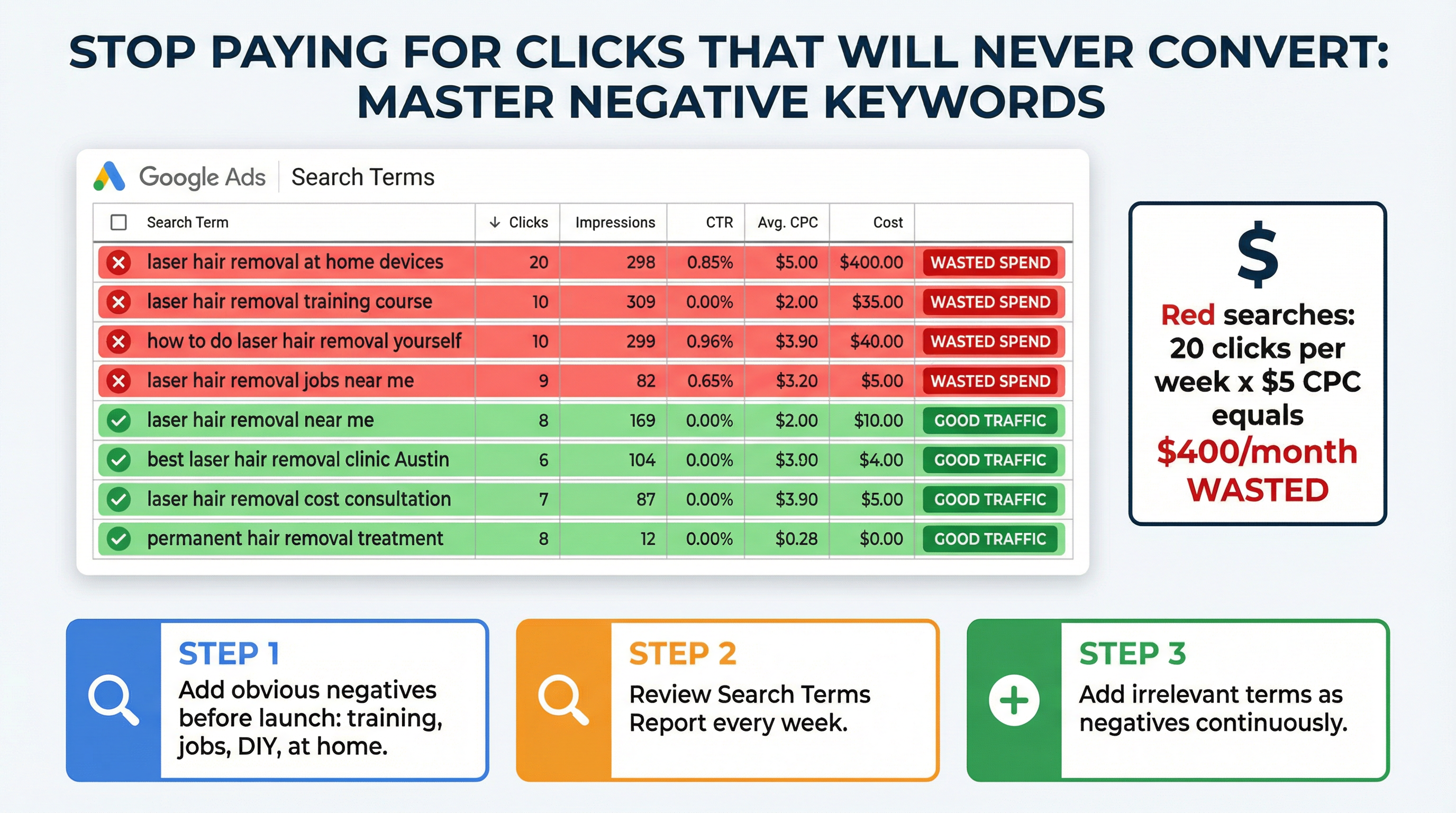
Let’s say you are bidding on the phrase match keyword "laser hair removal". Without a strong negative keyword list, Google might show your ad for searches like “laser hair removal at home devices,” “laser hair removal training courses,” “how to do laser hair removal yourself,” or “laser hair removal jobs.”
None of these people are looking to book an appointment at your clinic. But if they click your ad, you still pay for it. If you are paying $5 a click and you get 20 of these irrelevant clicks a week, you are wasting $400 a month on traffic that has a zero percent chance of converting.
The Fix: Aggressive Negative Keyword Management
Building a negative keyword list isn’t a “set it and forget it” task. It requires ongoing maintenance.
- Start with the obvious. Before you even launch the campaign, add terms like “training,” “jobs,” “courses,” “salary,” “at home,” “DIY,” “cheap,” and “groupon” to your negative keyword list.
- Review your Search Terms Report weekly. Open your campaigns and look at the “Search Terms” report. This shows you exactly what people typed into Google before clicking your ad.
- Prune the weeds continuously. When you spot an irrelevant search term, add it as a negative keyword. Over time, your traffic will become hyper-targeted, and your cost per lead will drop significantly.
5. Failing to Track Actual Revenue (Not Just Leads)
Here is a scenario I see all the time. A clinic owner looks at their Google Ads dashboard. They see they spent $1,000 and generated 20 leads at $50 a lead. They think, “Great! The ads are working.”
But when they look at their actual booking software, they realize only 3 of those leads actually showed up for an appointment, and only 1 of them bought a package.
If you are only tracking “form fills” or “button clicks” in Google Ads, you are flying blind.
The Disconnect Between Clicks and Cash
Not all leads are created equal. A campaign targeting “cheap lip injections” might generate leads at $20 a pop, but if none of those leads can afford your services, they are worthless. Meanwhile, a campaign targeting “best facial rejuvenation clinic” might generate leads at $80 each, but if they all book high-ticket packages, that campaign is vastly more profitable.
If you don’t connect your ad spend to your actual revenue, you will inevitably optimize your campaigns for the wrong metrics. You will cut the budget on the expensive leads that actually convert to paying patients, and pour money into the cheap leads that flake out.
The Fix: Closed-Loop Tracking
You need to know exactly which keywords and which campaigns are driving actual paying patients into your chairs.
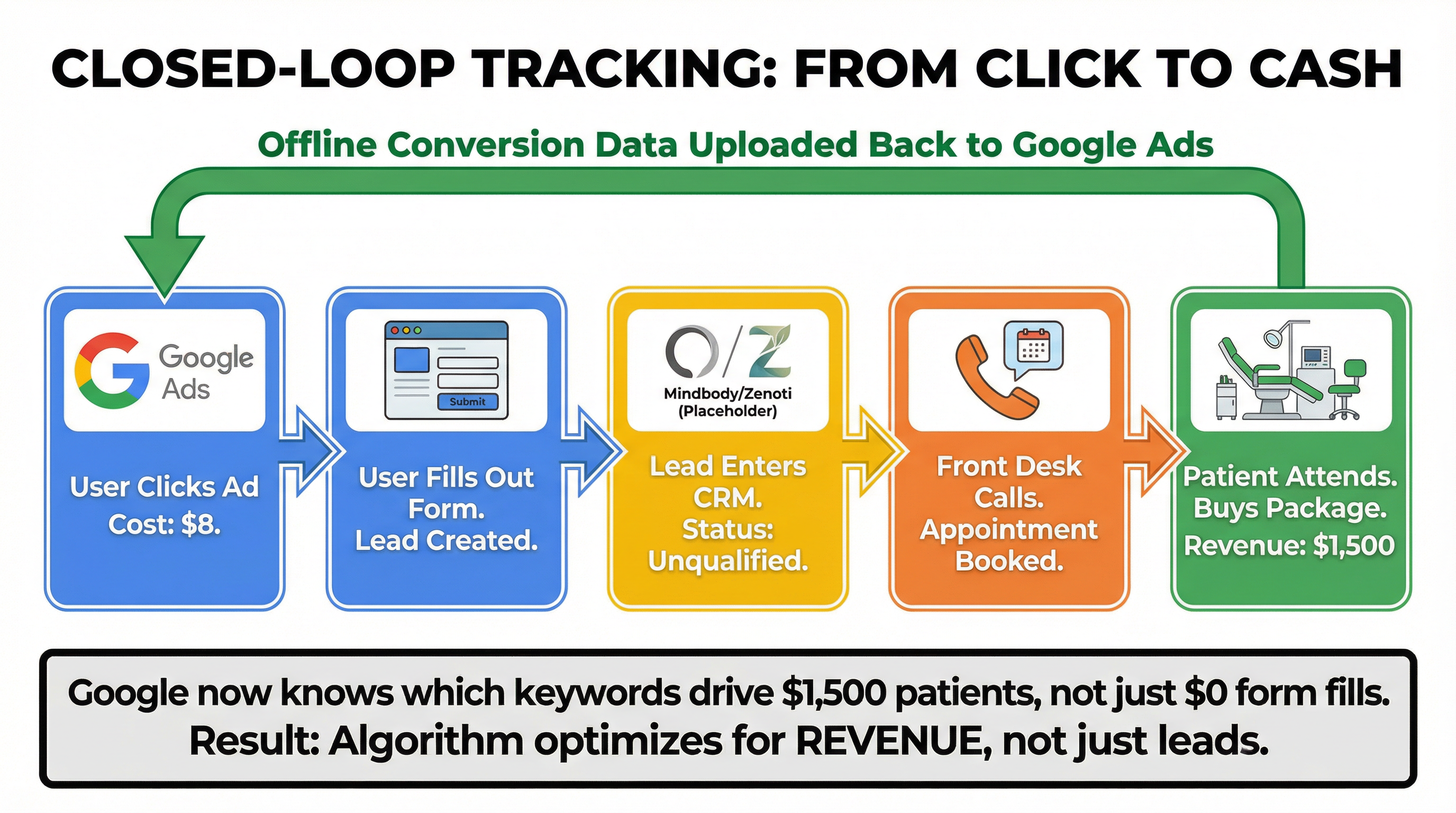
- Implement Offline Conversion Tracking. If you use a CRM or booking software like Zenoti, Mindbody, or even a well-maintained spreadsheet, you can upload your actual sales data back into Google Ads. This tells Google, “This specific click turned into a $1,500 sale.”
- Use Value-Based Bidding. Once Google knows which leads are actually generating revenue, you can switch your bidding strategy to “Maximize Conversion Value.” Instead of just looking for cheap leads, Google’s algorithm will actively hunt for users who behave like your highest-paying patients.
- Listen to the Front Desk. Your front desk staff are your best marketing feedback loop. If they tell you that all the leads from the “CoolSculpting” campaign are price-shoppers who never book, you need to adjust your ad copy to qualify people better before they click.
The Bottom Line
Google Ads is not a slot machine. You don’t just put money in, pull the lever, and hope patients fall out. It is a highly logical, highly structured system.
When med spa campaigns fail, it is almost never because Google Ads “doesn’t work for this industry.” It fails because the campaigns are disorganized, the policy restrictions are ignored, the landing pages are confusing, the traffic is irrelevant, or the tracking is superficial.
Fixing these foundational issues doesn’t require doubling your ad budget. It just requires intention.
Isolate your treatments. Navigate the healthcare policies carefully. Build dedicated, high-converting landing pages. Ruthlessly prune your search terms. And track your revenue, not just your clicks.
If you get those five things right, Google Ads can become the most reliable, predictable patient-acquisition engine your clinic has ever had.
Ready to Stop Guessing and Start Growing?
If you’re reading this and realizing your account might be suffering from some of these foundational cracks, don’t panic. The fastest way to get clarity is to have an expert look under the hood.
I offer comprehensive Google Ads management and audits for aesthetic clinics and med spas. If there are structural problems, policy restrictions, or wasted spend holding your campaigns back, I’ll identify exactly what they are and build a clear plan to fix them.
Get in touch today and let’s talk about your campaigns →
