


Google Ads Keyword Match Types Explained: The Complete Guide to Broad, Phrase, and Exact Match
April 5, 2026
Why Your Med Spa Google Ads Are Bleeding Money (And Exactly How to Fix Them)
April 7, 2026
Let me say something that most real estate coaches will not: if referrals are your primary lead source, you are not running a predictable business—you are running a waiting game.
I have managed Google Ads for real estate clients, and the same problem comes up every single time. Agents are skilled, motivated, and serious about growing their business. They spend hours perfecting their listing presentations and negotiating deals. Yet, they remain completely invisible at the exact moment buyers and sellers are ready to act.
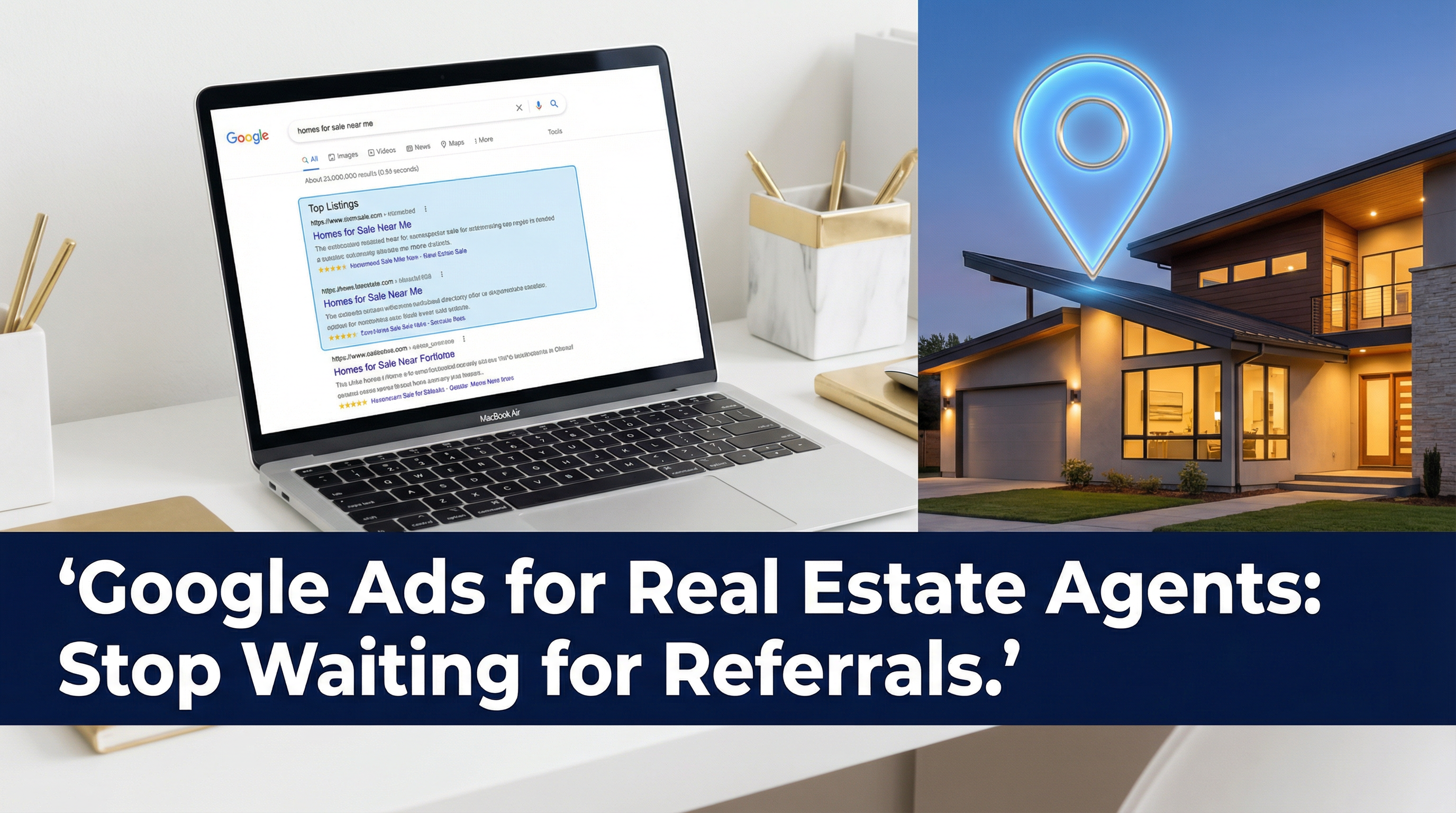
That moment? When someone opens Google and types “homes for sale near me” or “best realtor in [city].”
In this comprehensive guide, we are going to break down exactly how real estate agents can use Google Ads to capture high-intent traffic, build a predictable lead pipeline, and stop relying on luck and referrals to grow their business.
1. High-Intent Traffic Is the Whole Point
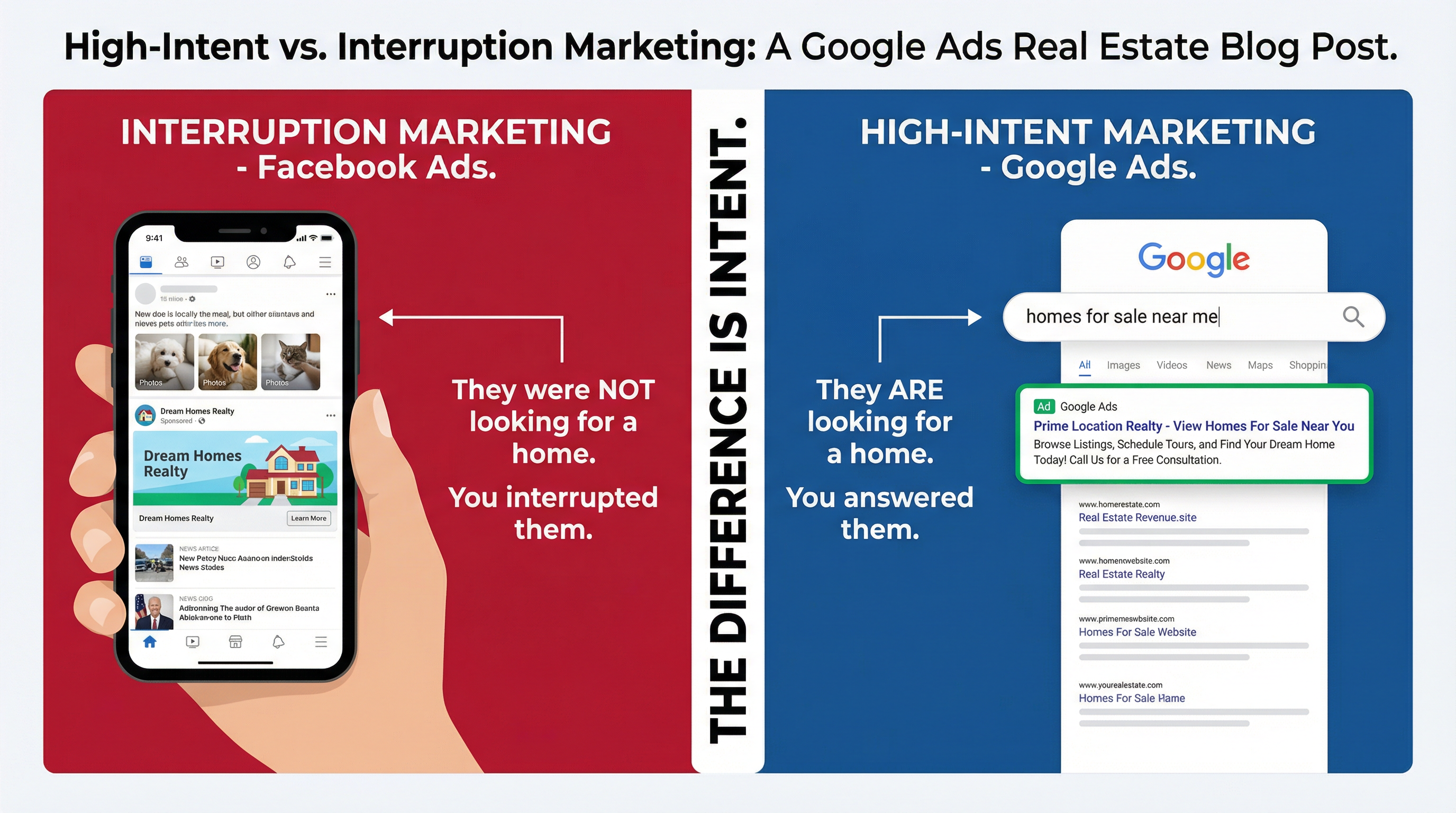
Here is what makes Google Ads fundamentally different from social media advertising (like Facebook or Instagram Ads).
When someone scrolls past a Facebook ad for a new listing, they were not looking for a home. They were looking at photos of their cousin’s birthday party or watching a video. The ad interrupted them. You are trying to generate interest where none previously existed.
When someone types a real estate keyword into Google, they came to find something specific. That is high intent. That is a buyer or seller in motion.
Google Ads puts your listing, your agency, or your name at the very top of that search results page before any organic result even shows up. That is not just visibility; that is timing. You are answering a question they are actively asking.
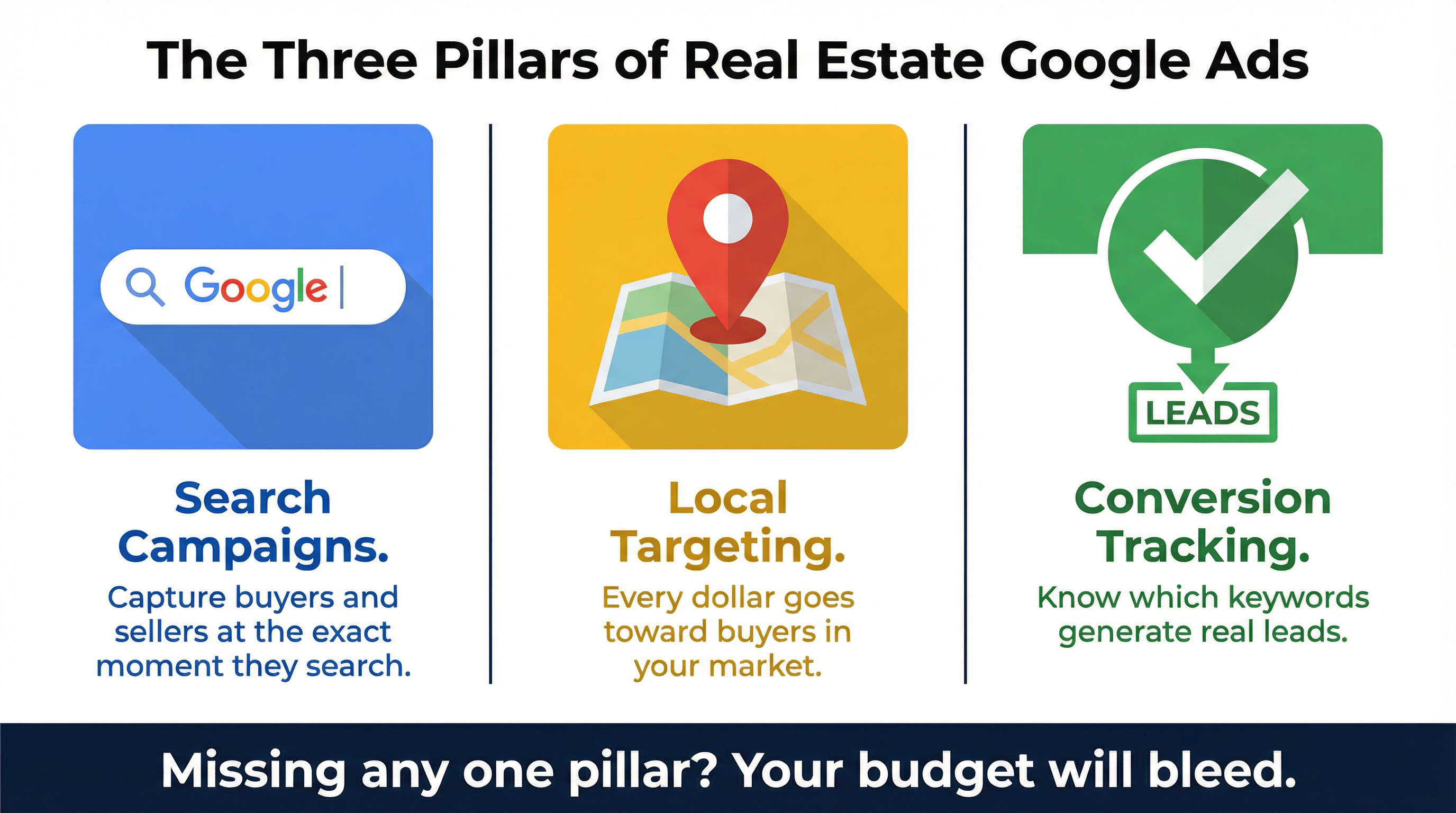
2. The Three Pillars of Real Estate Google Ads
To build a successful real estate campaign, you cannot just throw money at the platform and hope for the best. A profitable account rests on three foundational pillars. If any of these are missing, your budget will bleed.
- Search Campaigns (Capturing Demand): This is the core of your strategy. You are bidding on specific keywords that indicate someone is looking to buy or sell property.
- Local Targeting (Protecting the Budget): Real estate is inherently local. If you do not restrict your ads to a specific geographic radius, you will pay for clicks from people who will never be your clients.
- Conversion Tracking (Measuring Success): You must track what happens after the click. Did they fill out a form? Did they call your office? Without this data, you are flying blind.
3. Local Targeting Is What Makes the Budget Work
One of the biggest mistakes I see with real estate Google Ads accounts is broad, untargeted campaigns bleeding budget on clicks from outside the service area.
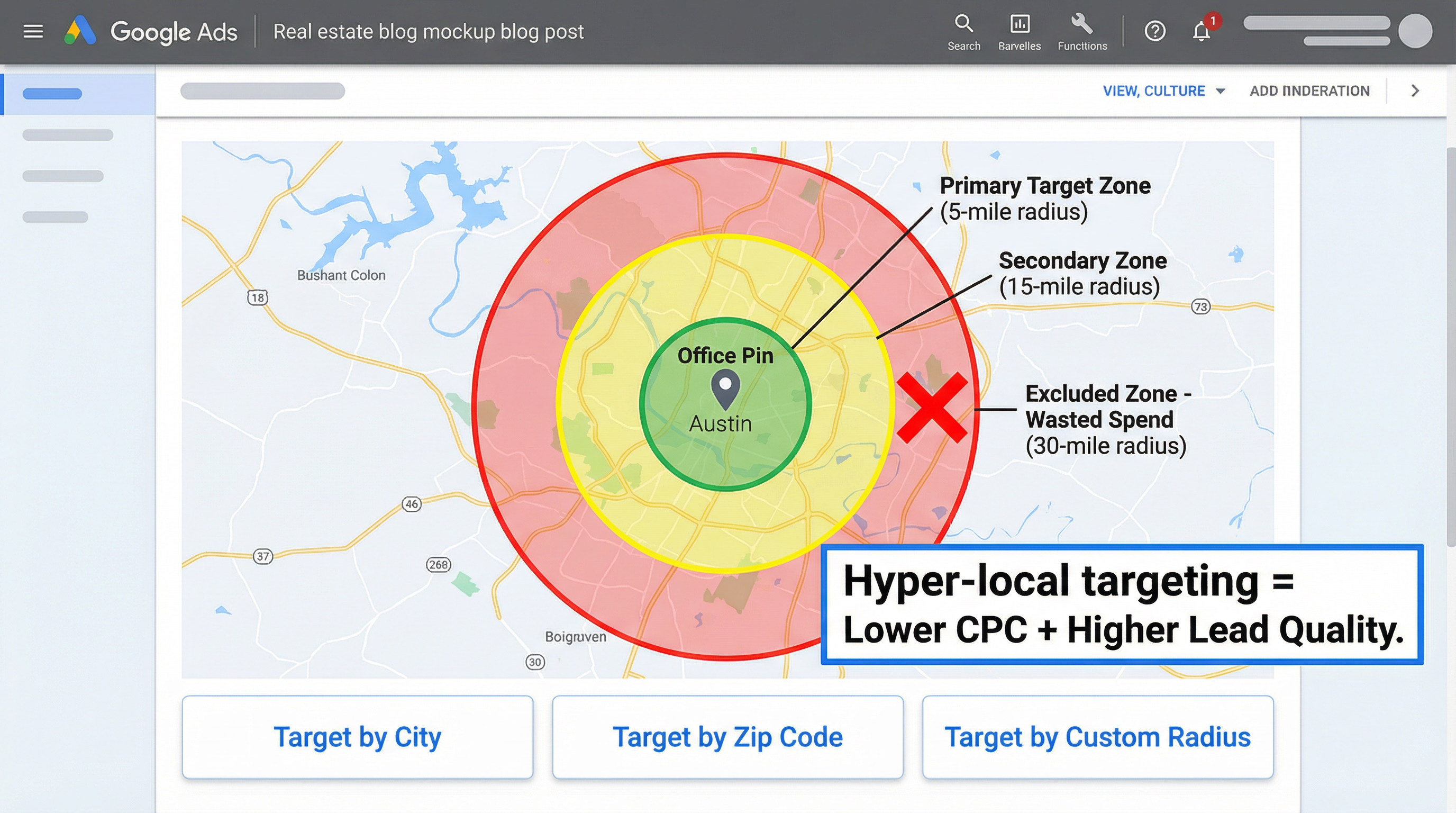
Imagine you are an agent in Austin, Texas. You bid on the keyword “homes for sale.” Without strict local targeting, someone in Seattle searching “homes for sale” might see your ad. If they click it, you just paid $5 for a lead that is geographically useless to you.
The fix is simple but critical: hyper-local targeting.
You can target by:
- City name
- Specific zip codes
- A custom radius around your listings or office (down to a mile if you need to)
That means every dollar you spend goes toward reaching buyers who are actually looking in your market. When you set this up correctly, your cost-per-click goes down and your lead quality goes up. You are not paying for random traffic—you are paying for intent in the right place.
4. Conversion Tracking Is Non-Negotiable
This is where most agents lose deals without even knowing it.
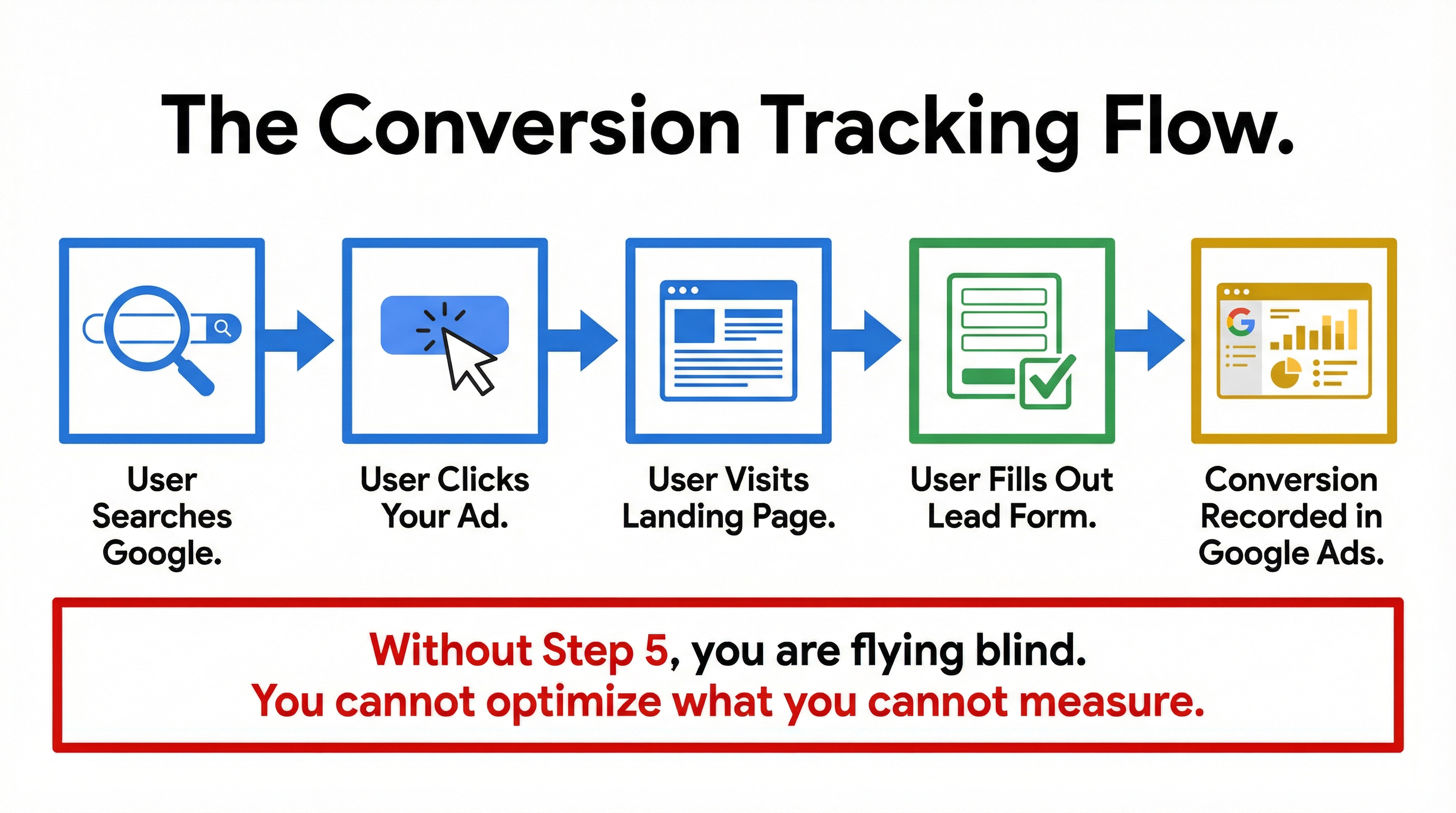
You can have a well-structured campaign, solid keywords, and great local targeting—and still waste a significant chunk of your budget if you do not have conversion tracking set up. Without it, you have no idea which keywords are generating actual inquiries and which are just generating clicks that go nowhere.
Set up conversion tracking on your lead form submission. Every time someone fills out a contact form after clicking your ad, that registers as a conversion. Over time, that data tells you exactly which keywords, which ads, and which targeting settings are driving real business—and which ones you should cut.
No conversion tracking means you are optimizing blind. And guessing in paid ads is expensive.
5. Structuring Your Campaigns: Buyers vs. Sellers
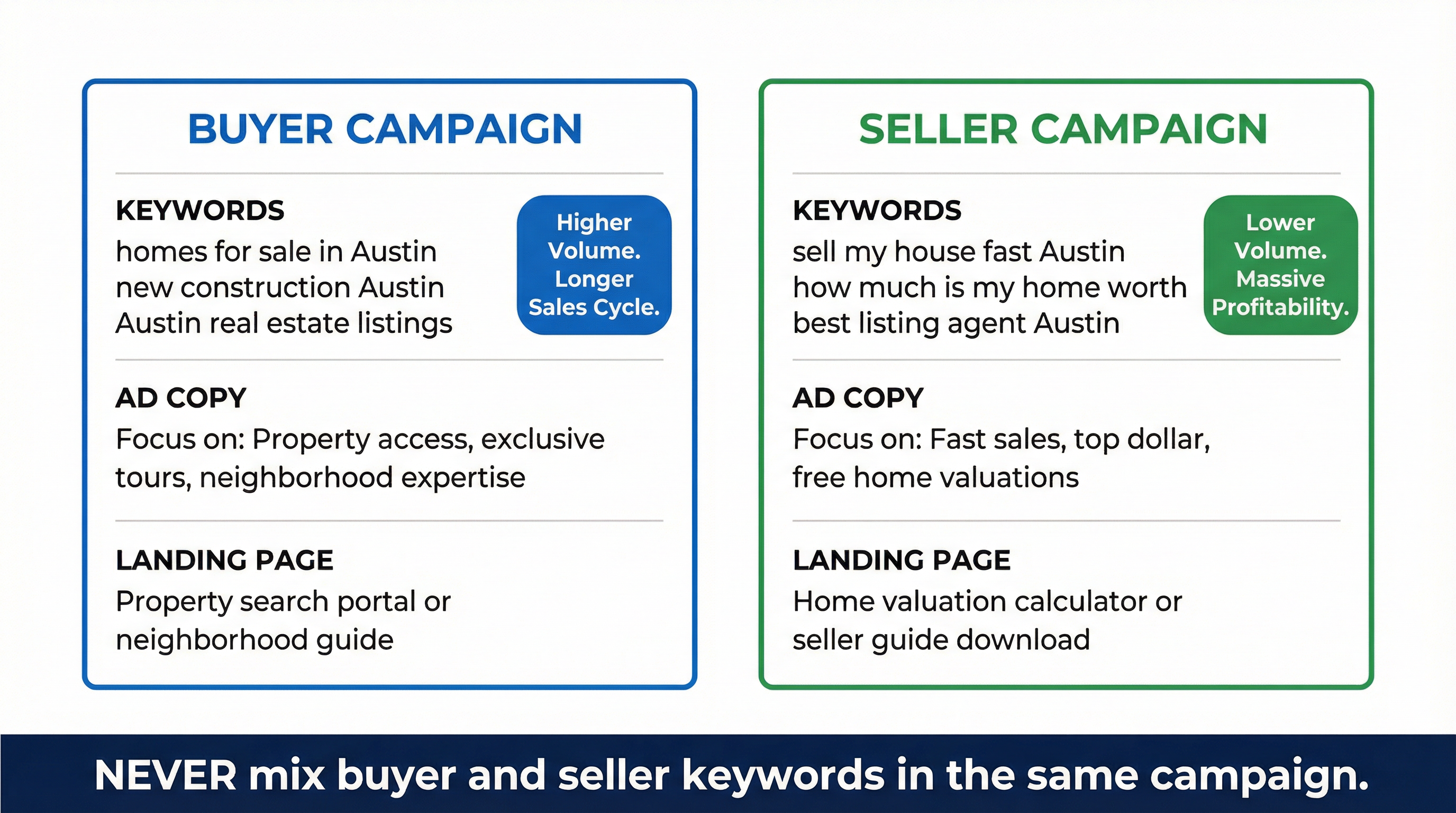
Real estate agents have two distinct audiences: people looking to buy, and people looking to sell. You cannot mix these two audiences into the same campaign. They require different keywords, different ad copy, and different landing pages.
The Buyer Campaign
Buyer campaigns generally have higher search volume but lower immediate profitability per lead (since buyers take longer to close).
- Keywords: “homes for sale in [city],” “new construction [city],” “[neighborhood] real estate listings.”
- Ad Copy: Focus on access to listings, exclusive property tours, and neighborhood expertise.
- Landing Page: A property search portal or a specific neighborhood guide.
The Seller Campaign
Seller campaigns have lower search volume but massive profitability. Every agent wants more listings.
- Keywords: “sell my house fast [city],” “how much is my home worth,” “best listing agent in [city].”
- Ad Copy: Focus on fast sales, getting top dollar, and free home valuations.
- Landing Page: A home valuation calculator or a seller’s guide download.
6. Keyword Match Types for Real Estate
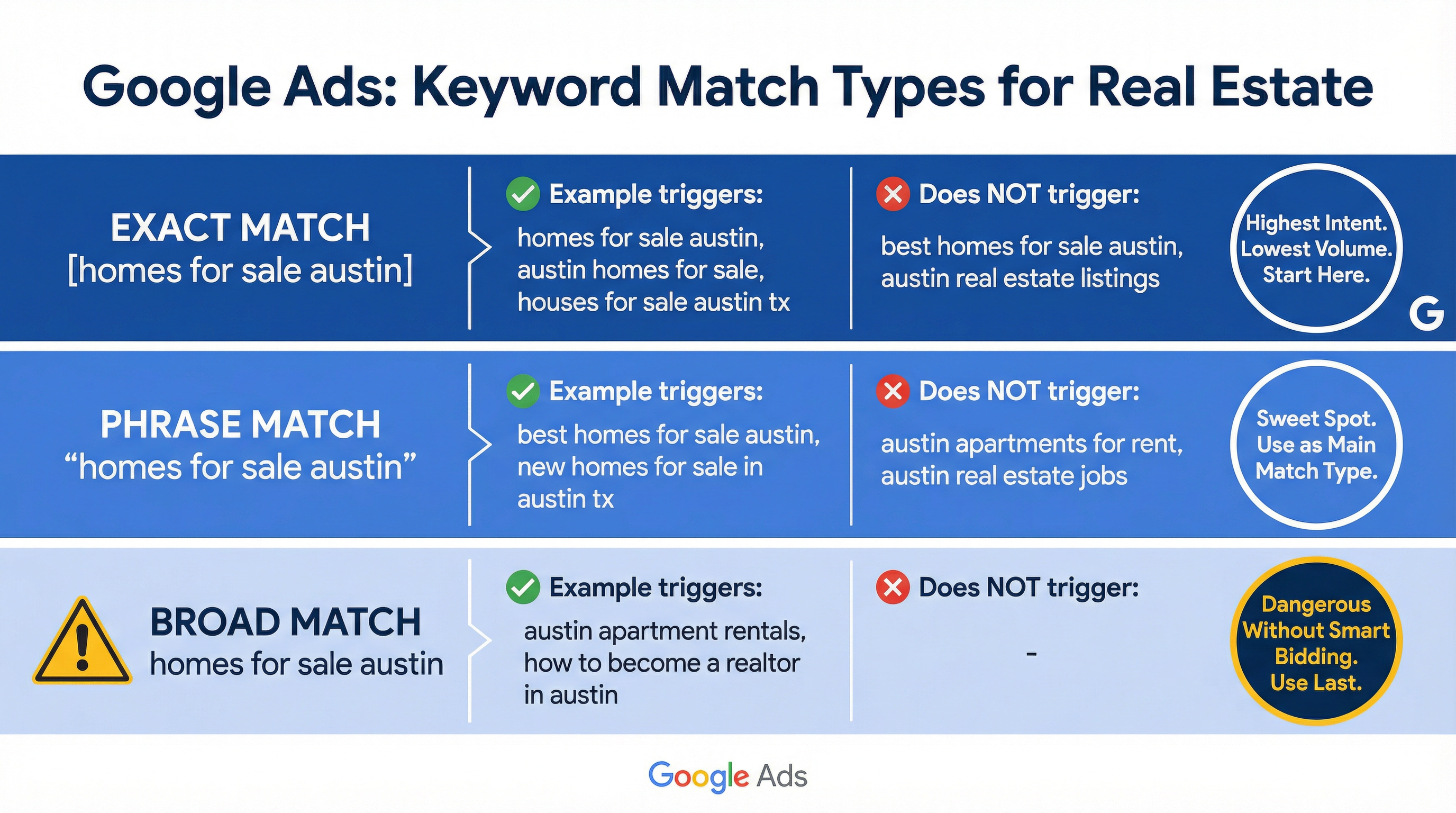
If you do not understand keyword match types, Google will spend your money on irrelevant searches. There are three main types you need to know:
- Exact Match
[homes for sale austin]: Your ad only shows when someone types exactly that phrase or a very close variant. This gives you the most control and highest intent, but the lowest volume. - Phrase Match
"homes for sale austin": Your ad shows when the search includes the meaning of your phrase. It might trigger for “best homes for sale austin tx.” This is the sweet spot for most real estate campaigns. - Broad Match
homes for sale austin: Your ad shows for any related search. It might trigger for “austin apartment rentals” or “how to become a real estate agent in austin.” Broad match is dangerous for real estate unless paired with strict Smart Bidding.
Start your campaigns with Phrase and Exact match. Earn your way to Broad match only after you have solid conversion data.
7. The Power of Negative Keywords
If match types are the accelerator, negative keywords are the brakes. A negative keyword prevents your ad from showing when a specific word is used in the search query.
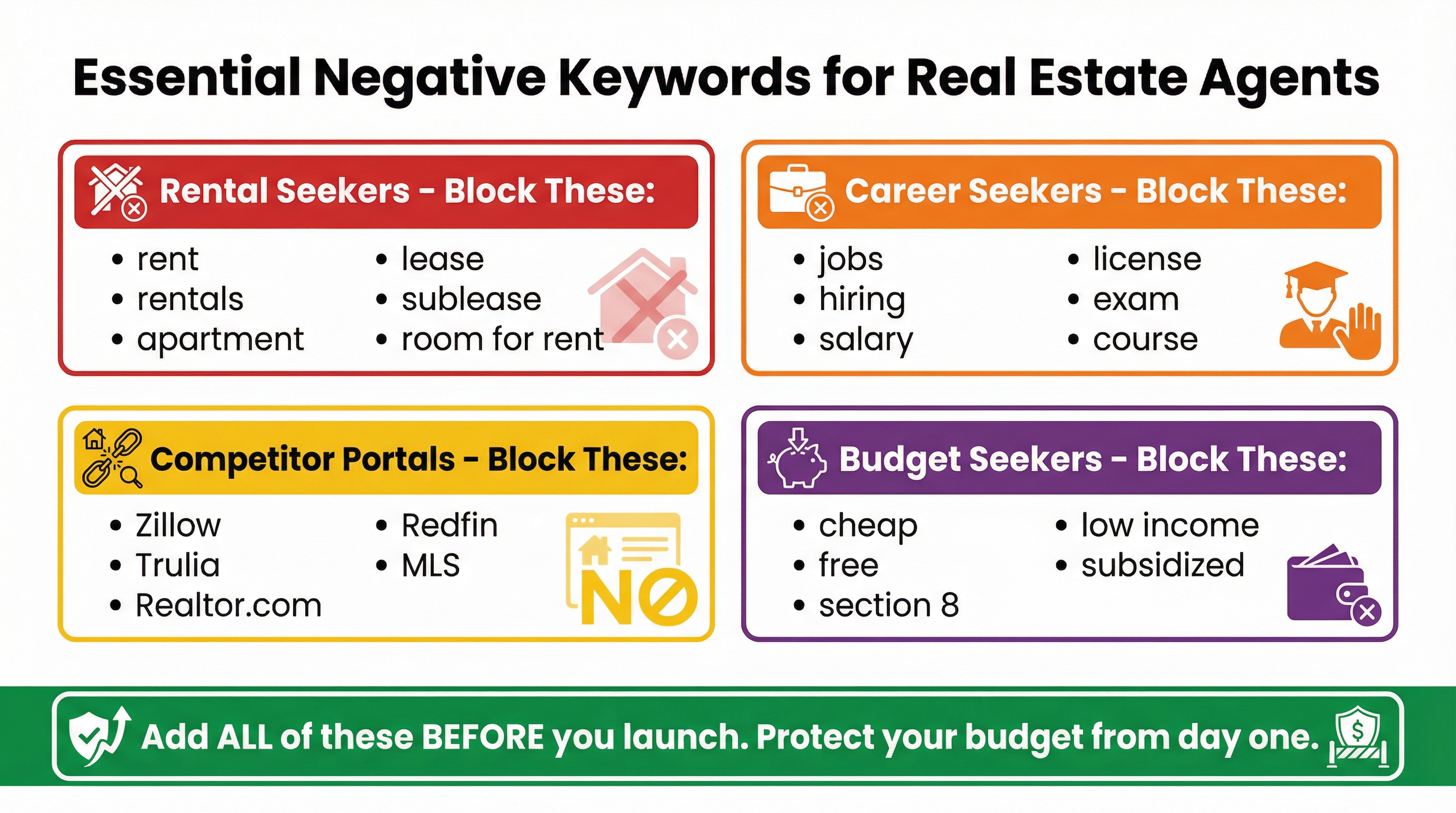
For real estate agents, a robust negative keyword list is mandatory before launching. You want to block people who are looking for rentals, jobs, or DIY information.
Essential Real Estate Negative Keywords:
- Rent, rentals, apartment, lease
- Jobs, hiring, salary, career
- Zillow, Trulia, Realtor.com (unless you are running a specific competitor conquesting campaign)
- Cheap, free, section 8
- Course, license, exam
By adding these negatives, you ensure your budget is only spent on actual buyers and sellers, not people looking for an apartment lease or a new career.
8. Writing Ad Copy That Actually Converts
Your ad copy has one job: get the right person to click, and the wrong person to keep scrolling.
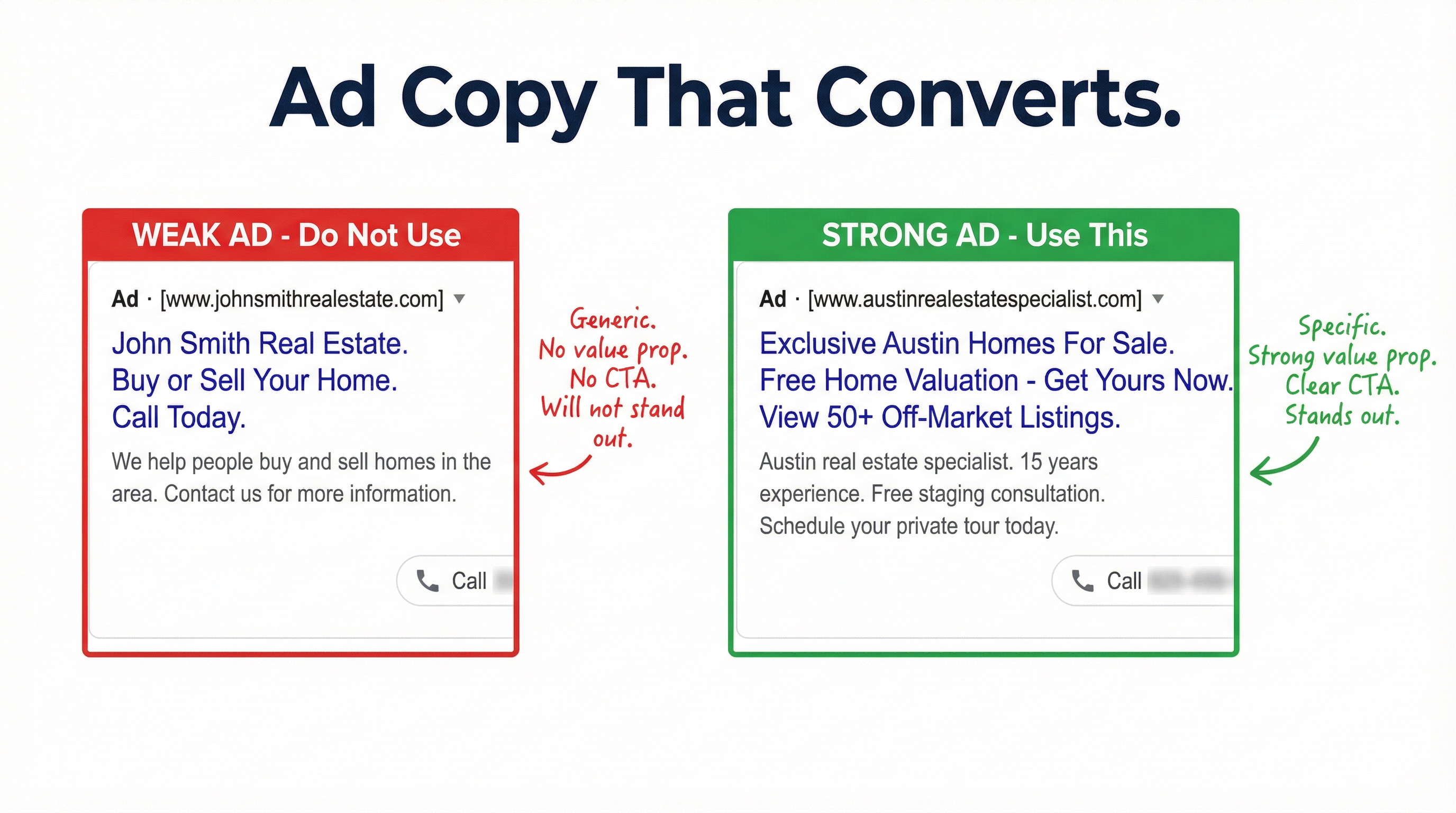
Most real estate ads are incredibly boring. They say: “John Smith Real Estate | Buy or Sell Your Home | Call Today.” That does not stand out.
To write winning ad copy, you need to focus on the user’s specific problem and your unique solution.
- Use Dynamic Location Insertion: Make sure the city or neighborhood they searched for is in the headline. (e.g., “Exclusive Homes in Downtown Austin”).
- Highlight Unique Value: Do you offer a free staging consultation? Do you have off-market listings? Put that in the ad.
- Include Strong Calls to Action (CTAs): Tell them exactly what to do next. “View New Listings Today,” “Get Your Free Home Valuation,” “Schedule a Tour.”
9. Landing Pages: The Silent Deal Killer
You can build the perfect Google Ads campaign, but if you send that traffic to your agency’s generic homepage, you will lose the lead.
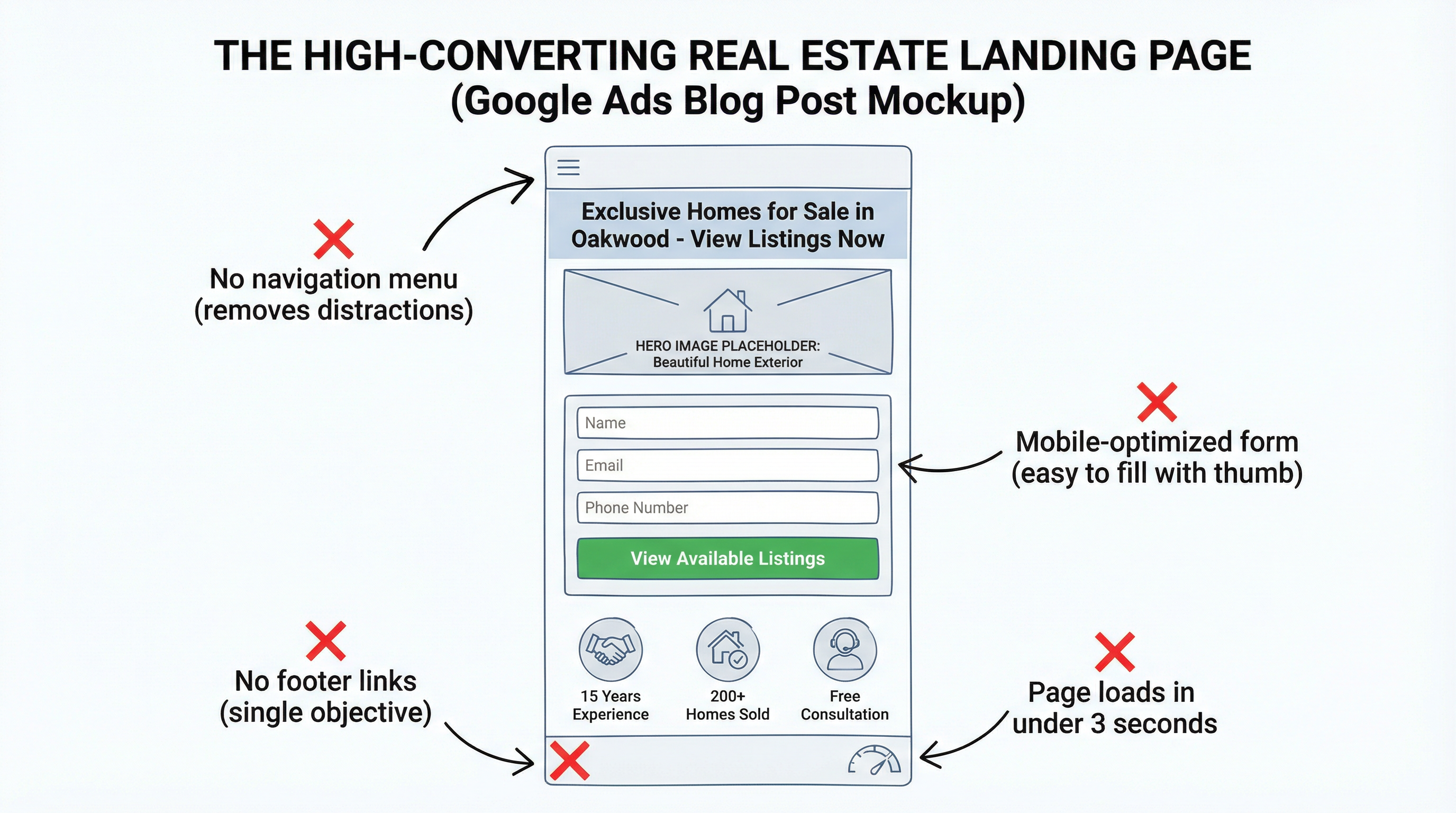
When someone clicks an ad for “homes for sale in Oakwood,” they expect to see homes for sale in Oakwood. If they land on a homepage with a giant picture of your face and a long bio about how much you love dogs, they will bounce.
Landing Page Rules for Real Estate:
- Message Match: The headline of the landing page must match the headline of the ad.
- Single Objective: The page should have one goal (e.g., fill out a form to see the listings). Remove all other navigation links.
- Speed: If the page takes more than 3 seconds to load, you lose 50% of your traffic.
- Mobile Optimization: Over 70% of real estate searches happen on a phone. Your form must be easy to fill out with a thumb.
10. Budgeting for Real Estate Google Ads
“How much should I spend?” is the most common question I get from agents.
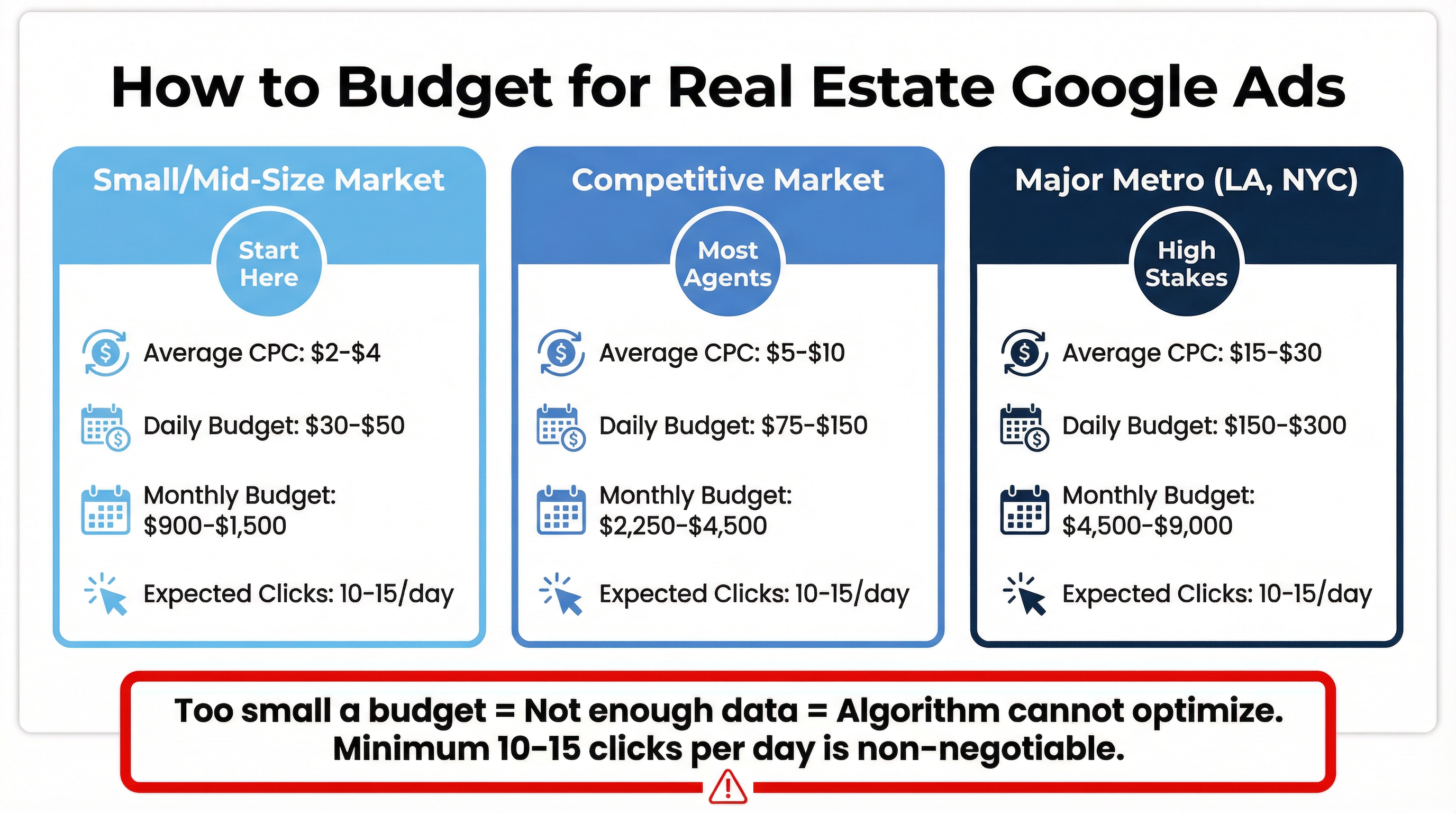
The answer depends on your market. In a highly competitive market like Los Angeles or New York, the cost per click (CPC) will be significantly higher than in a mid-sized Midwestern city.
However, a general rule of thumb is that you need enough budget to generate at least 10-15 clicks per day. If your average CPC is $3, you need a minimum budget of $30-$45 per day (roughly $1,000 per month).
If your budget is too small, Google’s algorithm will not have enough data to optimize, and your campaign will stall out. It is better to run a highly targeted, hyper-local campaign with a proper budget than to spread a small budget across a massive geographic area.
11. Using Ad Extensions to Dominate the Search Results
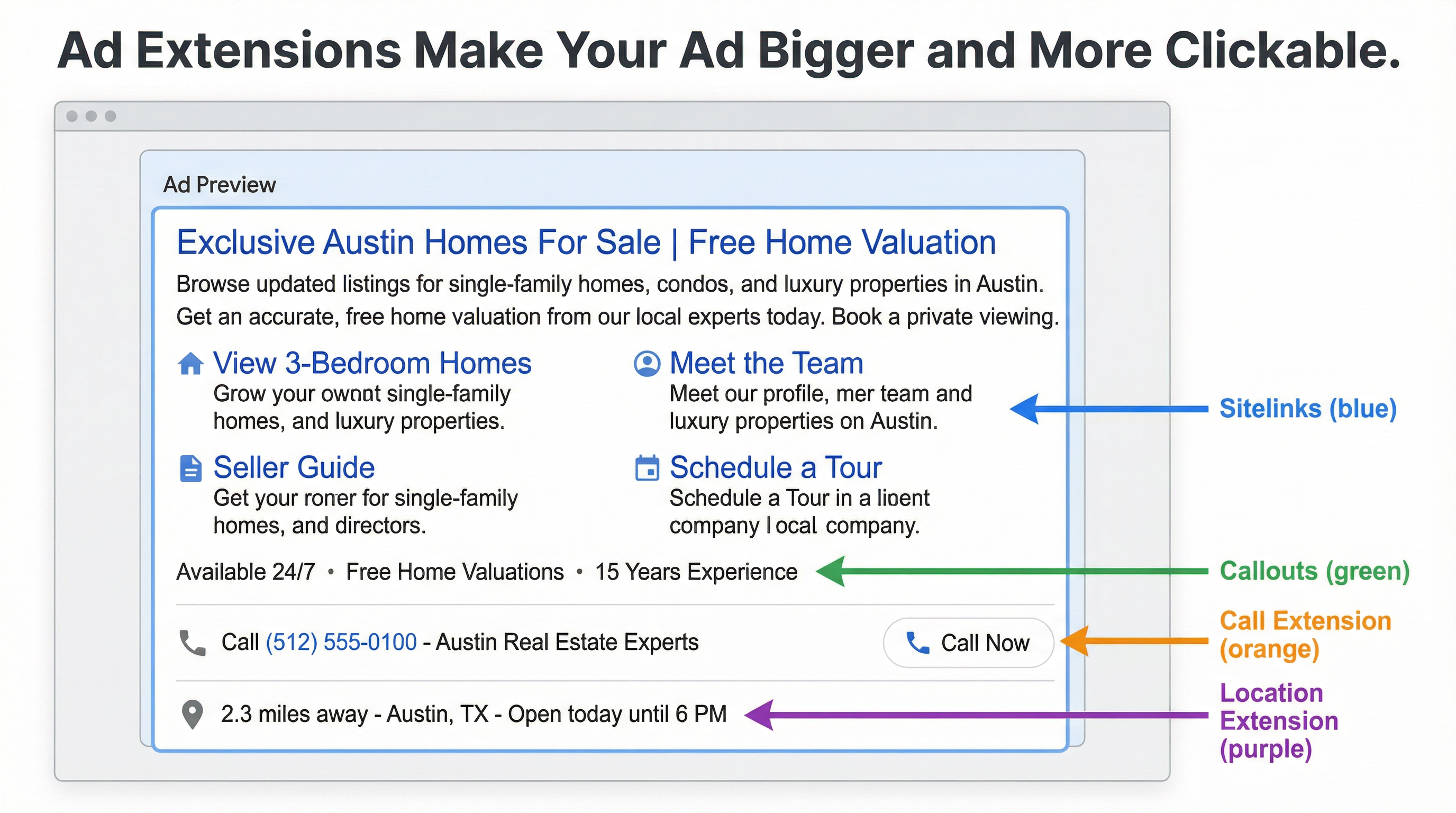
Ad extensions (now called “Assets” by Google) are additional pieces of information that expand your ad, making it physically larger on the search results page. They are free to use and proven to increase Click-Through Rates (CTR).
Crucial Extensions for Agents:
- Sitelink Extensions: Link to specific pages (e.g., “View 3-Bedroom Homes,” “Meet the Team,” “Seller’s Guide”).
- Callout Extensions: Highlight specific benefits (e.g., “Available 24/7,” “Free Home Valuations,” “15 Years Experience”).
- Call Extensions: Put your phone number directly in the ad so mobile users can click-to-call without even visiting your website.
- Location Extensions: Connect your Google Business Profile to show your office address and distance from the user.
12. The Role of Google Local Services Ads (LSAs)
In addition to traditional Google Search Ads, real estate agents should heavily consider Google Local Services Ads (LSAs).
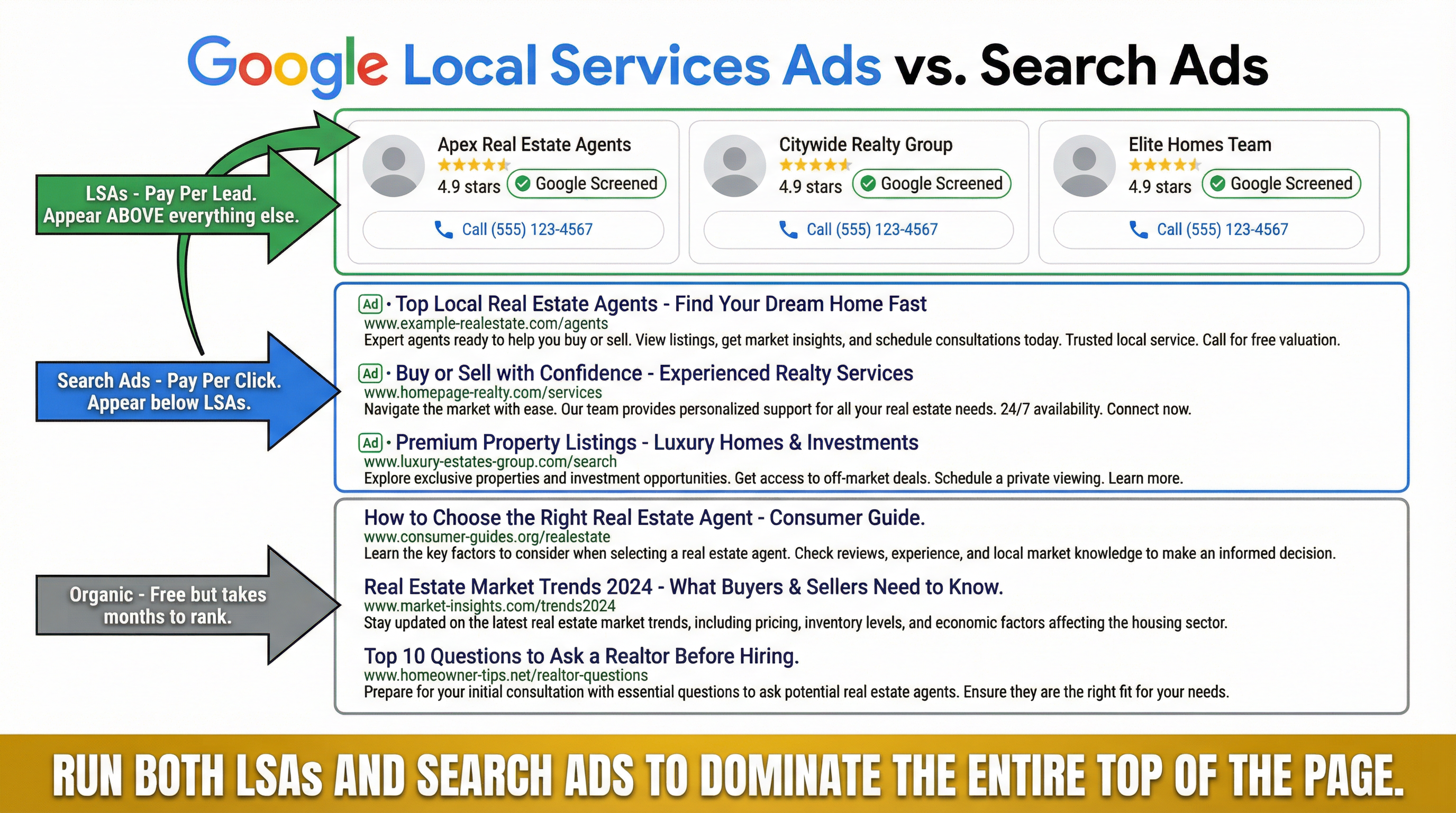
LSAs appear at the very top of the search results, above the traditional text ads. They feature your headshot, your star rating, and a “Google Screened” badge.
The best part about LSAs? You do not pay per click. You pay per lead. If someone calls you through an LSA and they are looking for a rental (and you only do sales), you can dispute the charge with Google and get your money back.
Running traditional Search Ads alongside LSAs is the ultimate strategy for dominating the top of the search results page.
13. Remarketing: Staying Top of Mind
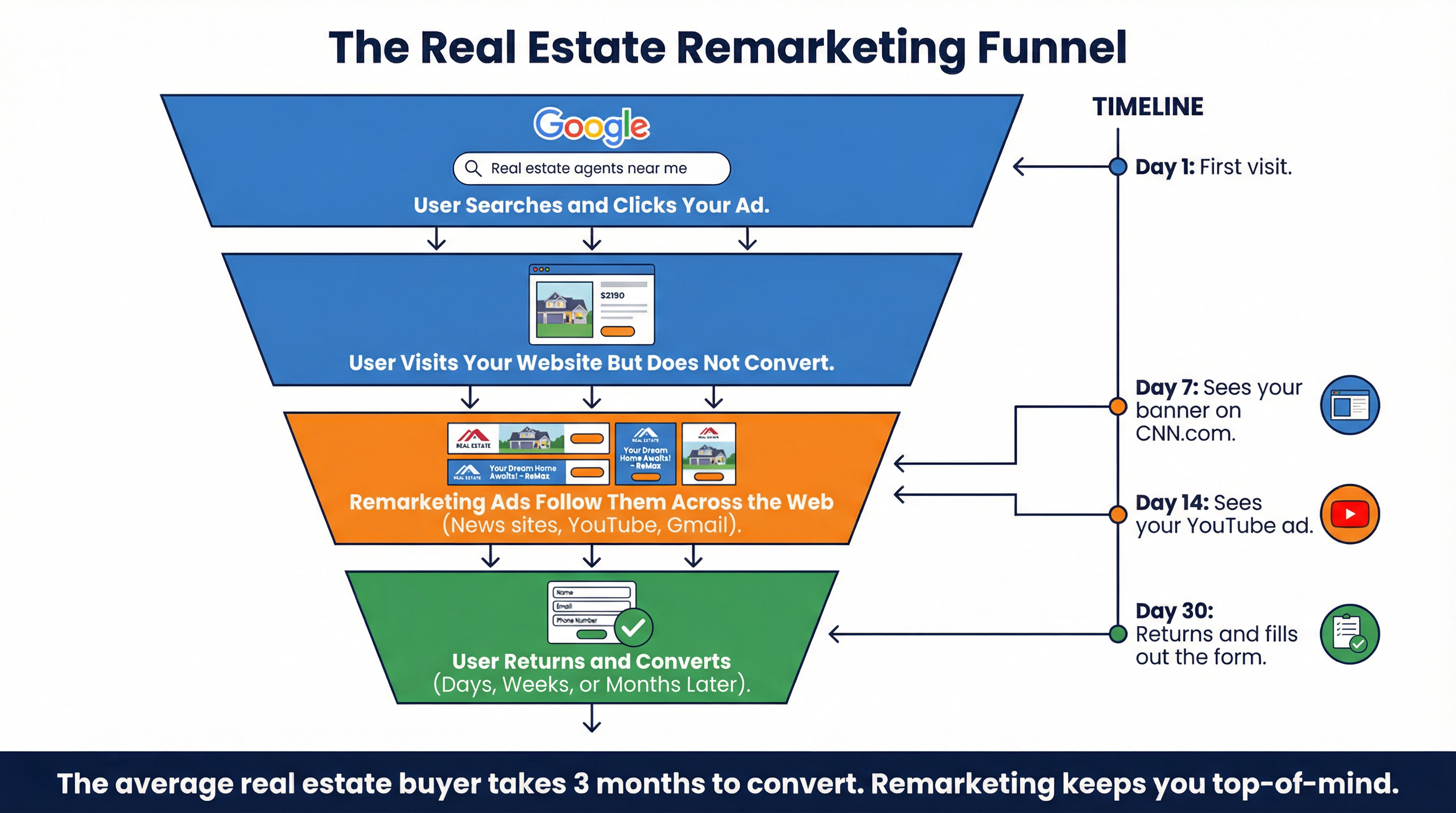
Real estate sales cycles are long. Someone might search for homes today, but they might not be ready to actually buy or list their home for another six months.
If you only rely on that first click, you will lose them to a competitor.
Remarketing (or retargeting) allows you to show visual banner ads to people who have previously visited your website as they browse other sites across the internet (like news sites, blogs, or YouTube).
By setting up a remarketing campaign, you ensure that your face, your brand, and your current listings follow that potential buyer around the web, keeping you top-of-mind until they are finally ready to pull the trigger.
14. Tracking ROI: The Math of Real Estate Ads
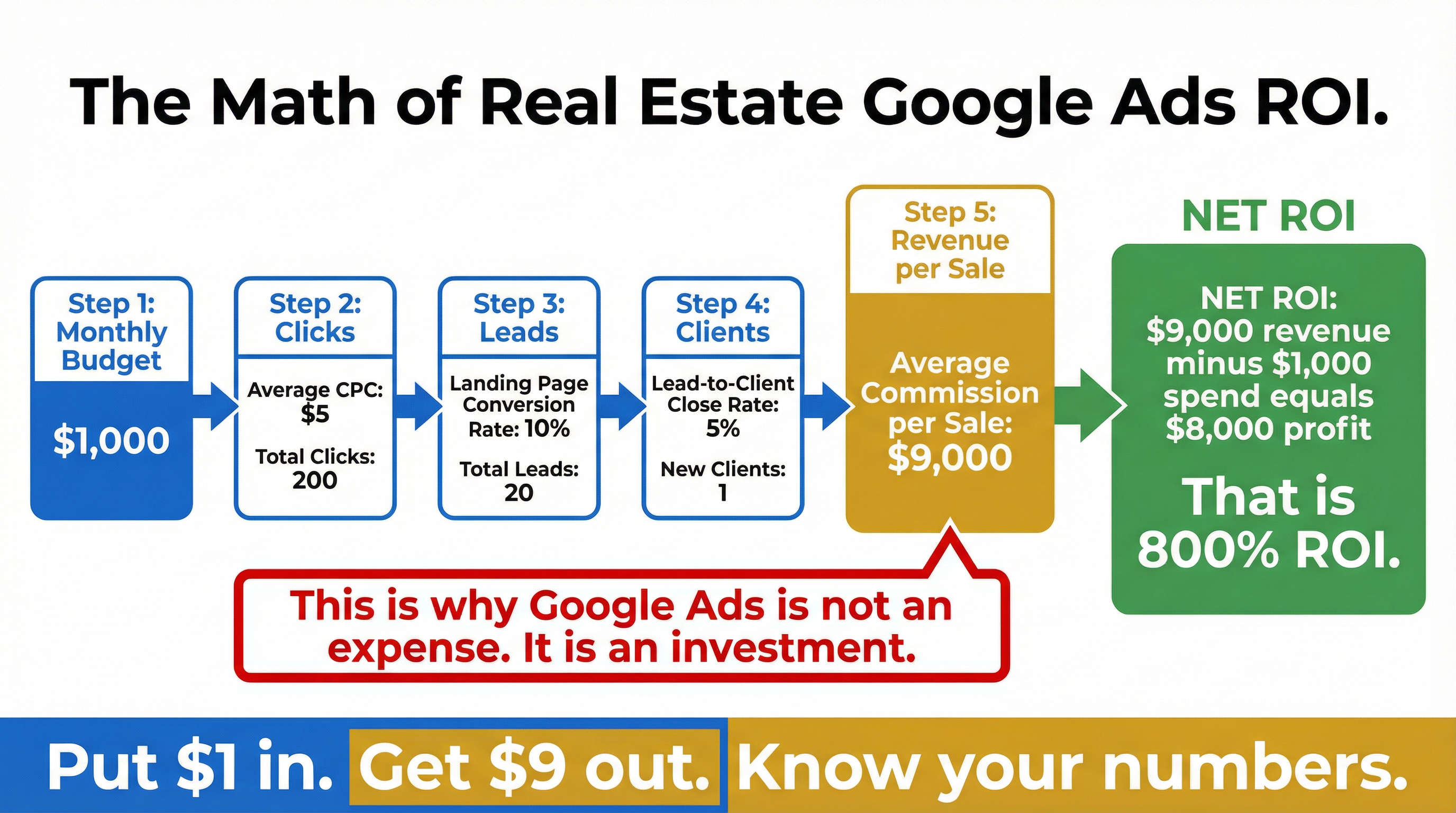
To truly succeed with Google Ads, you must treat it like a math equation, not an expense.
Let’s say you spend $1,000 in a month.
- That buys you 200 clicks (at $5 per click).
- Your landing page converts at 10%, giving you 20 leads.
- Your cost per lead is $50.
- You close 1 out of every 20 leads (a 5% close rate).
- You just acquired 1 new client for $1,000.
If your average commission on a home sale is $9,000, you just turned $1,000 into $9,000. That is an 800% Return on Investment (ROI).
When you know your numbers, spending money on Google Ads is no longer scary. It becomes a predictable machine. You put $1 in, and you get $9 out.
15. Stop Waiting. Start Capturing.
Are you actively capturing demand, or are you waiting for it?
Referrals are great—but they are unpredictable. You cannot scale a business based on hoping your past clients mention your name at a dinner party.
Google Ads is a system. You build it, you optimize it, and it runs. Buyers search, you show up, they inquire. That is a pipeline. Not a prayer.
If you are a real estate agent who wants to stop waiting for the phone to ring and start capturing high-intent buyers and sellers in your local market, you need a professionally managed Google Ads account.
I offer expert Google Ads management services tailored specifically for the real estate industry. I can audit your current account, build out hyper-local campaigns, and set up the conversion tracking required to turn clicks into closings.
👉 Book your free Google Ads audit here
16. The “Omnipresence” Strategy: YouTube and Display Ads
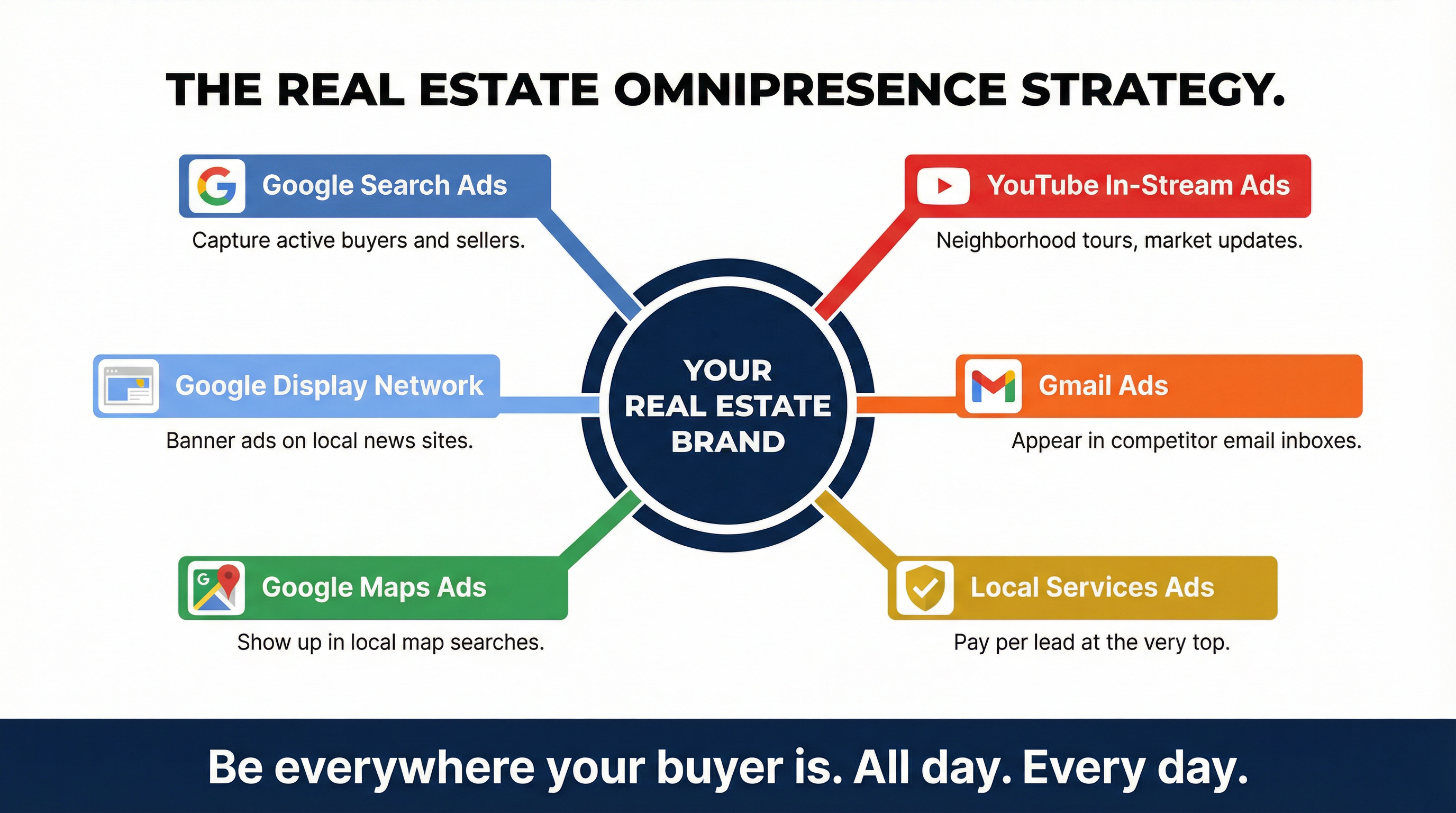
Once your Search campaigns are highly profitable, you can scale your brand using the Google Display Network and YouTube Ads. This is how you create “omnipresence” in your local market.
YouTube Ads for Real Estate
YouTube is the second largest search engine in the world. As a real estate agent, you can run in-stream video ads that play before someone watches a video about “moving to Austin” or “first-time homebuyer tips.”
- Video Content: A 30-second neighborhood tour or a quick market update.
- Targeting: Target people who have recently searched for real estate keywords on Google (Custom Intent Audiences).
Display Network Banners
The Google Display Network allows you to show banner ads on millions of websites across the internet (including local news sites).
- Strategy: Use this for brand awareness. Show a beautiful picture of a recently sold home with a banner that says “Just Sold in 3 Days by [Your Name].”
- Cost: Display ads are incredibly cheap (often pennies per click), making them perfect for keeping your face in front of the local community.
17. Dealing with the “Click Fraud” Myth
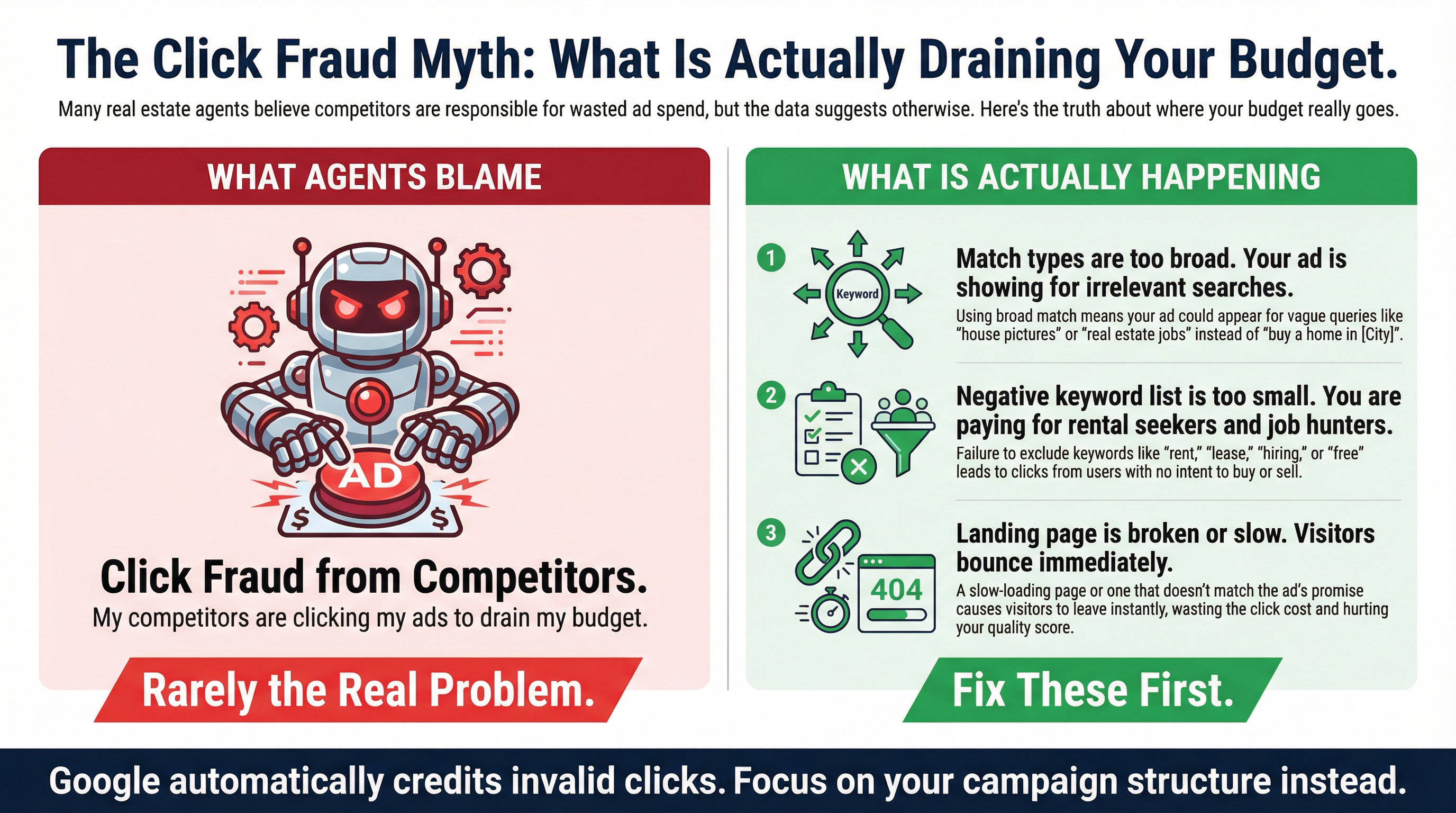
Many real estate agents are terrified of “click fraud”—the idea that competitors or bots are clicking their ads to drain their budget.
While click fraud exists, it is vastly overstated in the real estate niche. Google has incredibly sophisticated algorithms designed to detect and filter out invalid clicks. If Google detects a bot or a competitor repeatedly clicking your ad from the same IP address, they will automatically credit the money back to your account.
If you see a sudden spike in clicks with no leads, the problem is rarely click fraud. The problem is usually:
- Your match types are too broad.
- Your negative keyword list is too small.
- Your landing page is broken or slow.
Focus on fixing your campaign structure before blaming invisible bots.
18. Seasonality in Real Estate Google Ads
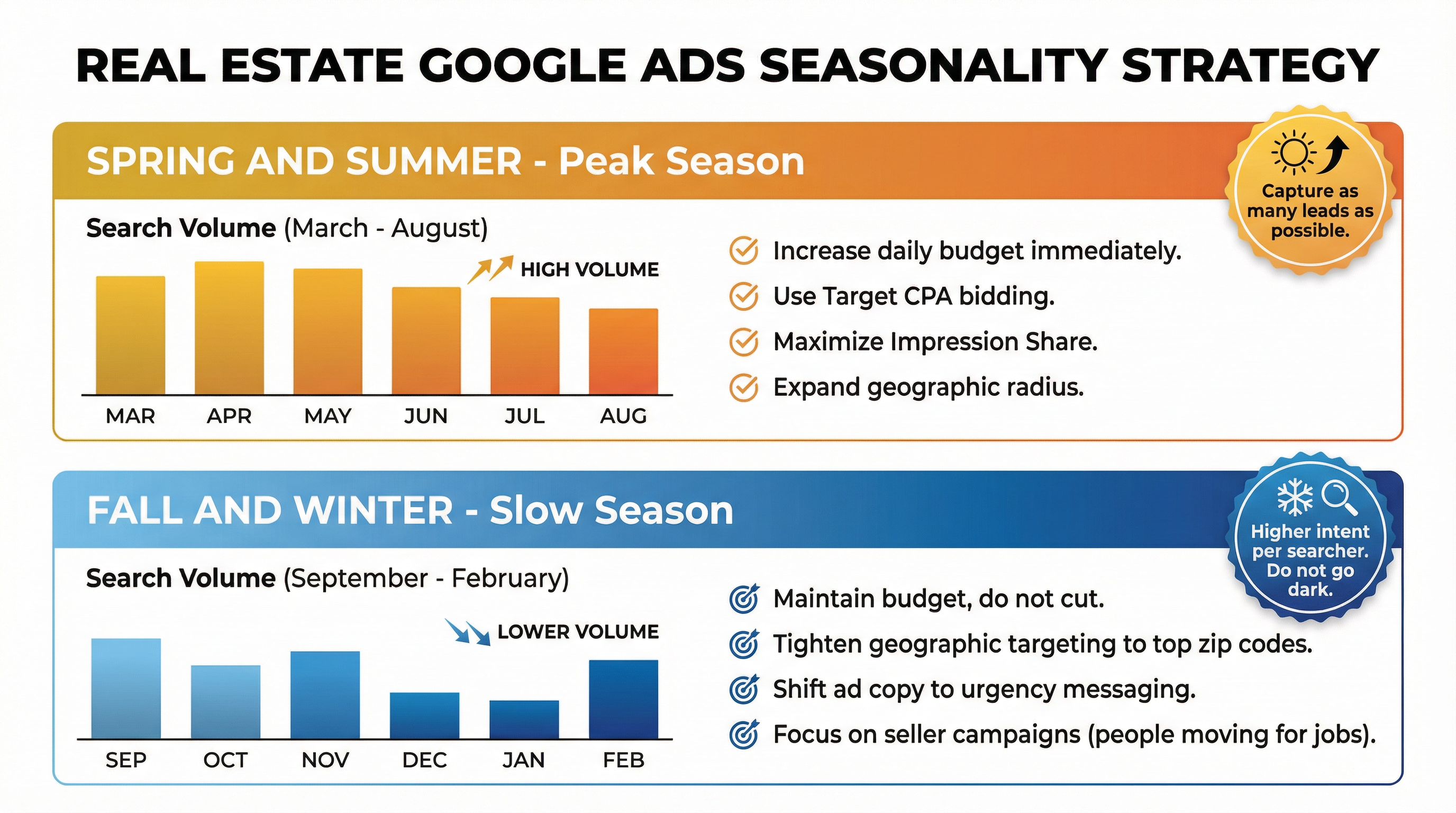
Real estate is a highly seasonal business. Spring and summer are typically the busiest seasons, while late fall and winter slow down. Your Google Ads strategy must adapt to these seasonal shifts.
The Spring/Summer Strategy
During peak season, search volume explodes. Your goal is to maximize impression share.
- Action: Increase your daily budget. You do not want your campaigns pausing at 2 PM because you ran out of money during the busiest time of the year.
- Bidding: Be aggressive. Use Target CPA to capture as many leads as possible while the market is hot.
The Fall/Winter Strategy
During the slow season, search volume drops, but the intent of those searching is often much higher (people moving for jobs or urgent life changes).
- Action: Maintain your budget, but tighten your geographic targeting. Focus on your highest-converting zip codes.
- Messaging: Shift your ad copy to focus on urgency and holiday-related moves.
19. Building a Team to Handle the Leads
A common “problem” agents face when they launch a successful Google Ads campaign is that they generate too many leads to handle alone.
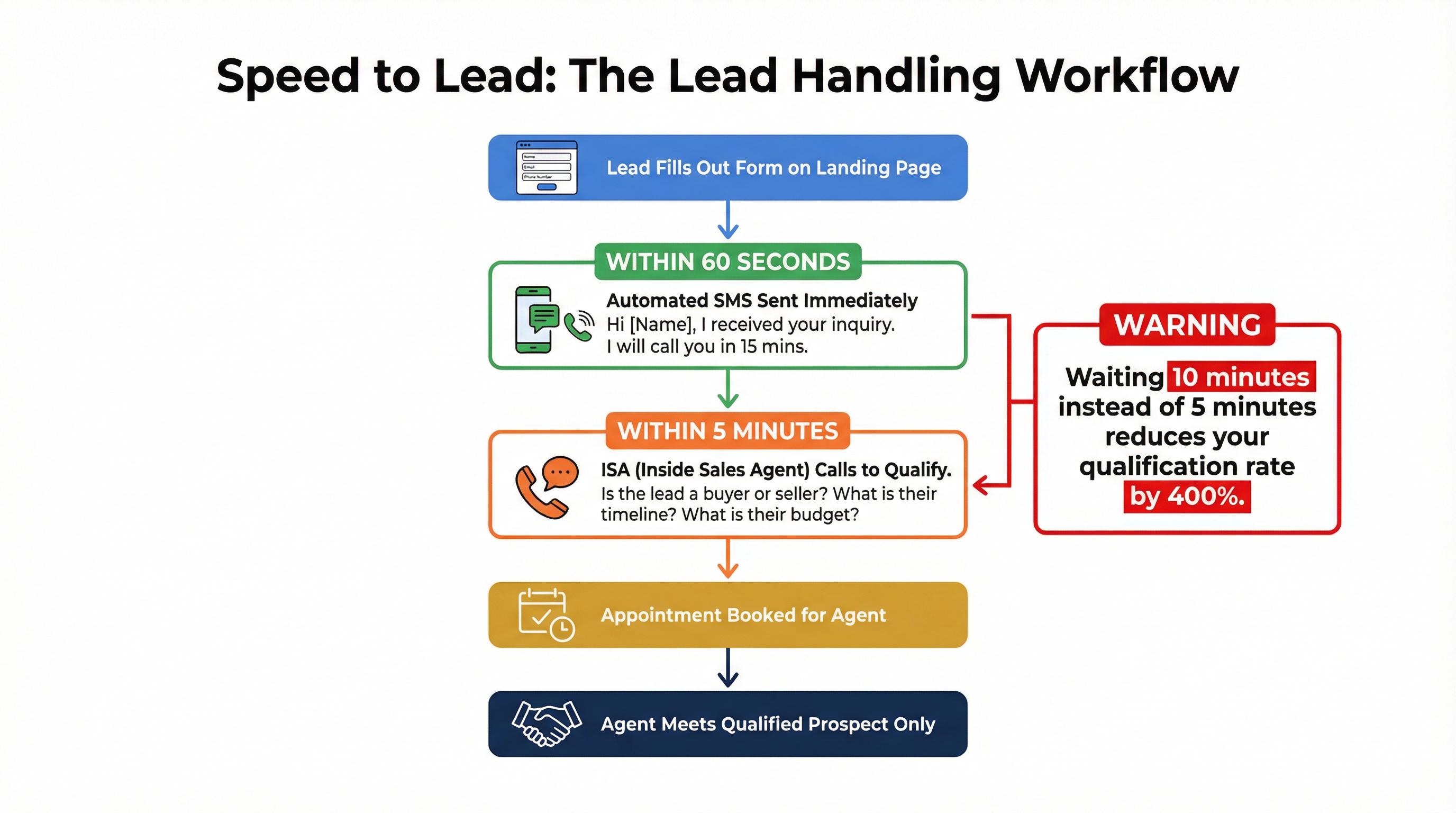
If you are generating 50 leads a month, you cannot afford to let them sit in your inbox for 24 hours. The speed to lead is critical. Studies show that if you respond to an internet lead within 5 minutes, your chances of qualifying them drop by 400% if you wait just 10 minutes.
The Solution:
- Automated SMS: Set up an automated text message that goes out the second a lead fills out your form. “Hi [Name], I just received your inquiry about homes in Oakwood. I’m with a client but will call you in 15 mins. Are you looking to buy in the next 3 months?”
- Inside Sales Agent (ISA): Hire an ISA whose only job is to call, qualify, and book appointments for you. You only step in when the client is ready to tour a home or sign a listing agreement.
20. The Long Game: Why You Must Commit for 90 Days
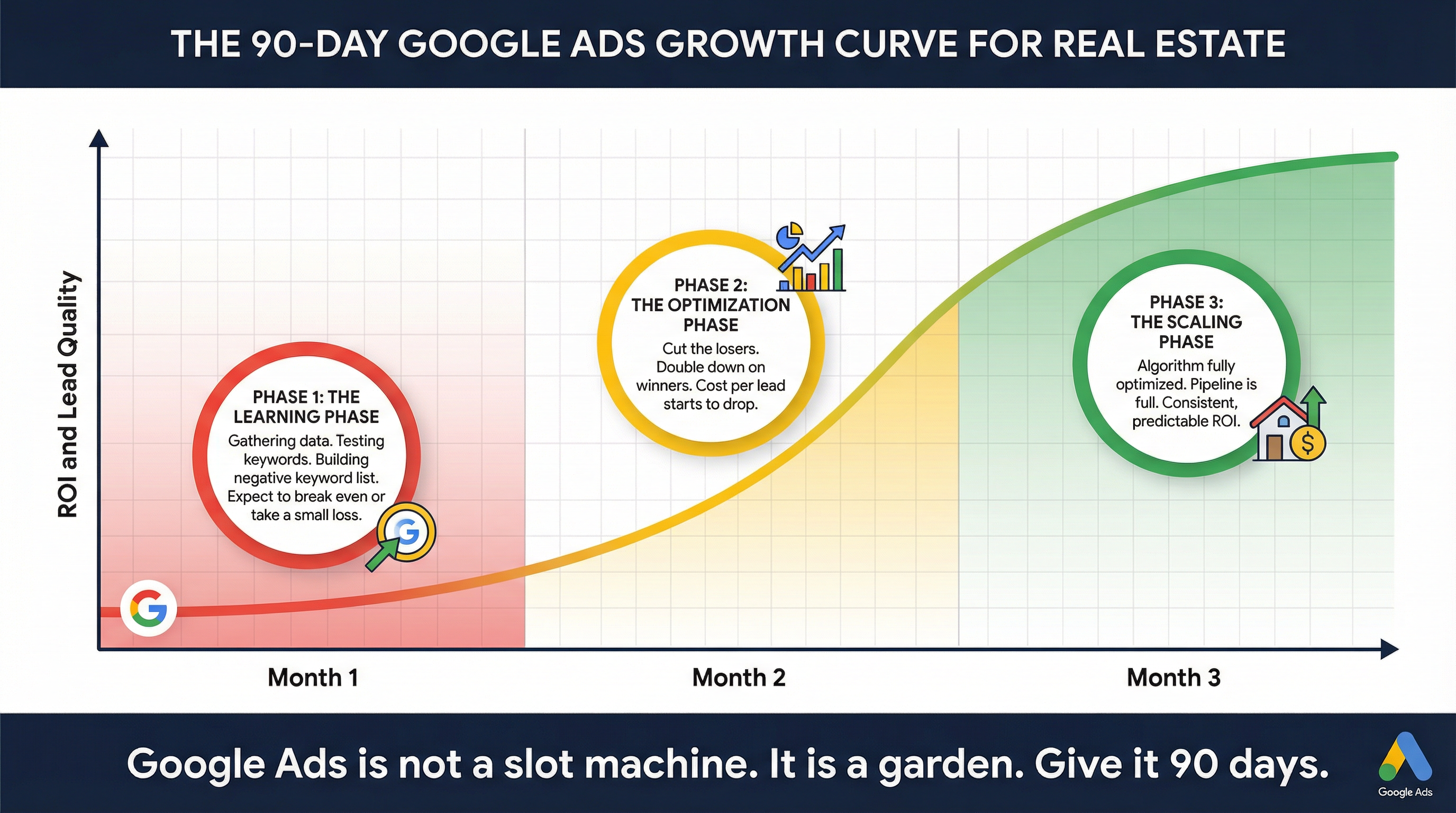
The final and most important piece of advice I give to real estate agents is this: Google Ads is not a slot machine. It is a garden. You have to plant the seeds, water them, and give them time to grow.
Many agents launch a campaign, spend $300 over three days, get no leads, and turn it off, declaring “Google Ads doesn’t work in my market.”
The 90-Day Reality:
- Month 1 (The Learning Phase): You are gathering data, testing keywords, and building your negative keyword list. You will likely break even or take a small loss.
- Month 2 (The Optimization Phase): You cut the losers and double down on the winners. Your cost per lead starts to drop.
- Month 3 (The Scaling Phase): The algorithm has enough conversion data to optimize efficiently. Your pipeline is full, and you start seeing a consistent, predictable ROI.
Commit to the 90-day process, trust the data, and you will build a lead generation machine that outpaces referrals ten to one.

2 Comments
This is a great reminder for real estate agents who rely too heavily on referrals alone. Referrals can be valuable, but they are not always predictable. I like how this article highlights Google Ads as a way to create a more consistent flow of leads.
Hi Bryant, thank you for your comment. That is exactly the point. Referrals are helpful, but they are often inconsistent and difficult to scale. Google Ads can help real estate agents build a more reliable lead pipeline and reduce dependence on word-of-mouth alone.