

Google Ads Audience Targeting: 3 Types That Actually Work (and How to Implement Them)
March 31, 2026
How to Use Seasonal Keywords in Google Ads (The Right Way)
April 3, 2026
If your Google Ads strategy begins and ends with turning on Smart Bidding and hoping for the best, you are likely leaving a significant amount of money on the table. Everyone talks about Smart Bidding like it is the obvious, undeniable choice for every campaign. Google certainly wants you to think that—the platform pushes automated strategies front and center every time you set up a new campaign, often hiding manual options behind “advanced” dropdown menus. And honestly, for a lot of mature accounts with robust data, automation does work incredibly well.
But here is the critical truth that many marketers learn the hard way: Smart Bidding is not always the right call.
There are specific, highly common situations where Manual Cost-Per-Click (CPC) bidding gives you more control, more consistency, and frankly, much better outcomes. If you have ever handed a brand-new campaign over to Target CPA (tCPA) or Maximize Conversions and watched it burn through your monthly budget in three days with almost nothing to show for it, you already know exactly what I am talking about. The algorithm can be incredibly powerful, but it is not magic. It requires fuel, and that fuel is data.
In this comprehensive guide, we are going to break down exactly when Manual CPC is the smarter move, why keyword-level bidding is the secret weapon most advertisers skip, and how to know exactly when it is time to transition your campaigns from manual control to machine learning.
1. The Core Concept: Why Smart Bidding Fails Without Data
To understand why Manual CPC is sometimes necessary, you first have to understand how Smart Bidding actually works.
Smart Bidding relies on machine learning algorithms to predict the likelihood of a conversion at the exact moment a user performs a search. It analyzes millions of signals—device, location, time of day, operating system, past browsing behavior, and more—to determine how much to bid in that specific auction.
The Data Dependency Problem
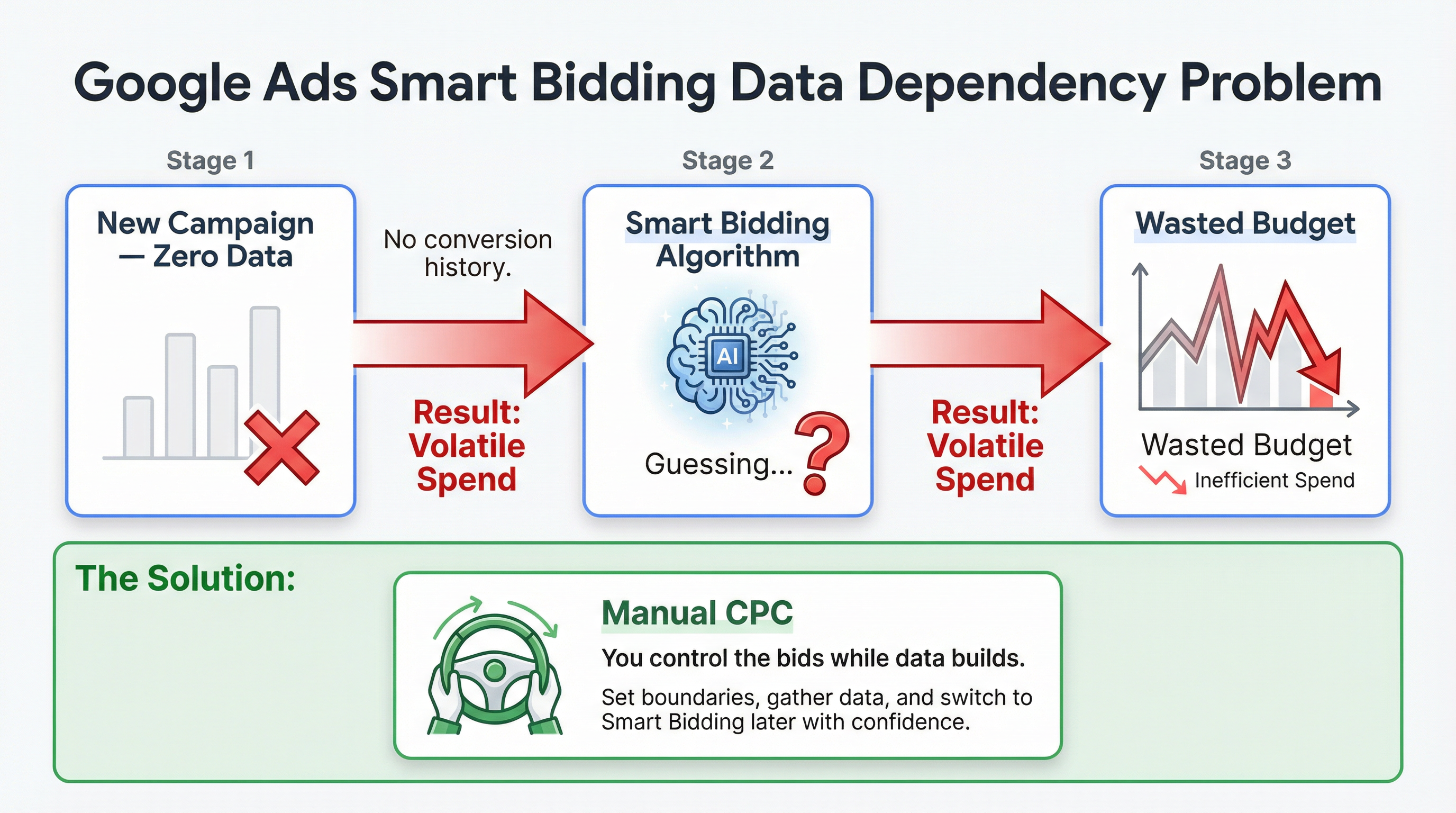
Machine learning needs data to learn. When your campaign is brand new and has absolutely no conversion history, the algorithm has very little to learn from. It is essentially guessing. When you launch a new campaign on a Smart Bidding strategy like Maximize Conversions, the system will often bid aggressively on broad, low-intent traffic just to see what happens. It is trying to find the boundaries of what works, but it is using your budget to conduct those experiments.
This is why new Smart Bidding campaigns often experience wild volatility. Performance can get messy fast. The campaign might significantly underspend because it cannot find users it thinks will convert, or worse, it might massively overspend, chasing the wrong signals entirely and generating expensive, low-quality clicks.
The Manual CPC Solution
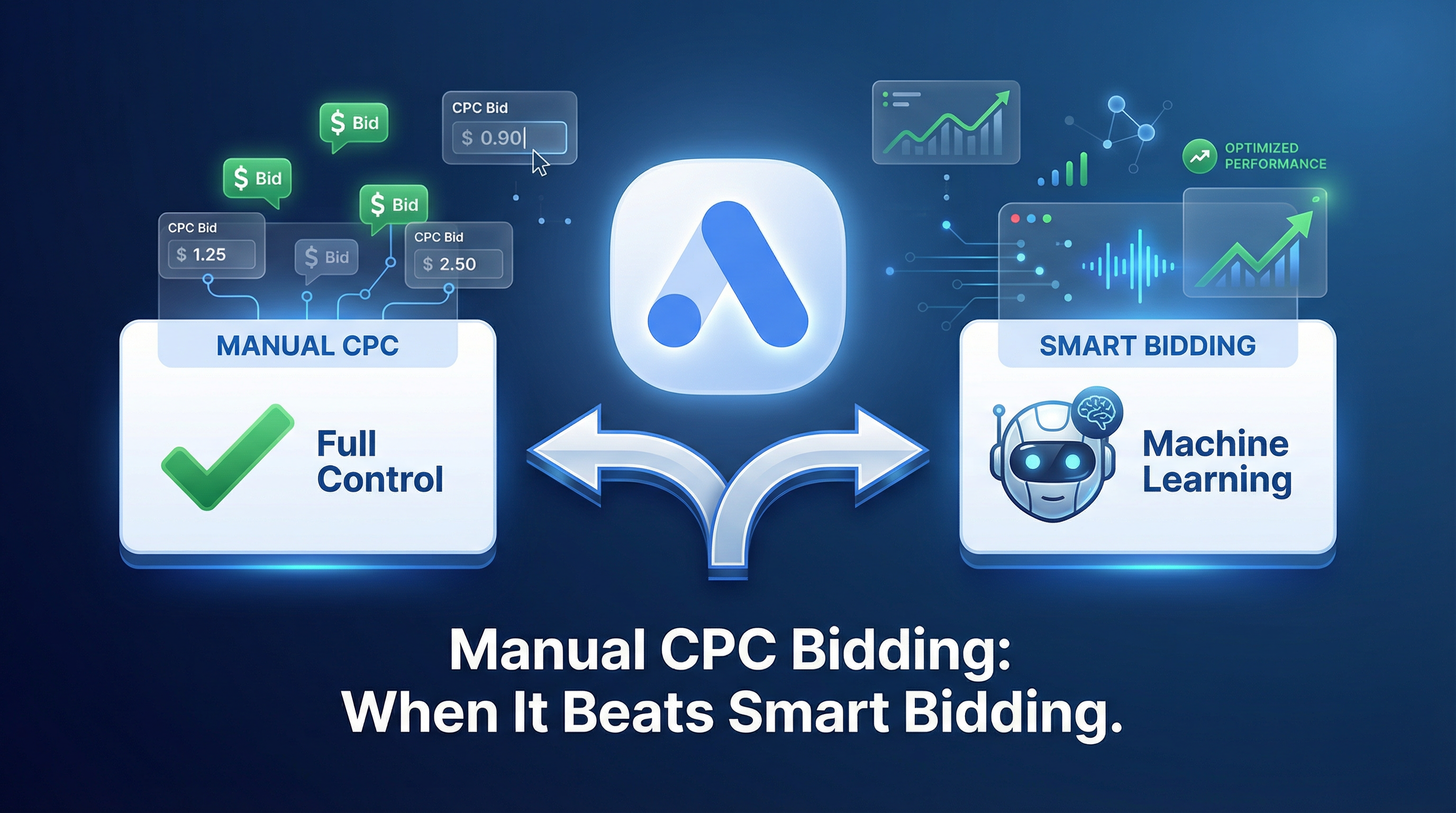
Manual CPC lets you take the wheel while you are building that foundational data. Instead of letting an algorithm guess what a click is worth, you decide exactly how much you are willing to pay per click. You control the pacing. You control the maximum exposure.
Once you have a solid baseline of data—usually a few hundred conversions over a 30-day period—then it makes complete sense to consider transitioning to an automated strategy. The algorithm now has a clear picture of what your ideal customer looks like. But in those crucial early weeks? Manual CPC keeps things stable, predictable, and budget-friendly.
2. Tight Budgets Where Every Click Counts
One of the most dangerous scenarios for Smart Bidding is a campaign with a highly constrained budget.
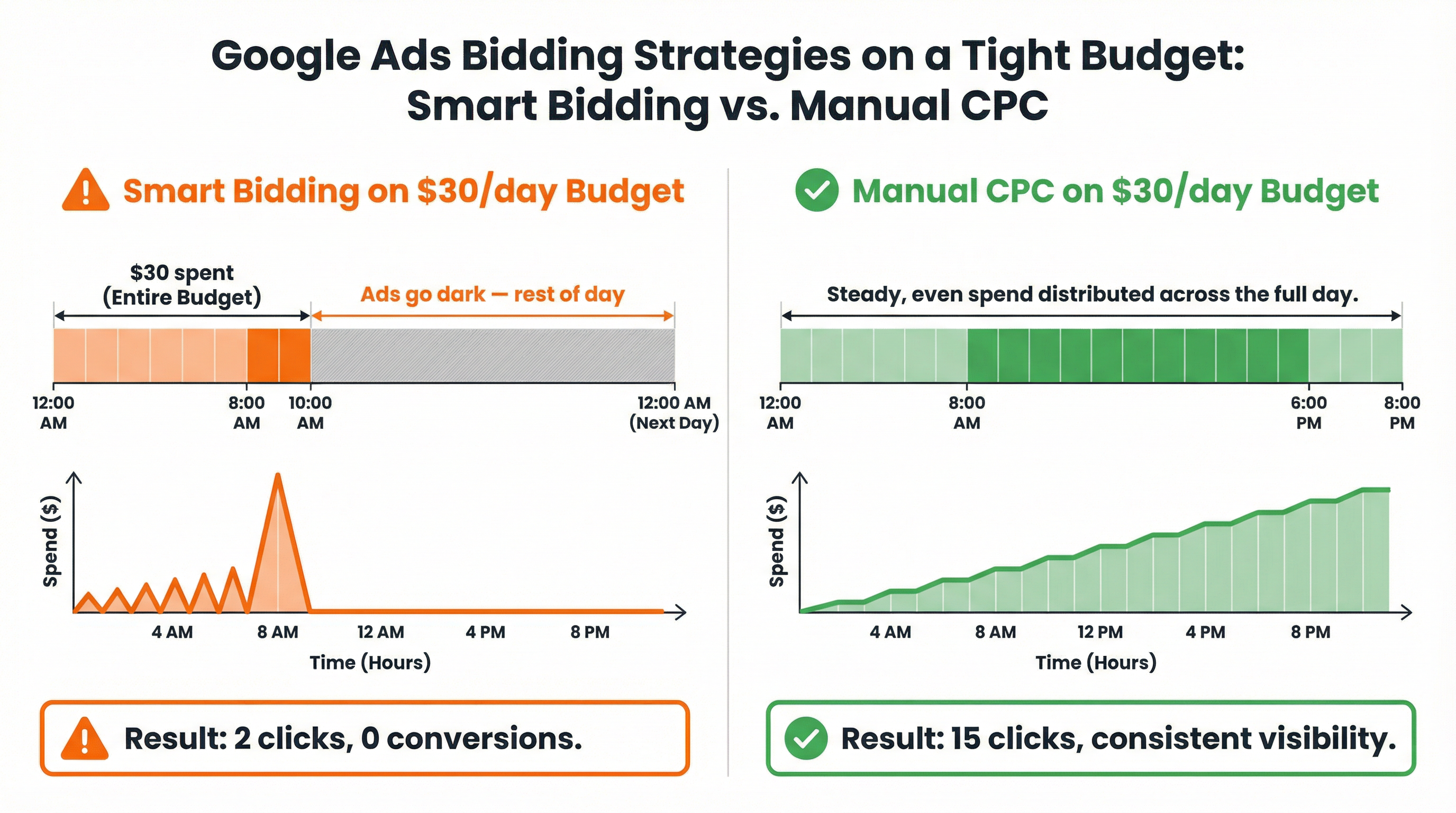
If you are running a campaign with a small daily budget—say, $20 or $30 a day—unpredictable spend is a massive problem. Smart Bidding algorithms are designed to maximize performance over a 30-day window, not necessarily on a day-to-day basis. Google explicitly states that campaigns using automated bidding can spend up to twice their average daily budget on days when the algorithm predicts high conversion volume.
The Tight Budget Trap
At scale, spending double your daily budget on a Tuesday and zero on a Wednesday averages out fine. But at tight budgets, this volatility is crippling. If your daily cap is $30, and the algorithm decides to bid $15 per click because it “senses” high intent, you might blow through your entire daily cap in an hour on just two clicks. If those two clicks do not convert, your campaign goes dark for the rest of the day. You lose out on the steady trickle of traffic that could have generated leads at a lower cost.
The Hard Ceiling Advantage
Manual CPC gives you a hard ceiling. You know exactly how much you are willing to pay per click, and the system cannot exceed that maximum bid (unless you enable Enhanced CPC, which we will discuss later).
For budget-conscious campaigns, that kind of control is genuinely valuable. If you set your maximum CPC at $2.00 on a $30 daily budget, you are guaranteed at least 15 clicks a day. You ensure your ads stay visible throughout the day, allowing you to gather consistent data and maintain a steady presence in the SERP, rather than burning out before breakfast.
3. Keyword-Level Bidding: The Move Most Accounts Skip
This is where most advertisers leave real money on the table, and it is the part I find myself explaining most often when auditing new client accounts.
When you use a Smart Bidding strategy at the campaign level, the algorithm sets the bids. You lose the ability to tell the system, “This specific keyword is worth more to me than that one.” The algorithm makes that decision for you based on its prediction of conversion probability.
But you understand your business better than the algorithm does, especially early on. Not all keywords are equal, and they should not be treated as if they are.
Intent Dictates Value
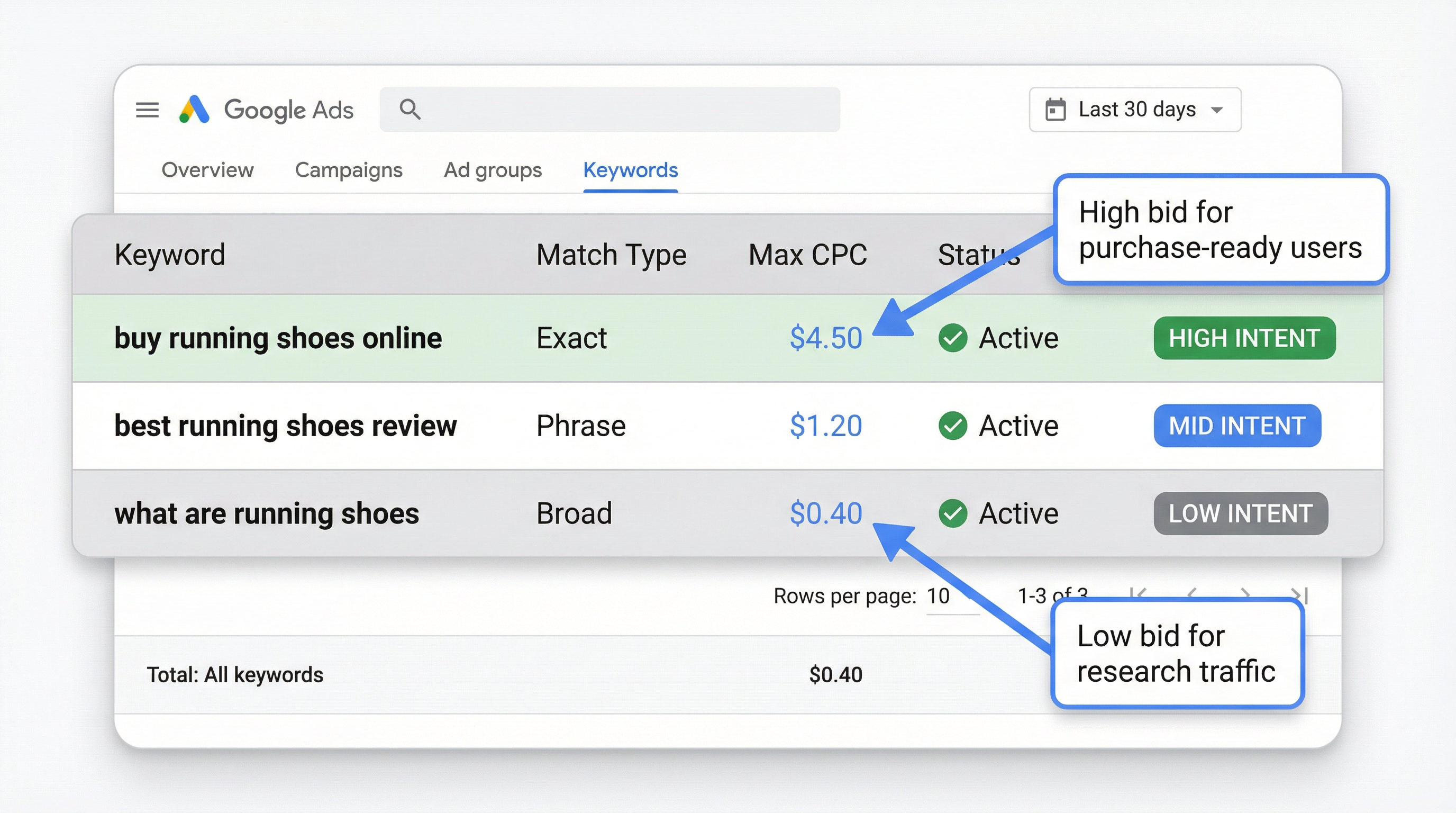
Consider a keyword like “buy running shoes online.” This is a high-intent, bottom-of-the-funnel search query. The user knows what they want, and they are ready to purchase.
Now consider a keyword like “what are the best running shoes for flat feet.” This signals curiosity and research. It is a top-of-the-funnel query. The user might be a future buyer, but they are probably not buying today.
These two keywords should not carry the same bid. But in a huge number of accounts using broad automated strategies, they effectively do.
The Power of Granular Control
With Manual CPC, you can set bids at the keyword level. High-intent, high-converting keywords get higher bids to ensure you capture top ad positions when users are ready to buy. Informational keywords get lower bids, allowing you to capture cheap traffic for remarketing later without blowing your primary acquisition budget.
The result? You are allocating your budget exactly where it is most likely to drive an actual outcome, instead of paying the same premium price for two completely different types of traffic. This one adjustment alone can meaningfully improve efficiency across a campaign, especially in highly competitive industries where average CPCs are steep.
4. Step-by-Step Implementation Guide: Setting Up Manual CPC
If you are ready to take back control of your campaigns, here is exactly how to implement Manual CPC bidding correctly.
Step 1: Selecting the Strategy
- Navigate to your Google Ads account and select the specific campaign you want to adjust.
- Click on Settings in the left-hand menu.
- Scroll down to the Bidding section and click to expand it.
- Click on Change bid strategy.
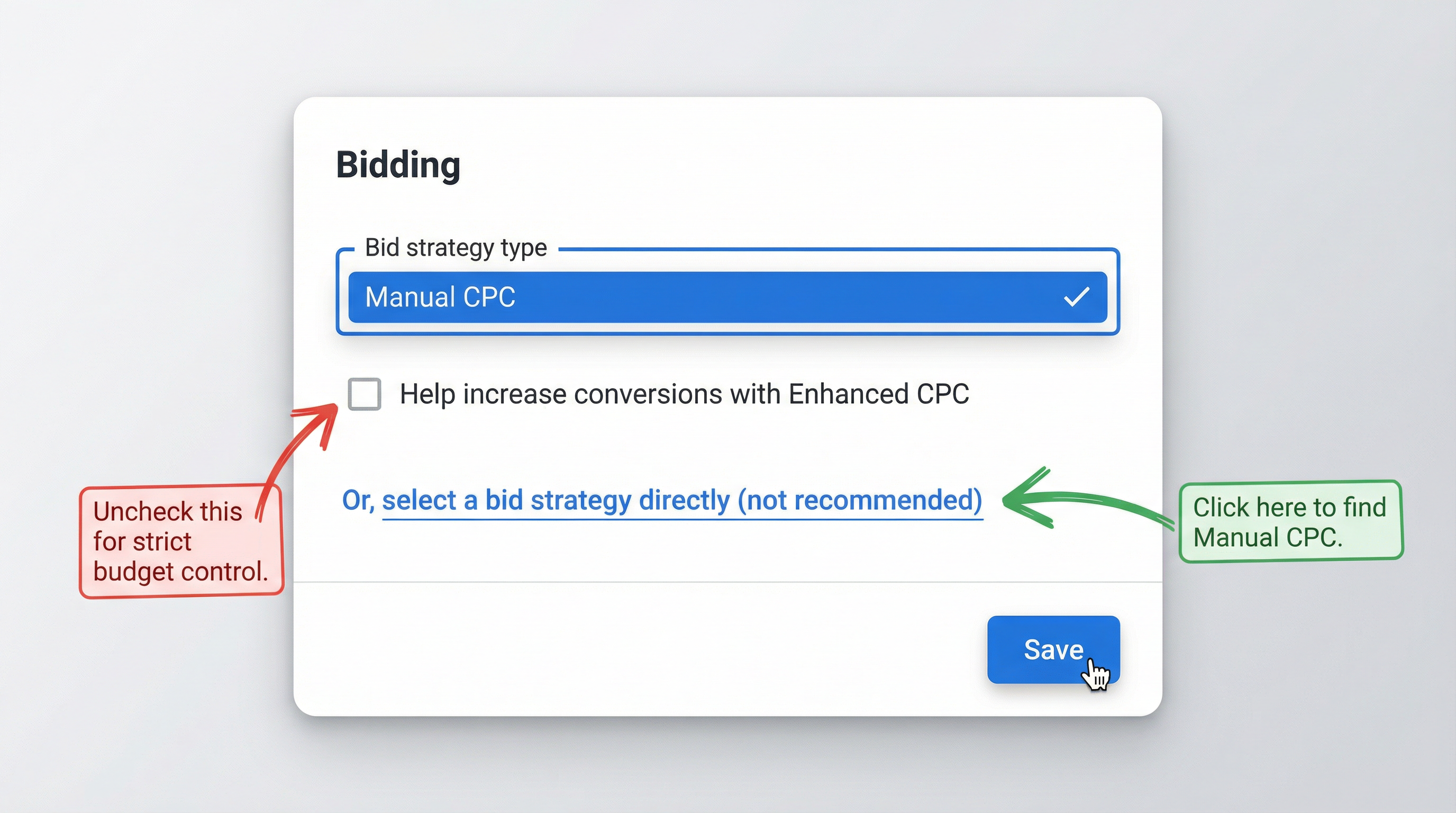
- Google will try to steer you toward an automated strategy. Ignore the main dropdown and look for the small blue text that says “Or, select a bid strategy directly (not recommended).” Click that link.
- From the new dropdown menu, select Manual CPC.
Step 2: The Enhanced CPC Decision
When you select Manual CPC, Google will automatically check a box labeled “Help increase conversions with Enhanced CPC.”
Enhanced CPC (eCPC) is a hybrid strategy. It allows you to set your manual bids, but it gives Google permission to raise or lower your bid at auction time if the algorithm believes a conversion is highly likely or unlikely.
Best Practice: If your goal is strict budget control or if the campaign is brand new, uncheck this box. Keep it strictly manual. If you have some conversion data and want to give the algorithm a little bit of flexibility while maintaining baseline control, leave it checked.
Step 3: Setting Keyword-Level Bids
- Navigate to the Keywords tab for your campaign.
- Ensure your columns are customized to show “Max. CPC.”
- Review your keywords based on intent. Select your high-intent, bottom-of-funnel keywords.
- Click the Edit button, select Change max. CPC bids, and increase the bids for these specific terms.
- Select your broader, top-of-funnel research keywords and lower their max CPC bids.
- Monitor the “Est. first page bid” and “Est. top of page bid” columns to ensure your bids are competitive enough to actually show.
5. Advanced Strategies: Bid Modifier Stacking
Once you have mastered keyword-level bidding, the next layer of control in a Manual CPC campaign comes from Bid Modifiers.
While Smart Bidding automatically adjusts bids based on user signals, Manual CPC requires you to set these adjustments yourself. This is where you can apply deep business intelligence to your campaigns.
Device Bid Adjustments
Are your mobile users browsing but not buying? Do desktop users convert at a 3x higher rate? With Manual CPC, you can apply a -50% bid adjustment to mobile devices and a +20% adjustment to desktop.
Location Bid Adjustments
If you know that users in New York generate a higher Lifetime Value (LTV) than users in Florida, you can increase your bids for New York specifically. You can get granular down to the zip code or radius around a specific address.
Ad Schedule (Dayparting) Adjustments
If your B2B software company only closes deals during business hours, you can use Manual CPC to bid aggressively from 9 AM to 5 PM, and decrease bids by 80% during evenings and weekends.
The Advanced Tactic: Stacking
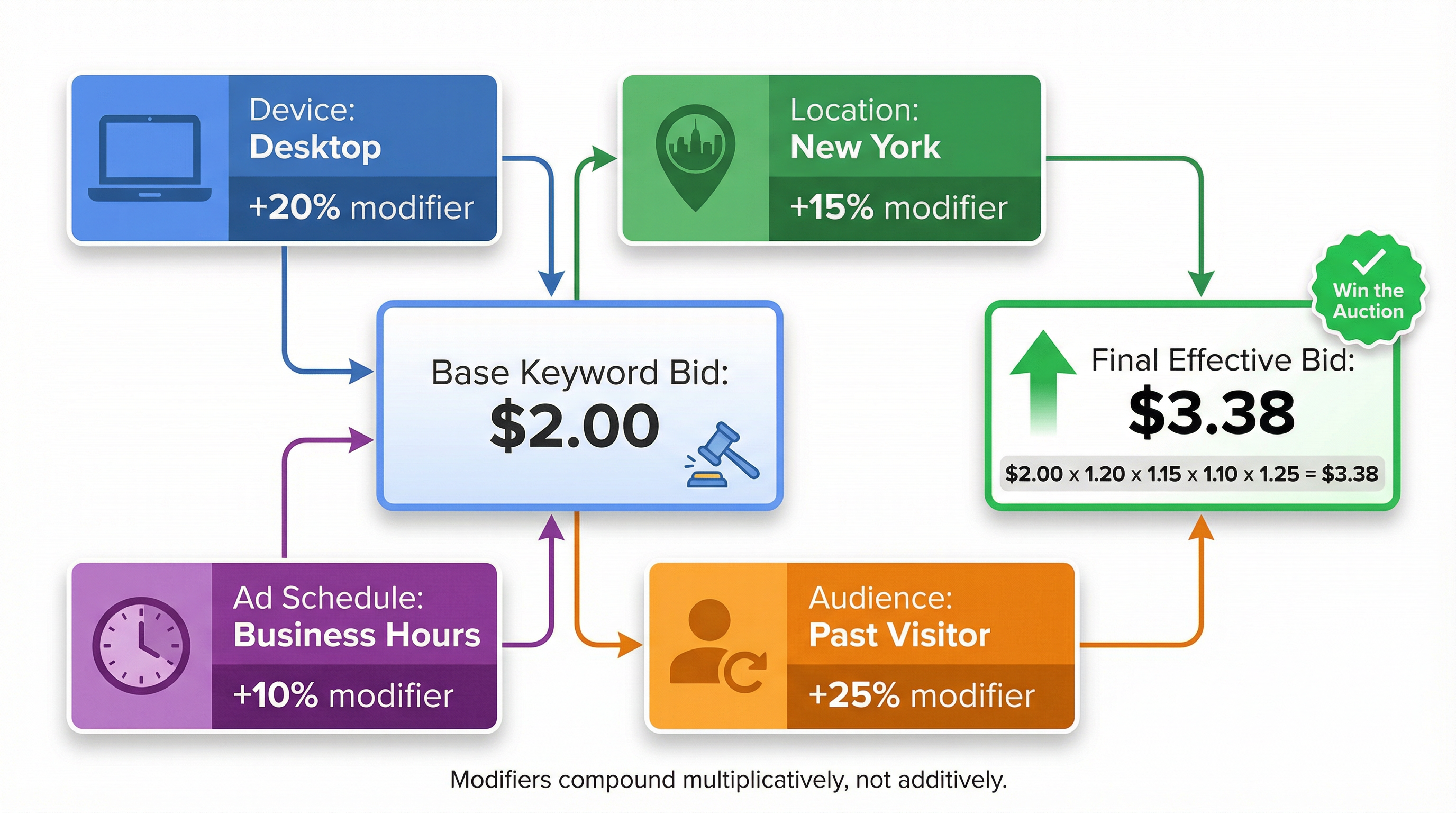
The true power of Manual CPC is stacking these modifiers. If a user searches your high-intent keyword (+20% base bid), on a desktop (+20% modifier), in New York (+15% modifier), during business hours (+10% modifier), your bid compounds to ensure you win that highly valuable auction. Conversely, if a user searches a low-intent keyword on mobile at 2 AM in a low-performing state, your bid adjustments stack negatively, saving you from wasting money on a low-probability click.
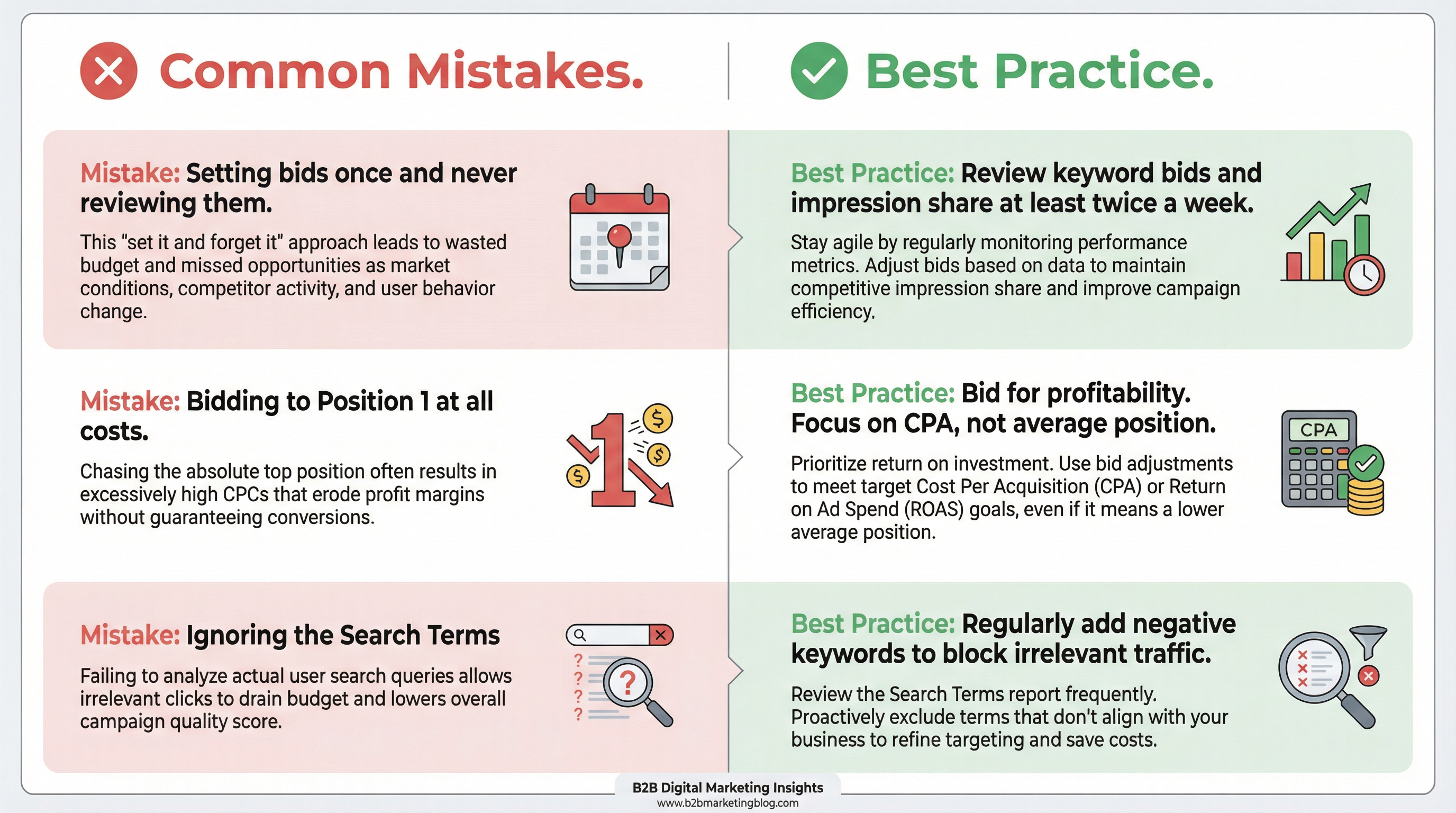
6. Common Mistakes to Avoid with Manual CPC
While Manual CPC offers incredible control, it also introduces the opportunity for human error. Avoid these common pitfalls:
Mistake 1: “Set It and Forget It”
Manual CPC is not a passive strategy. It requires active management. Search volume fluctuates, competitors change their bids, and market dynamics shift. If you set your manual bids on day one and do not look at them for a month, your performance will slowly degrade.
Best Practice: Review your keyword bids and search impression share metrics at least twice a week.
Mistake 2: Bidding to Position 1 at All Costs
It is a common ego trap to want your ad to be the absolute first result every single time. But Position 1 is expensive. Often, Position 2 or 3 will yield a significantly better Return on Ad Spend (ROAS) because the CPC is much lower, even if the click-through rate is slightly reduced.
Best Practice: Bid for profitability, not for ego. Focus on Cost Per Acquisition (CPA), not Average Position.
Mistake 3: Ignoring the Search Terms Report
Setting a manual bid on a Broad Match or Phrase Match keyword does not mean you know exactly what you are paying for. You must regularly review the Search Terms report to see the actual queries triggering your ads.
Best Practice: Aggressively add negative keywords to ensure your manual bids are only being applied to relevant traffic.
7. The Transition: When to Move On From Manual CPC
Manual CPC is not forever. It is a tool designed for a specific job: building a foundation of data with strict financial control.
The time investment required to manage a Manual CPC campaign effectively is worth it during the early stages, but at a certain point, it becomes inefficient. Once you have built up solid conversion data, transitioning to Smart Bidding is usually the right move.
The Threshold for Transition
Google states that Smart Bidding needs a minimum of 15 conversions in the last 30 days to function. In reality, that is far too low. To ensure a smooth transition without wild volatility, you should aim for at least 30 to 50 conversions in a 30-day period.
Once you hit this threshold, the algorithm has enough historical data to understand who your buyers are. It can now leverage auction-time signals (like the user’s specific browser, precise location, and past search history) that you simply cannot account for with manual bid modifiers.
How to Transition Safely
Do not just flip the switch from Manual CPC to Target CPA. Use Google’s Drafts and Experiments feature.
Set up an experiment where 50% of your traffic remains on Manual CPC, and 50% is routed to a Target CPA strategy. Let the experiment run for at least 3-4 weeks (ignoring the first week of learning phase volatility). If the Smart Bidding arm of the experiment produces a lower CPA or higher conversion volume, you can confidently apply the change to the entire campaign.
Manual CPC is not a step backward. It is a deliberate, strategic choice that gives you control when the algorithm does not yet have what it needs to work properly. Knowing when to hold the reins and when to hand them over is what separates average media buyers from elite marketers.
8. Beyond the Basics: Structuring Campaigns for Manual CPC Success
If you are committed to running Manual CPC, your campaign structure must support it. A poorly structured campaign makes keyword-level bidding chaotic and impossible to manage.
To maximize the effectiveness of Manual CPC, you need a structure that isolates variables. This is where Single Keyword Ad Groups (SKAGs) or Single Theme Ad Groups (STAGs) become highly relevant.
The Single Theme Ad Group (STAG) Approach
Instead of dumping 50 loosely related keywords into one ad group, break them down into highly specific themes.
For example, if you sell office furniture, do not put “buy ergonomic chair,” “cheap desk,” and “office filing cabinet” in the same ad group. Create one ad group for “Ergonomic Chairs,” another for “Desks,” and another for “Filing Cabinets.”
Why does this matter for Manual CPC? Because when you set your keyword bids, you want the ad copy and the landing page to perfectly match the user’s intent. If you are bidding aggressively on “buy ergonomic chair,” you want to ensure the ad explicitly mentions ergonomic chairs and links directly to that product page. STAGs allow you to align your manual bids with hyper-relevant ad copy, significantly increasing your Quality Score and lowering your actual CPC.
Isolating Match Types
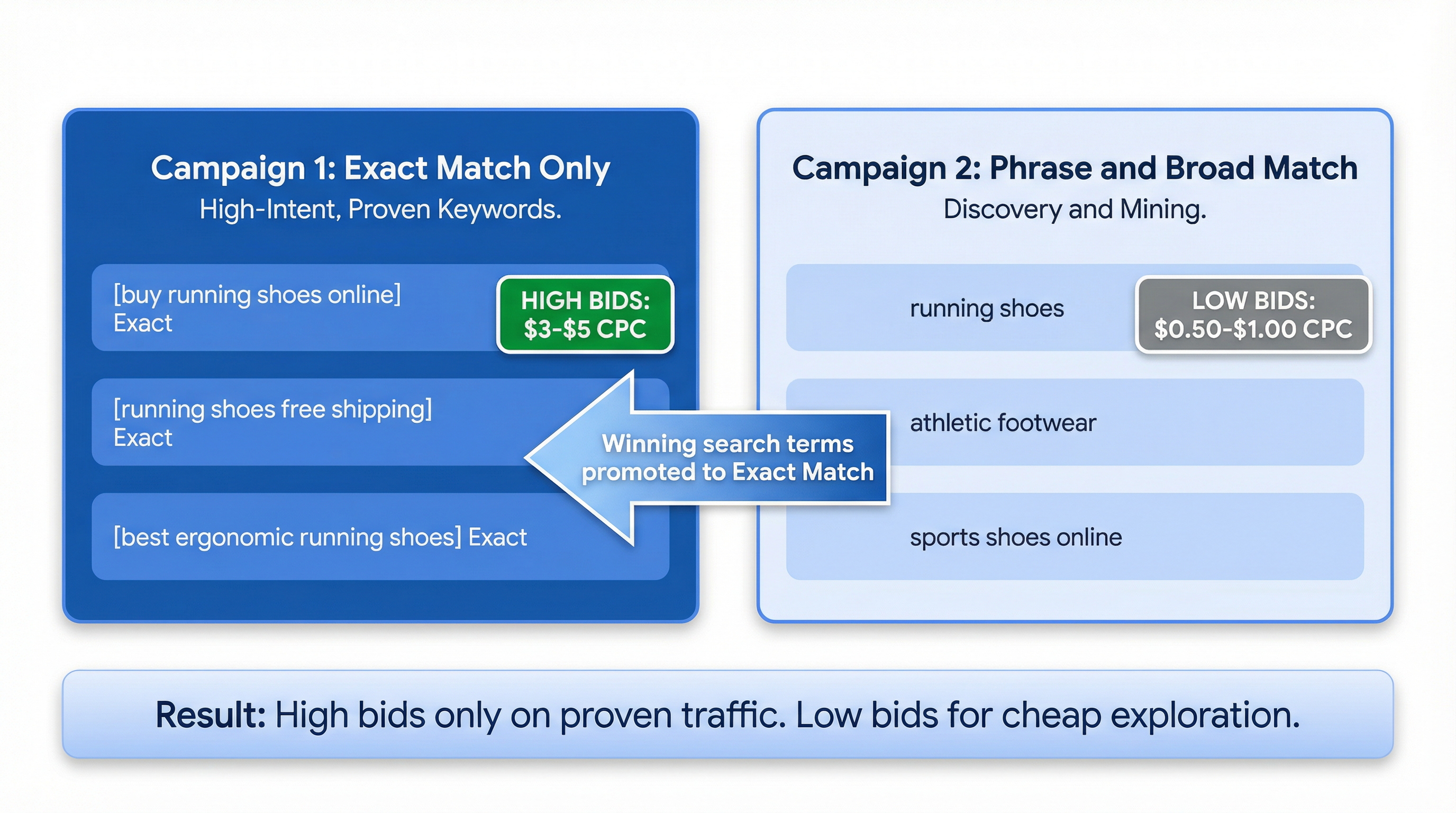
For advanced Manual CPC management, consider isolating match types. Create one campaign (or ad group) strictly for Exact Match keywords, and another for Phrase or Broad Match keywords.
Since Exact Match keywords have the highest intent and the most predictable conversion rates, you can set aggressive manual bids on them. The Phrase/Broad Match campaign acts as a “mining” campaign to discover new search terms. You set much lower manual bids on the broad campaign to acquire cheap research traffic, and when you find a winning search term, you add it as an Exact Match keyword in your primary campaign and bid up.
This structural separation ensures that your high bids are only spent on proven, high-intent traffic, while your low bids are used for inexpensive exploration.
9. Measuring the True Impact of Manual CPC
When you switch from Smart Bidding to Manual CPC, you must adjust how you measure success. The metrics that matter most will shift.
Focus on Impression Share
When you are manually controlling bids, your primary diagnostic metric is Search Impression Share. This tells you what percentage of available auctions your ads are actually appearing in.
If your Search Impression Share is 20%, and you are losing 60% due to ad rank (Search Lost IS (rank)), it means your manual bids are too low to compete in those auctions. If your CPA is currently profitable, this is a clear signal that you have room to increase your manual bids and capture more volume.
Conversely, if your Search Impression Share is 90%, you are effectively maxed out on volume for those keywords. Increasing your bids further will likely just increase your CPC without driving significantly more clicks.
The ROAS vs. CPA Debate
While Target CPA is a common Smart Bidding goal, Manual CPC allows you to focus deeply on Return on Ad Spend (ROAS) at a granular level.
By analyzing the conversion value of individual keywords, you can adjust your manual bids to optimize for revenue, not just lead volume. If Keyword A drives 10 conversions at $50 each, and Keyword B drives 2 conversions at $500 each, a Smart Bidding algorithm focused on CPA might prioritize Keyword A. With Manual CPC, you can aggressively bid up Keyword B to maximize your total revenue.
Conclusion: The Strategic Value of Control
The digital advertising landscape has evolved, and automation is undoubtedly the future. But the future is not a one-size-fits-all solution. Success in Google Ads requires a deep understanding of when to leverage the machine, and when to take the wheel yourself.
Manual CPC bidding is not an outdated relic of the past. It is a precision instrument. It allows you to gather intelligence, protect tight budgets, prioritize high-intent keywords, and ultimately, spend your advertising dollars with surgical accuracy. It is the difference between hoping the algorithm figures it out, and engineering a profitable outcome yourself.
Start by auditing your newest campaigns or those with highly constrained budgets. Switch them to Manual CPC, adjust your bids based on keyword intent, and watch the efficiency improve. The results—in the form of lower CPAs and a more predictable flow of leads—will speak for themselves.
Need Expert Help Managing Your Bidding Strategy?
If you are unsure whether your current campaigns should be running on Manual CPC or Smart Bidding, or if you suspect you are bleeding budget due to a lack of granular control, professional guidance can make all the difference.
Managing keyword-level bids, structuring STAGs, and executing safe transitions to automated bidding requires technical expertise and a deep understanding of the Google Ads ecosystem.
I offer comprehensive Google Ads Management Services designed to audit your current setup, identify wasted spend, and implement the exact bidding strategies needed to drive measurable improvements in your CPA and ROAS.
Stop letting the algorithm guess with your budget. Let’s build a strategy that puts you back in control.
👉 Contact Me for a Free Google Ads Audit and Strategy
ttps://www.upwork.com/freelancers/nazdiocampoaimarketing
