


Why Your Insurance Google Ads Are Stalling (And How to Fix Your Setup)
April 8, 2026
Will AI Replace Google Ads Managers? The Uncomfortable Truth After 8 Years in the Trenches
April 10, 2026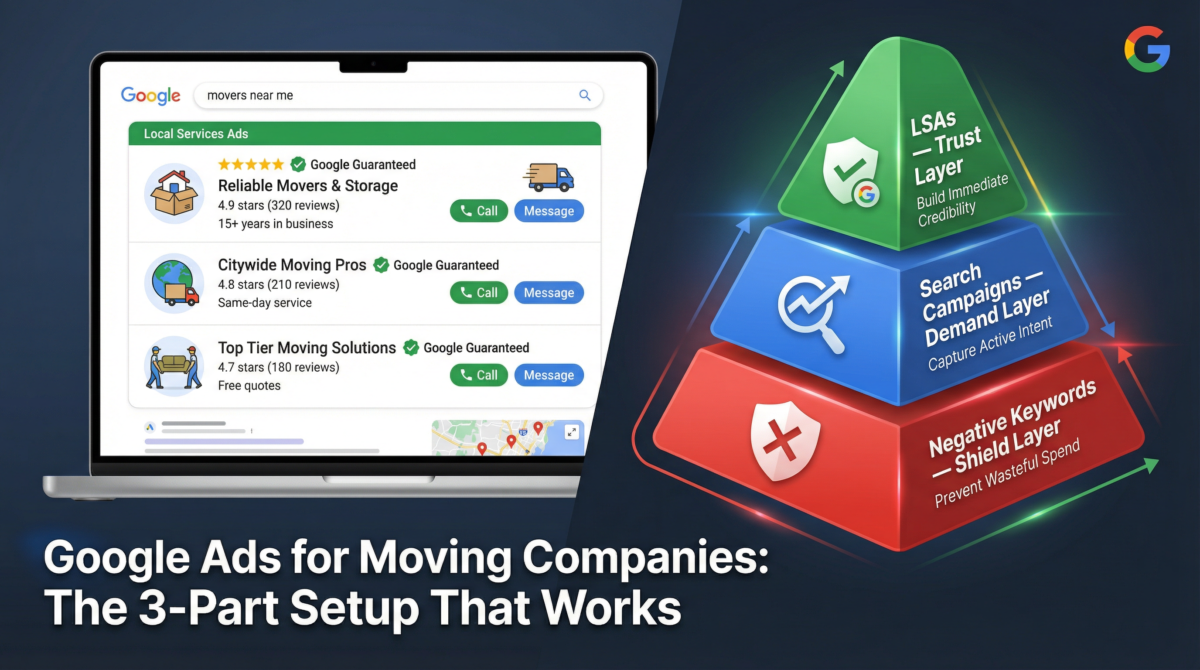
I talk to moving company owners regularly who are completely fed up with Google Ads. They’ve spent thousands of dollars. They’ve hired agencies. They’ve tried running campaigns themselves. And at the end of the month, they look at their dashboard, see a massive credit card charge, and realize they only booked two jobs from it.
When this happens, the reaction is almost always the same: “Google Ads just doesn’t work for movers in my city. The market is too saturated.”
Here is the truth: It is almost never the market, and it is almost never the budget. It is the setup.
After managing Google Ads for service businesses for over eight years, I see the exact same mistakes repeated across the moving industry. Companies jump into the platform, throw a daily budget at a handful of generic keywords, and then wonder why their phones aren’t ringing.
Google Ads works incredibly well for moving companies. In fact, it is arguably the highest-converting marketing channel available to local movers today—but only when it is built correctly.
The most successful moving companies aren’t necessarily spending more than you. They just have a smarter system. Today, I’m going to walk you through the exact three-part Google Ads setup that actually produces predictable, high-quality moving leads.
The Fatal Flaw: Running a One-Legged Race
Before we look at the winning setup, we need to address why most campaigns fail. The vast majority of moving companies are running incomplete systems.
They either run Local Services Ads (LSAs) and ignore standard Search campaigns, or they run Search campaigns but completely neglect their negative keywords.
Running Google Ads like this is like trying to win a race with one leg. Each piece of the Google Ads ecosystem serves a very specific, distinct function. When one piece is missing, the entire machine underperforms. You end up paying a premium for low-quality traffic while your competitors scoop up the people who are actually ready to book a move.
To dominate your local market, you need a layered approach. Let’s break down the three layers of a winning setup.
Layer 1: Local Services Ads (The Trust Layer)
If your moving company is not currently running Local Services Ads, you are actively giving up the most valuable real estate on the internet.
Why LSAs Are Non-Negotiable
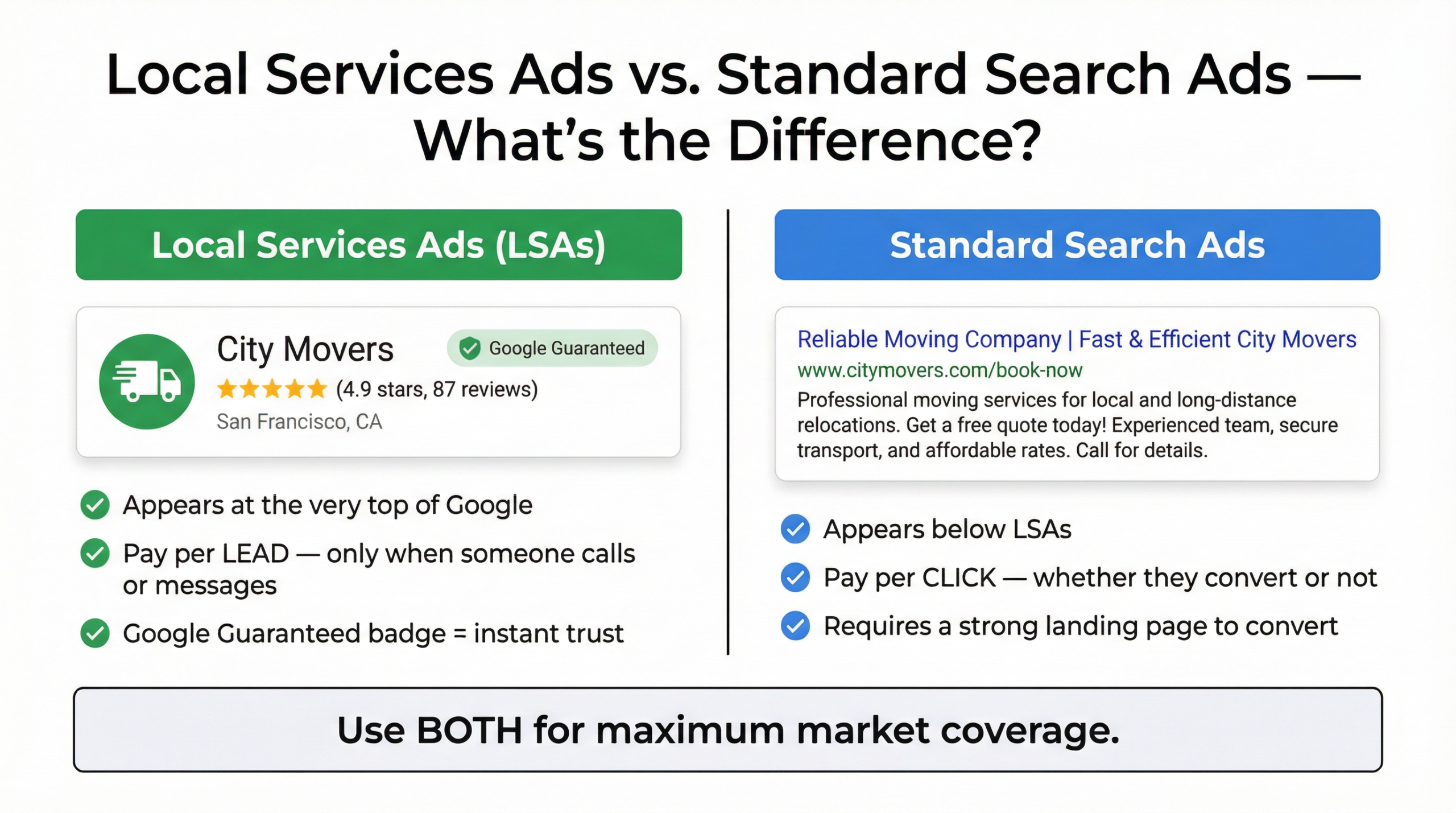
Local Services Ads appear at the absolute top of the Google search results page. They sit above the organic map pack, and more importantly, they sit above the standard text ads.
When someone searches for “movers near me,” the first thing they see is a row of businesses featuring a green “Google Guaranteed” badge. That badge is a massive trust signal. It tells the consumer that Google has verified your business, checked your background, and confirmed your insurance. In an industry where trust is everything—people are literally trusting you with everything they own—that badge changes the conversation before you even pick up the phone.
The Pay-Per-Lead Advantage
The other reason LSAs are a no-brainer for movers? The payment model is completely different.
With traditional Google Ads, you pay every time someone clicks on your ad. If they click your ad, spend three seconds on your website, and leave, you still pay $15.
With Local Services Ads, you pay per lead. You are only charged when a potential customer actually calls your business or sends you a direct message through the platform. You aren’t paying for window shoppers; you are paying for actual conversations. Furthermore, if you get a spam call or someone trying to sell you SEO services, you can dispute the lead with Google and get your money refunded.
Getting set up requires some paperwork—you have to pass a background check and provide proof of insurance—but the payoff is a steady stream of high-intent, low-risk leads.
Layer 2: High-Intent Search Campaigns (The Demand Layer)
Local Services Ads are powerful, but they do not cover the entire search landscape. They are limited by geography and specific search terms. To capture the rest of the market, you need traditional Search campaigns.
Capturing Active Demand
Search campaigns are your traditional text ads. These are the ads that trigger when someone types specific phrases into Google.
The key to making Search campaigns profitable for moving companies comes down to one word: Intent.
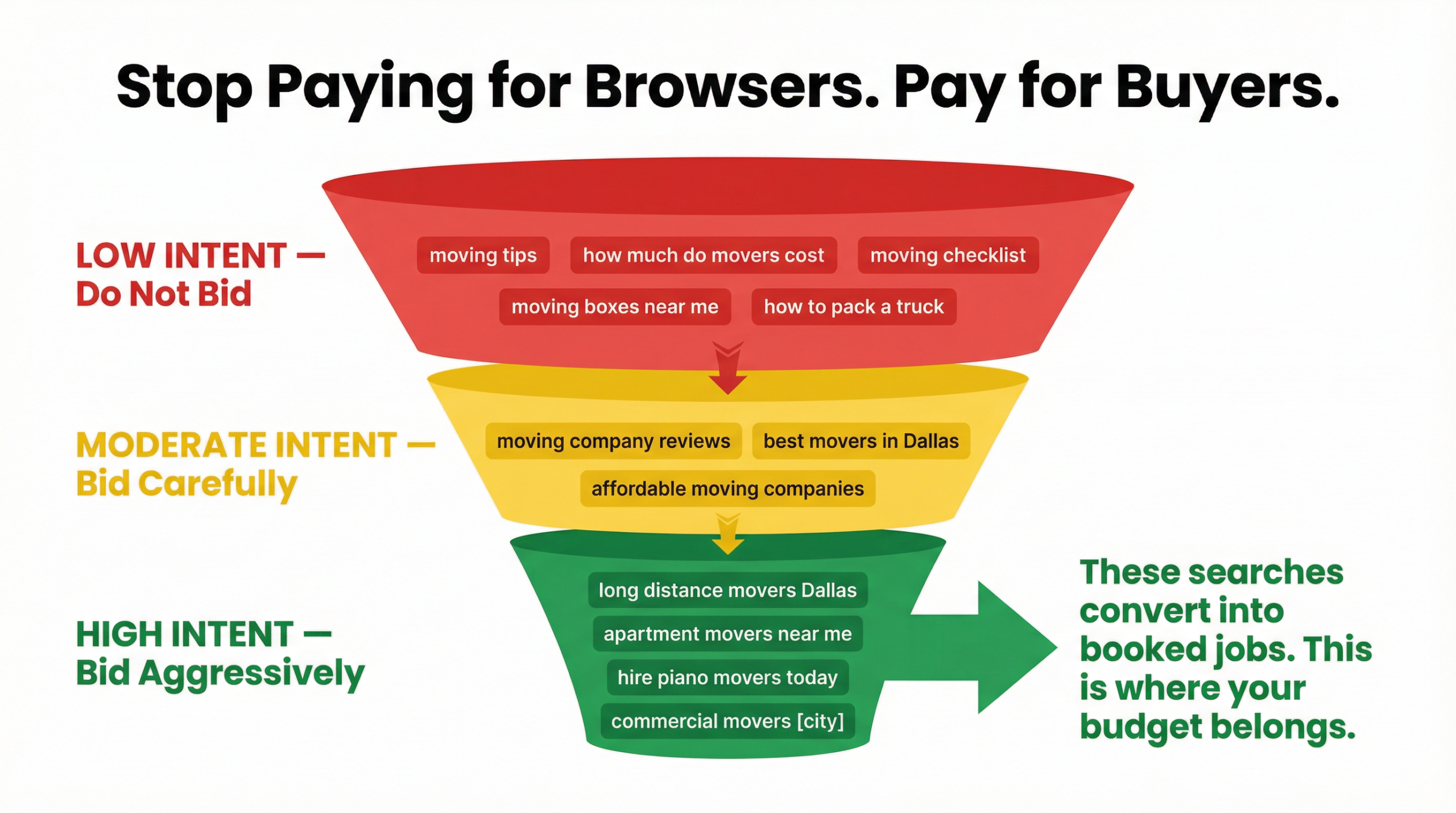
You do not want to pay for people who are researching moving. You want to pay for people who are ready to hire a mover right now. That is the kind of traffic that converts into booked jobs.
Structuring for Profitability
The biggest mistake movers make here is using broad, generic keywords like “moving” or “movers.” Those keywords are too vague. Someone searching for “movers” might be looking for a job as a mover, or they might be looking for a movie about movers.
Instead, your campaigns need to be hyper-focused on location and specific services. You should be bidding on exact match and phrase match keywords like:
"long distance movers [your city]""apartment movers near me""commercial moving company [your city]""piano movers [your city]"
By structuring your campaigns around specific services and locations, you can write ad copy that perfectly matches what the user is looking for. If someone searches for “long distance movers Dallas,” your ad headline shouldn’t just say “Joe’s Moving Company.” It should say “Top-Rated Long Distance Movers in Dallas.” That relevance drives up your click-through rate and drives down your cost per lead.
Layer 3: Aggressive Negative Keywords (The Shield Layer)
This is the layer that almost everyone skips, and it is the exact reason why so many moving companies bleed cash on Google Ads.
The Silent Budget Killer
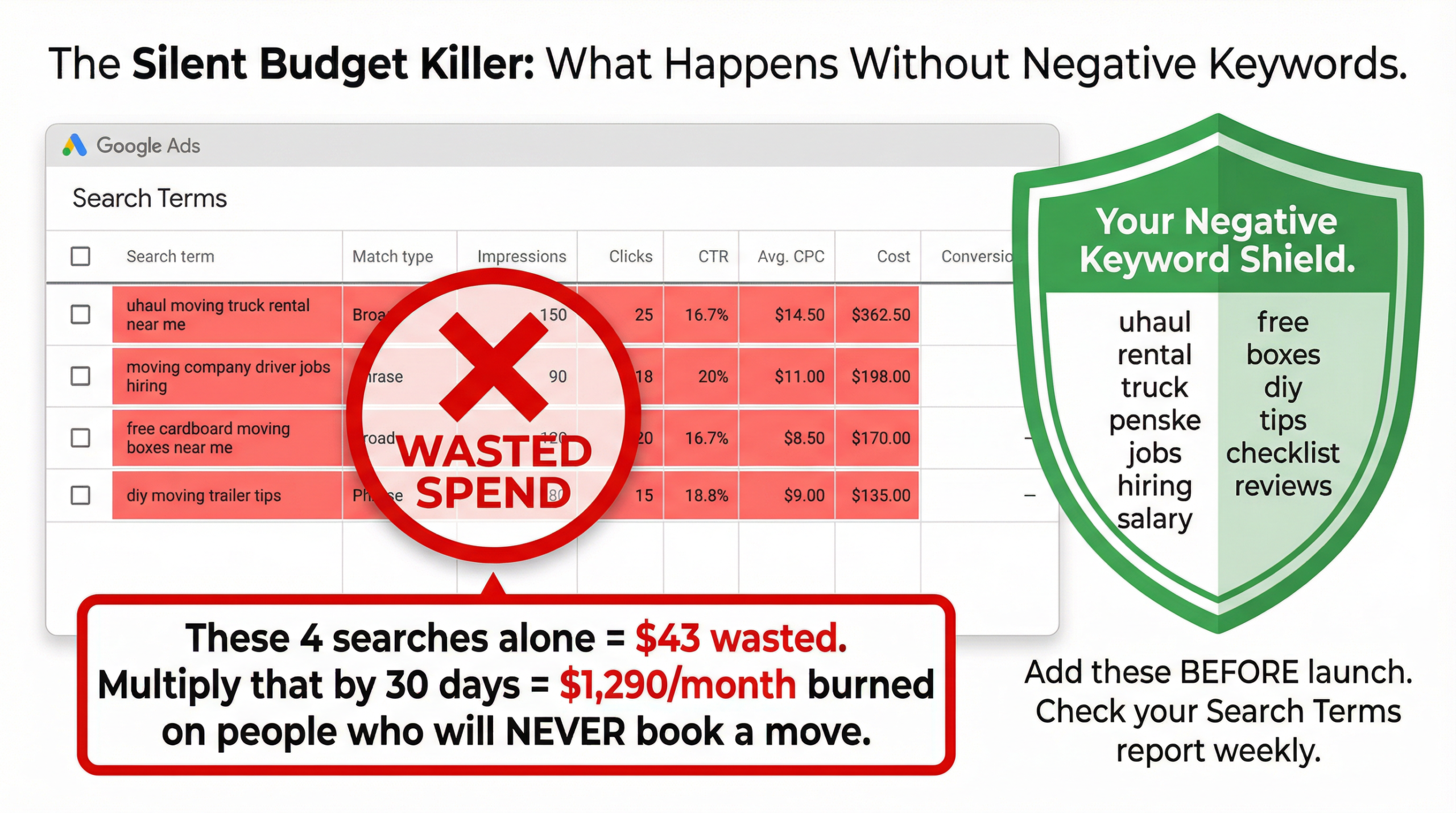
When you run Search campaigns, Google’s algorithm will try to show your ads to as many people as possible. If you don’t explicitly tell Google what not to show your ads for, they will show your ads for searches that are loosely related to your keywords but have absolutely zero commercial intent.
Without a negative keyword list, your $20 clicks will be wasted on searches like:
- “U-Haul moving truck rental”
- “DIY moving tips”
- “free moving boxes near me”
- “moving company jobs”
- “how much should I tip my movers”
Every single time someone clicks your ad after searching for “moving truck rental,” you lose money. They are looking to do it themselves. They will never, ever book your full-service moving company.
Building the Shield
Adding negative keywords is how you build a shield around your budget. It tells Google, “If a user’s search contains any of these words, do not show my ad under any circumstances.”
Before you even launch your campaign, you should have a robust list of negative keywords applied. Start with the obvious categories:
- DIY/Rental terms: uhaul, rental, truck, trailer, penske, budget, diy
- Employment terms: jobs, hiring, career, salary, resume, driver jobs
- Cheap/Free terms: free, cheap, boxes, supplies, cardboard
It is not glamorous work, but aggressively managing your negative keyword list and checking your Search Terms report every week is the fastest way to tighten up a campaign and force every dollar you spend toward actual, paying customers.
The Winning Stack: Putting It All Together
The moving companies that are dominating their local markets and scaling their fleets aren’t using secret Google hacks. They are just executing the fundamentals better than you are.
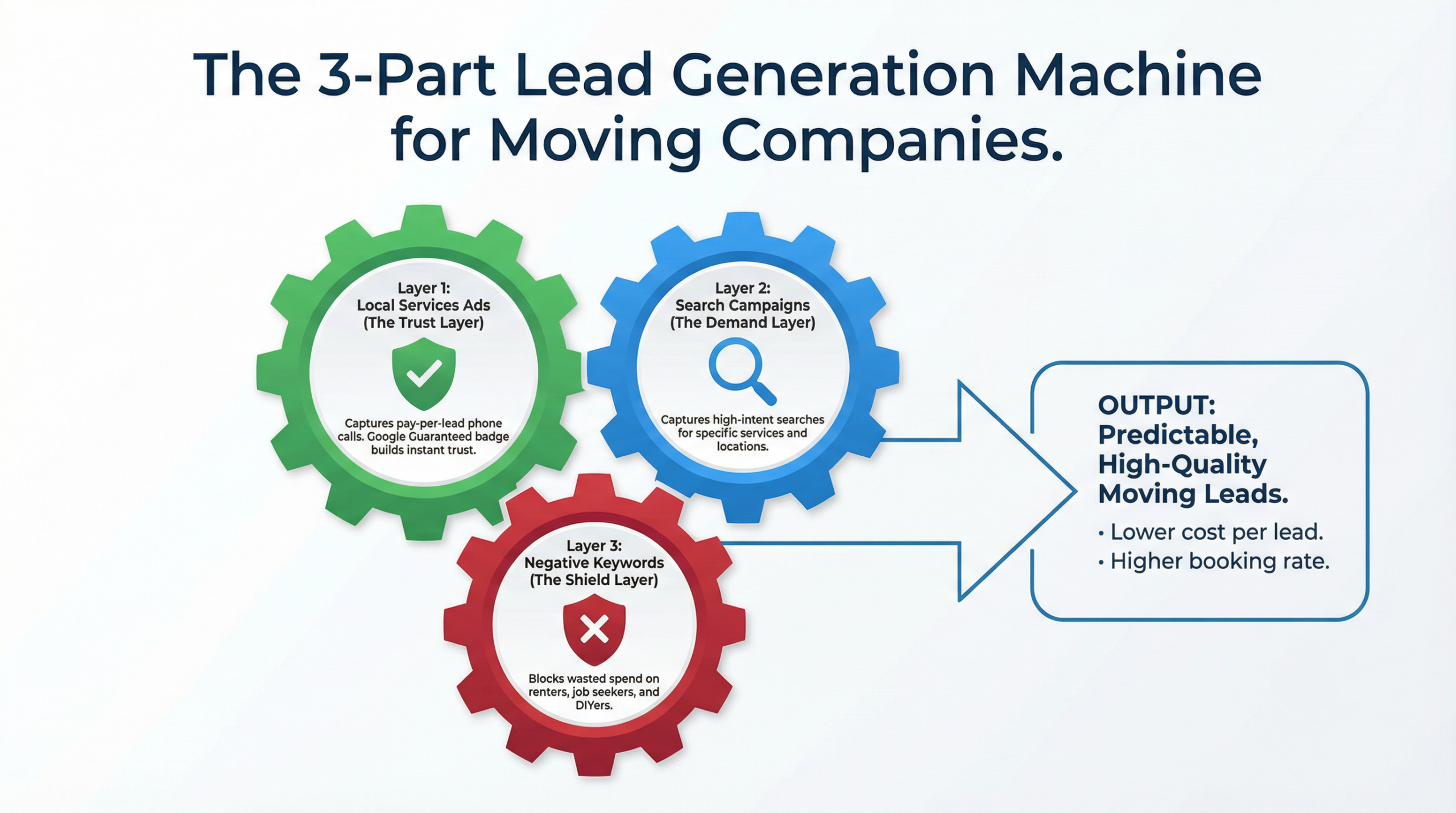
They use Local Services Ads to establish immediate trust at the top of the page and capture pay-per-lead phone calls.
They use Search campaigns to capture active, high-intent demand for specific services like long-distance or commercial moves.
They use Negative Keywords as a shield to ensure that their budget is never wasted on DIYers, job seekers, or people looking for free boxes.
When you put all three of these layers together, you no longer have a disjointed ad campaign. You have a comprehensive, highly efficient lead generation system.
What Is Your Biggest Google Ads Challenge?
Whether you are struggling with a limited budget, a messy campaign setup, or leads that just won’t convert—I want to hear where you are stuck. The moving industry is tough, but your marketing doesn’t have to be a black hole for your cash.
If you are tired of trying to figure this out on your own and you would rather have an expert handle the entire setup for you, I can help.
I offer free, no-obligation Google Ads audits specifically for moving and service-based businesses. I will look under the hood of your current account, identify exactly where your budget is leaking, and give you a clear, actionable roadmap of what needs to change to get your phone ringing.
👉 Book your free Google Ads audit here
(Looking to track those new leads? Check out our guide on How to Set Up Google Ads Conversion Tracking for Service Businesses.)
Naz Diocampo is a Google-certified ads strategist and the founder of Web Solutions PH, specializing in Google Ads management for service-based businesses.

2 Comments
I enjoyed this article. The step-by-step setup makes a lot of sense, especially for service businesses like moving companies where lead quality matters more than just getting clicks. This gives a much clearer direction than generic ad advice.
Hi Jayla, thank you. I’m glad you found it helpful. For moving companies, getting the right leads is much more important than simply driving traffic. A proper setup can make campaigns more efficient and improve lead quality from the start.