

Google Ads Minimum Budget: What You Really Need to Start
May 6, 2026
I get this question a lot — usually from service business owners who’ve been told they need a website before they can do any kind of digital marketing.
It’s one of the most common reasons people delay running Google Ads. They figure they need to spend $3,000 on a custom site first, then maybe in six months they’ll think about advertising.
Here’s the thing — that’s not always true. And in some cases, it’s flat-out wrong.
The Short Answer
You don’t always need a website to run Google Ads. But you do need a verifiable online presence — and those aren’t the same thing.
Let me walk you through it.
When You Actually Need a Website
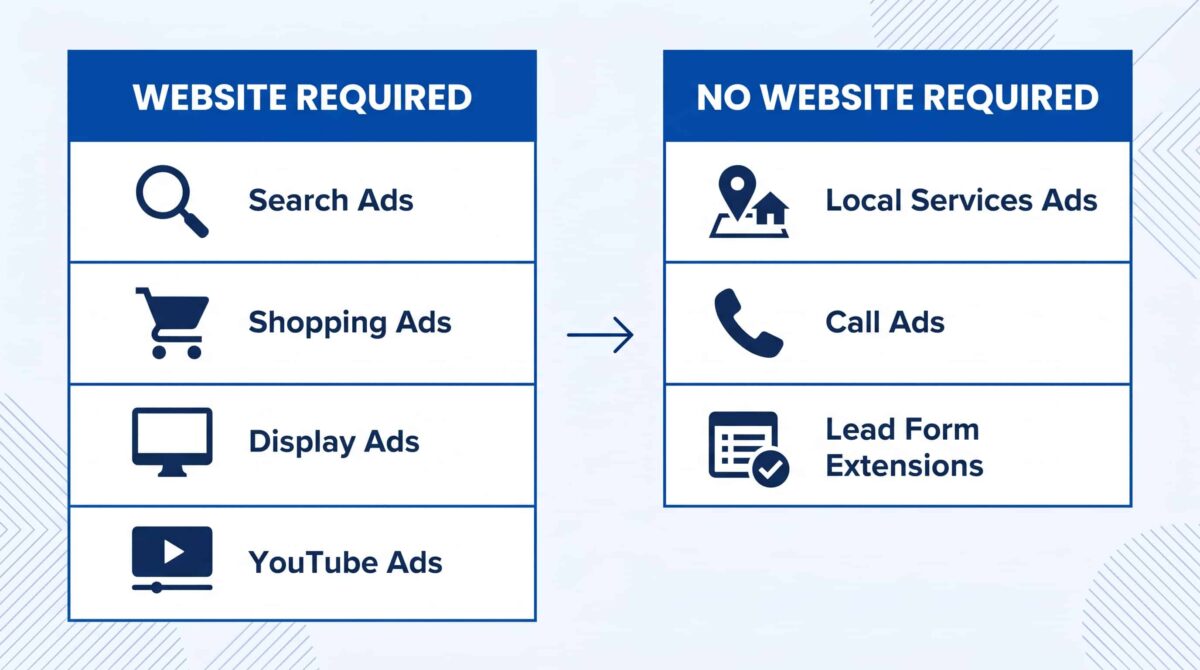
If you want to run any of these campaign types, yes, a functional website is essentially non-negotiable:
- Search ads (the text ads at the top of Google search results)
- Shopping ads (those product cards with images and prices)
- Display ads (banner ads across websites)
- YouTube ads (video ads on YouTube)
Why? Because Google’s algorithm needs a destination URL it can crawl, verify, and assess for quality. The landing page experience is part of your Quality Score, and Quality Score affects how much you pay per click. No landing page, no campaign — it’s that simple for these formats.
The Service Business Loophole
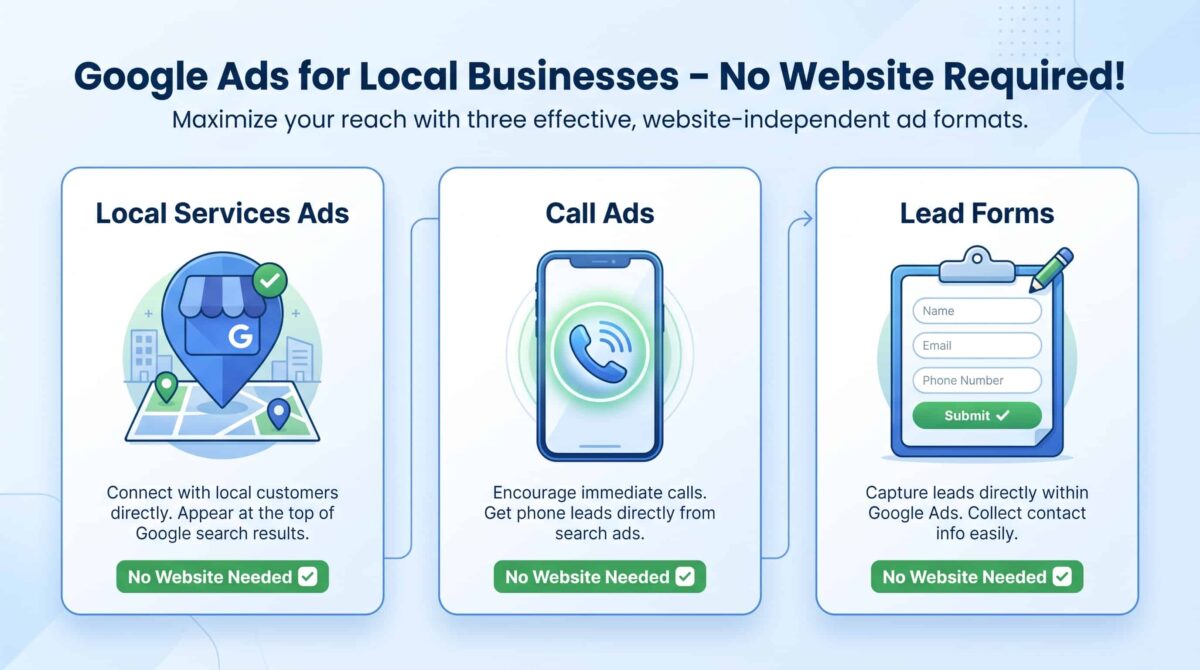
If you’re a service-based business — a plumber, electrician, lawyer, cleaner, HVAC tech, locksmith, anything in that category — there are three ad types that don’t require a traditional website.
1. Local Services Ads (LSAs)
LSAs are designed specifically for local service providers. In many cases, a verified Google Business Profile is enough to get started. You’ll need to pass Google’s screening process (background check, license verification, insurance verification depending on your industry), but once you’re approved, your ad shows up at the very top of search results — above even the regular text ads.
The kicker? You only pay for actual leads, not clicks. That’s a different pricing model entirely from standard Google Ads.
2. Call Ads
Call Ads are mobile-first ads where the entire point is to drive phone calls. Your ad displays your business phone number prominently. Users tap the ad and it dials your business directly. No landing page involved.
You still need a verifiable URL for Google to confirm your business is legitimate, but in many cases that “URL” can be your Google Business Profile or a basic single-page setup. The ad itself doesn’t send traffic anywhere — it generates calls.
3. Lead Form Extensions
Lead Forms let people submit their name, email, and phone number directly inside the ad. They never leave Google’s environment. You get the lead, they get an answer or callback, and there’s no website involved in the process.
This is especially powerful for service businesses where the goal is just “get this person on a call with me.” You don’t need a flashy site to do that — you need a working phone and someone who answers it.
The Catch Nobody Talks About
Here’s where most “you don’t need a website” advice falls apart. Even if you skip the website, Google still needs trust signals.
Specifically:
- A verified Google Business Profile
- A real, consistent business phone number
- Consistent NAP (Name, Address, Phone) information across the web
- A legitimate, traceable business entity
If your business can’t be verified properly, getting ads approved becomes a constant battle. Disapprovals, suspensions, and verification holds become the norm.
Google doesn’t just care about whether you have a website. It cares about whether your business is real and trustworthy. A website is one signal of that, but it’s not the only one.
So When Should You Build a Website Anyway?
Even if you can technically run ads without one, a basic website becomes valuable as you scale. It opens up:
- Search and Display ads (broader reach)
- Remarketing audiences (re-engaging people who showed interest)
- Conversion tracking and analytics (better optimization data)
- Trust and credibility (people often Google a business before calling)
You don’t need a $5,000 custom build. A clean, single-page site with your services, phone number, contact form, and a few testimonials is enough to unlock significantly more of Google Ads’ capabilities.
Final Thought
If you’re a service business holding off on Google Ads because you “don’t have a website yet,” stop waiting. There’s a real chance you can launch Local Services Ads, Call Ads, or Lead Form campaigns this week using your Google Business Profile.
But long-term, a basic website is one of the highest-ROI investments you’ll make in your business.
A website isn’t always required. But a verifiable online presence absolutely is.

4 Comments
This was a very helpful explanation. A lot of business owners assume they must have a full website before running Google Ads, so I like that this article gives a more practical answer and explains the situations where that may or may not be true.
Hi Dennis, thank you for your comment. I’m glad you found the article helpful. That was exactly the goal of the post. Many advertisers think a full website is always required, but the right setup really depends on the campaign goal, the platform, and how strong the landing experience is.
A lot of small service businesses get stuck thinking they need a full custom website before they can even test Google Ads, so this was a helpful clarification. The point about needing a verifiable online presence instead of immediately investing thousands into a site is especially relevant for local businesses trying to validate demand first. It’d also be interesting to hear your thoughts on how Google Business Profiles compare against simple landing pages for lead quality.
Hi Daniel, thank you for your thoughtful comment. I’m glad the article helped clarify that point. A lot of businesses delay testing because they assume they need a full website right away, when in many cases a strong and credible landing page can already be enough to start. As for Google Business Profiles versus simple landing pages, both can play an important role, but landing pages usually give you more control over messaging, tracking, and conversion flow.