

The Silent Killer of Facebook Ad Budgets: Why Your Account Structure Is Sabotaging Your Results
April 11, 2026
The Silent Revenue Killer: Why Your Facebook Retargeting Strategy Is Leaking Money
April 14, 2026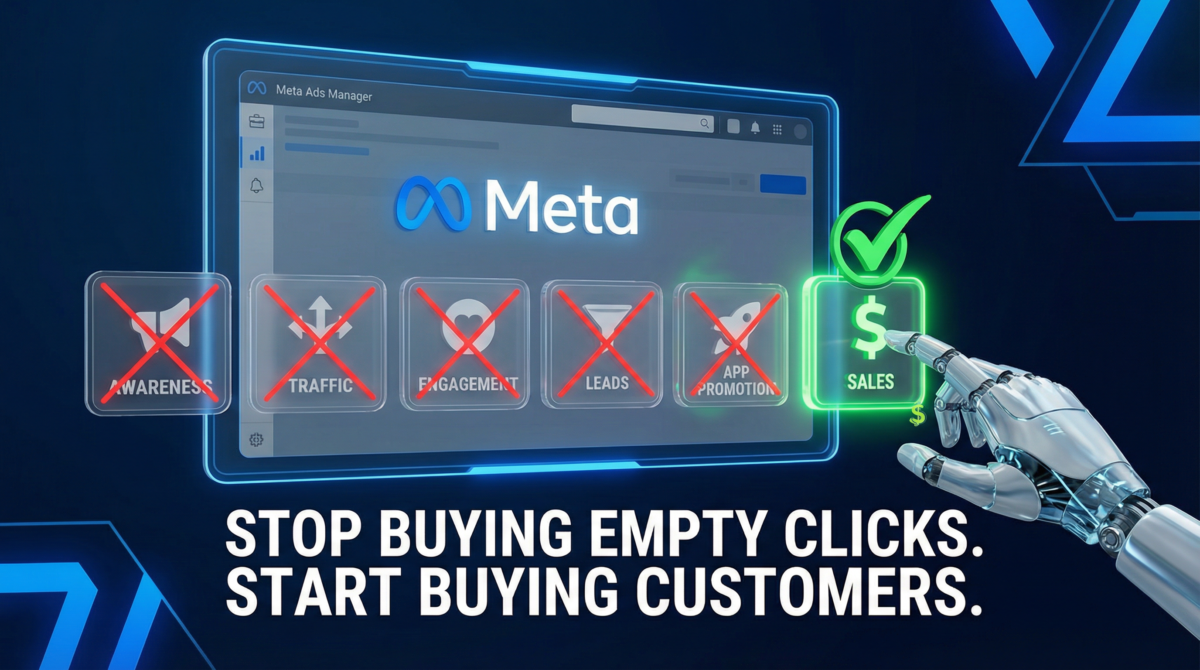
I recently audited an e-commerce account for a business owner who was on the verge of giving up on Facebook Ads entirely.
He had spent just over $5,000 in a single month. His ads looked incredible—high-production video, sharp copywriting, and irresistible offers. His dashboard showed over 15,000 link clicks. By all traditional vanity metrics, the campaign was a roaring success.
There was just one massive, glaring problem: He had generated exactly zero sales.
Not one.
When I looked under the hood, the issue took me exactly four seconds to diagnose. He hadn’t messed up his audience targeting. His creative wasn’t the issue. His website was converting organic traffic just fine.
He had simply chosen the “Traffic” objective instead of the “Sales” objective.
He thought he was telling Meta, “Send me people who will buy my product.”
Meta heard, “Send me people who will click a link, regardless of what they do afterward.”
Meta did exactly what he asked. It found 15,000 of the cheapest, most click-happy users on the internet and sent them to his store, where they immediately bounced. That single dropdown menu selection cost him $5,000.
Here is the uncomfortable truth about Facebook Ads that most beginners don’t understand: Your campaign objective is not just a category label. It is a direct, literal command to a highly sophisticated artificial intelligence.
If you give the AI the wrong command, it will execute that wrong command flawlessly. Here is exactly how Meta’s 6 campaign objectives actually work, which ones are silent budget-killers, and how to choose the right one to actually scale your business.
The Illusion of Choice: Why Meta Offers 6 Objectives
When you click “Create Campaign” in Ads Manager, Meta presents you with six distinct choices: Awareness, Traffic, Engagement, Leads, App Promotion, and Sales.
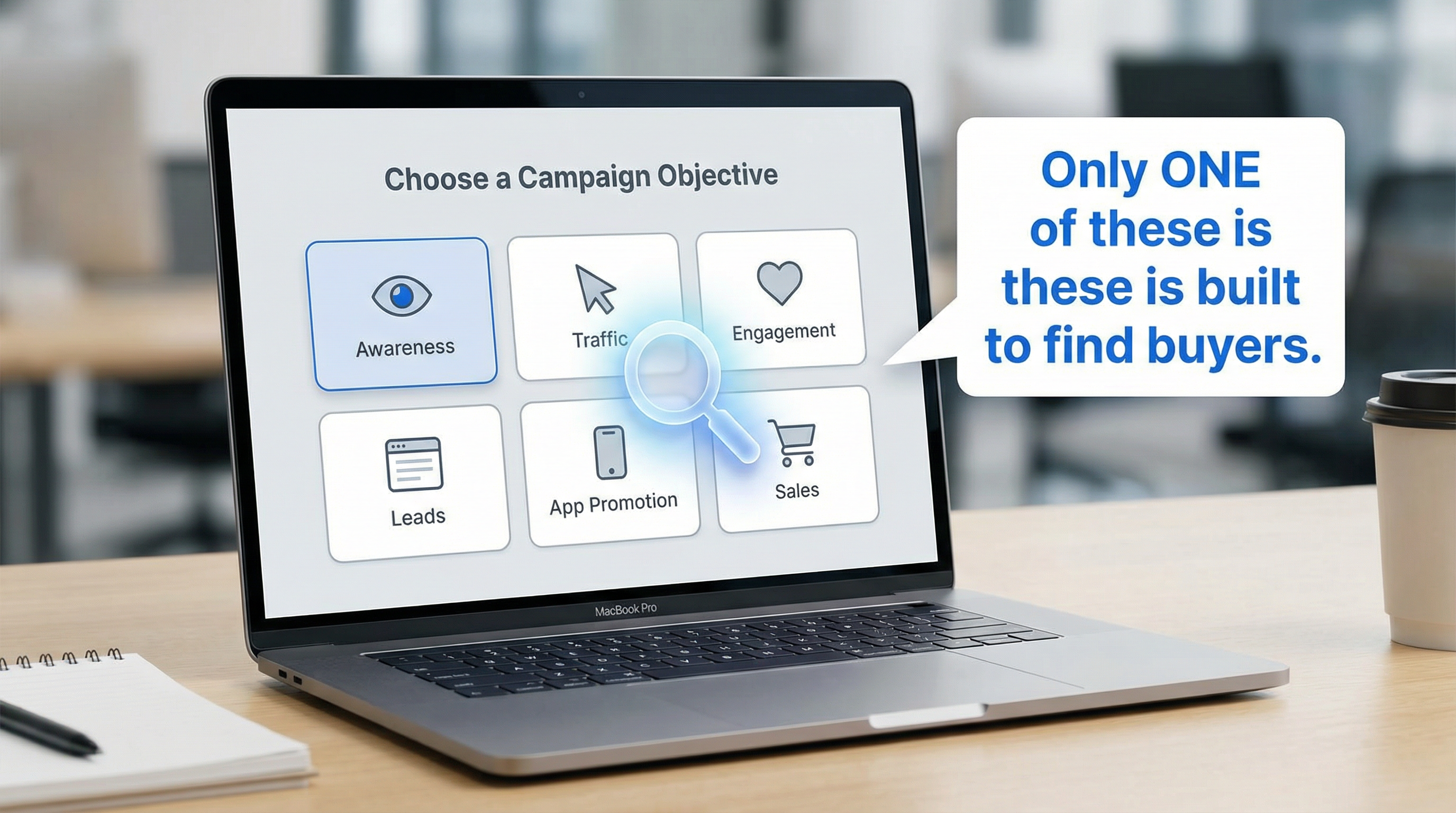
To a novice advertiser, this looks like a helpful menu of options. You might think, “Well, I want people to be aware of my brand, and I want traffic to my site, and I want sales… so maybe I should run a little bit of everything!”
This is exactly how you bleed money.
Meta’s algorithm is a prediction engine. It analyzes billions of data points across its user base—what posts you like, how long you hover over a video, what websites you visit, and what items you add to your cart. It then categorizes users based on their behavior.
There are people who scroll and “Like” everything they see, but never buy.
There are people who click every link in their feed, but abandon the page in three seconds.
And there are people who rarely click or like, but when they do, they pull out their credit card and purchase.
When you select an objective, you are telling Meta which bucket of users to target. If you pick the wrong bucket, you lose. Let’s break down exactly what each objective does.
1. The “Vanity” Objectives: Awareness, Traffic, and Engagement
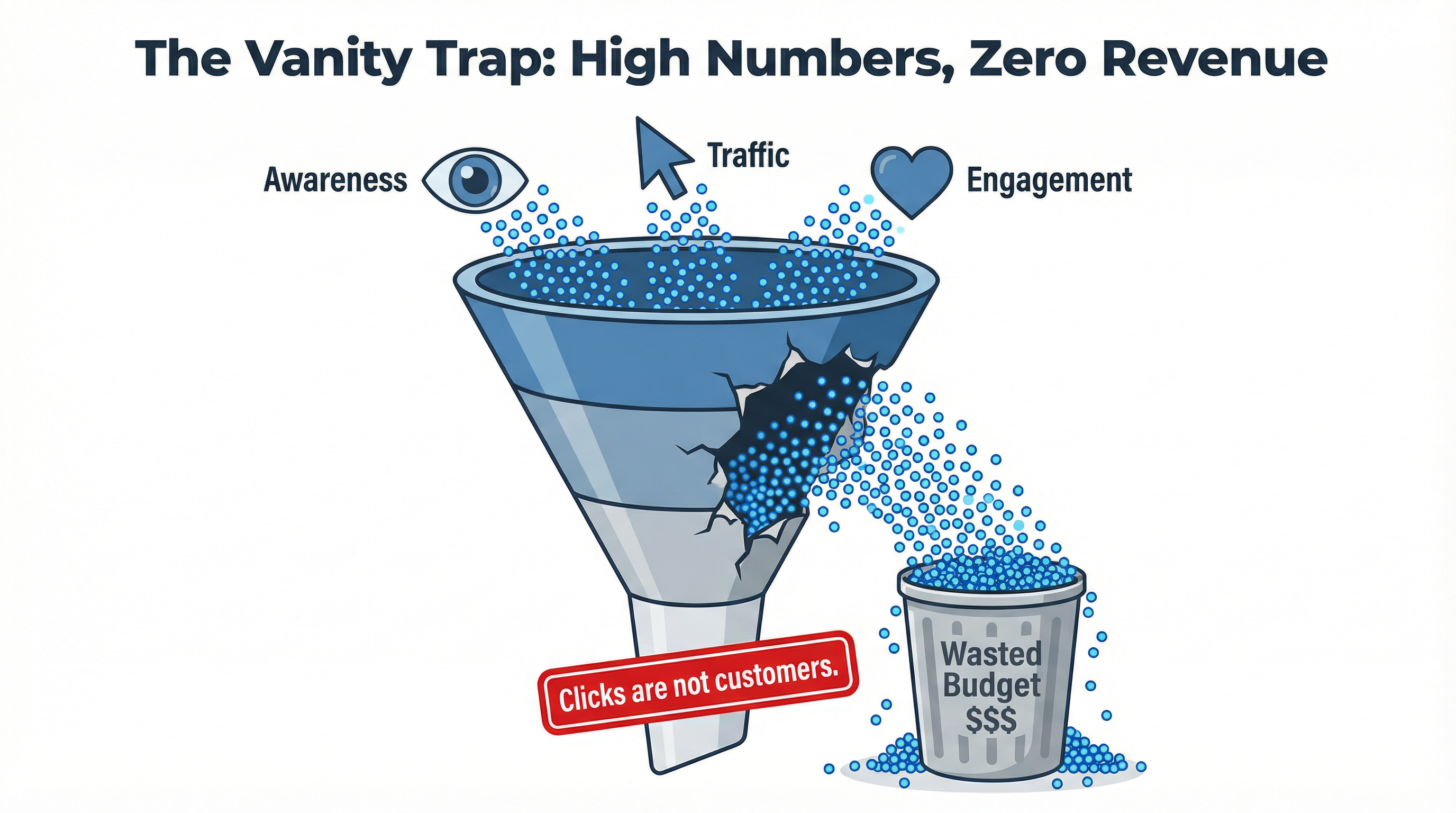
I group these three objectives together because, for 95% of small to medium-sized businesses, these are the danger zones. These are the objectives that make your dashboard look busy while your bank account stays empty.
Awareness
The Awareness objective is built to maximize reach and impressions. It tells the algorithm: “Show my ad to as many people as humanly possible for the lowest cost.”
The Reality: Meta will find the cheapest inventory available and show your ad to people who are highly unlikely to take any action. It is fantastic for Coca-Cola or Nike, who have multi-million dollar budgets and just want to stay top-of-mind. If you are a direct-response business trying to generate a return on ad spend (ROAS), Awareness campaigns are the equivalent of renting a billboard in the middle of a desert. You get eyeballs, but no action.
Traffic
As I mentioned in the opening story, the Traffic objective optimizes for Link Clicks or Landing Page Views. It tells the algorithm: “Find people who like to click things.”
The Reality: The internet is full of “clickers”—people who accidentally click ads, bots, or users with zero purchasing intent who just like opening tabs. Meta is incredibly good at finding these people cheaply. Your Cost Per Click (CPC) will look amazing, but your conversion rate will be abysmal. Never use the Traffic objective if your ultimate goal is a sale or a lead.
Engagement
The Engagement objective optimizes for likes, comments, shares, and video views. It tells the algorithm: “Find people who interact with posts.”
The Reality: We all have that one aunt who comments “Beautiful!” on every single post in her feed. The Engagement objective actively hunts for her. While social proof (likes and comments) can make an ad look trustworthy, you cannot pay your rent with Facebook Likes. I have seen Engagement campaigns generate thousands of reactions and absolutely zero revenue.
The Verdict on Vanity Objectives: Unless you are a massive brand with a dedicated top-of-funnel branding budget, stay away from these three. They will drain your budget and give you nothing but screenshots to brag about.
2. The “Action” Objectives: Leads and App Promotion
Now we are moving into the territory where Meta’s algorithm actually starts working for your bottom line. These objectives are designed to generate a specific, measurable action.
Leads
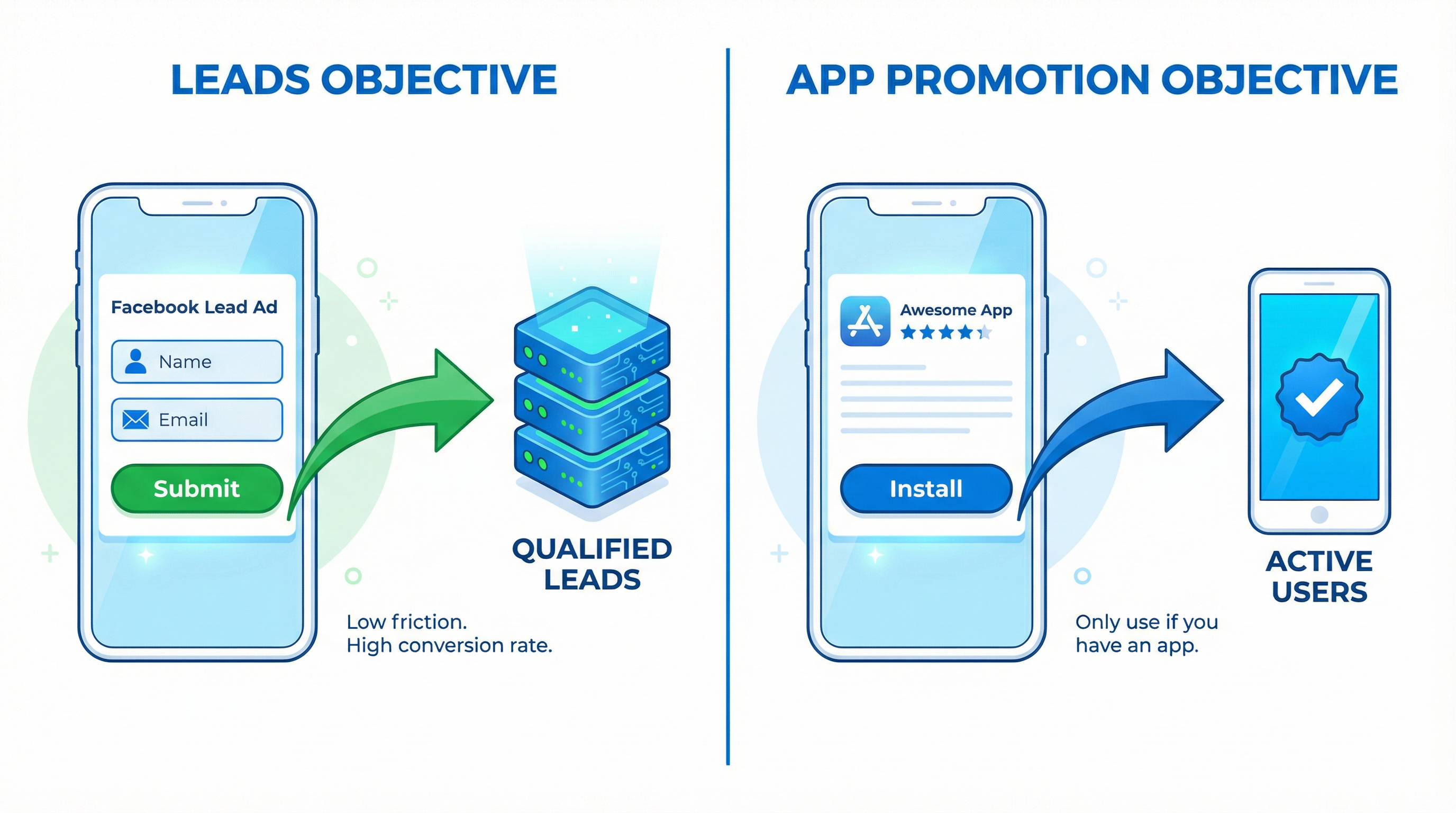
The Leads objective is a powerhouse for service-based businesses, B2B companies, real estate agents, and consultants. It tells the algorithm: “Find people willing to give me their contact information.”
You can use this objective to drive traffic to a landing page where users fill out a form, or you can use Meta’s native “Instant Forms.” Native forms pop up directly inside Facebook or Instagram, auto-filling the user’s name and email. Because the user never has to leave the app, the friction is incredibly low, and conversion rates are typically very high.
The Reality: The Leads objective works brilliantly, but there is a catch: Lead Quality. Because native forms are so easy to submit, you will inevitably get some low-quality leads (people who don’t remember filling out the form). To make this objective work, you must have a ruthless follow-up system in place. If you call a Facebook lead within 5 minutes, your close rate will be exponentially higher than if you wait 24 hours.
App Promotion
This one is incredibly straightforward. If you have a mobile app and you want people to install it, use this objective. It tells the algorithm: “Find people who frequently download and open new apps.”
The Reality: If you don’t have an app, ignore this entirely. If you do, it is highly effective because Meta tracks app installs perfectly through its SDK.
3. The King of ROI: The Sales Objective
If you are an e-commerce brand, a direct-to-consumer company, or selling any kind of digital product, the Sales objective is the only button you should be clicking.
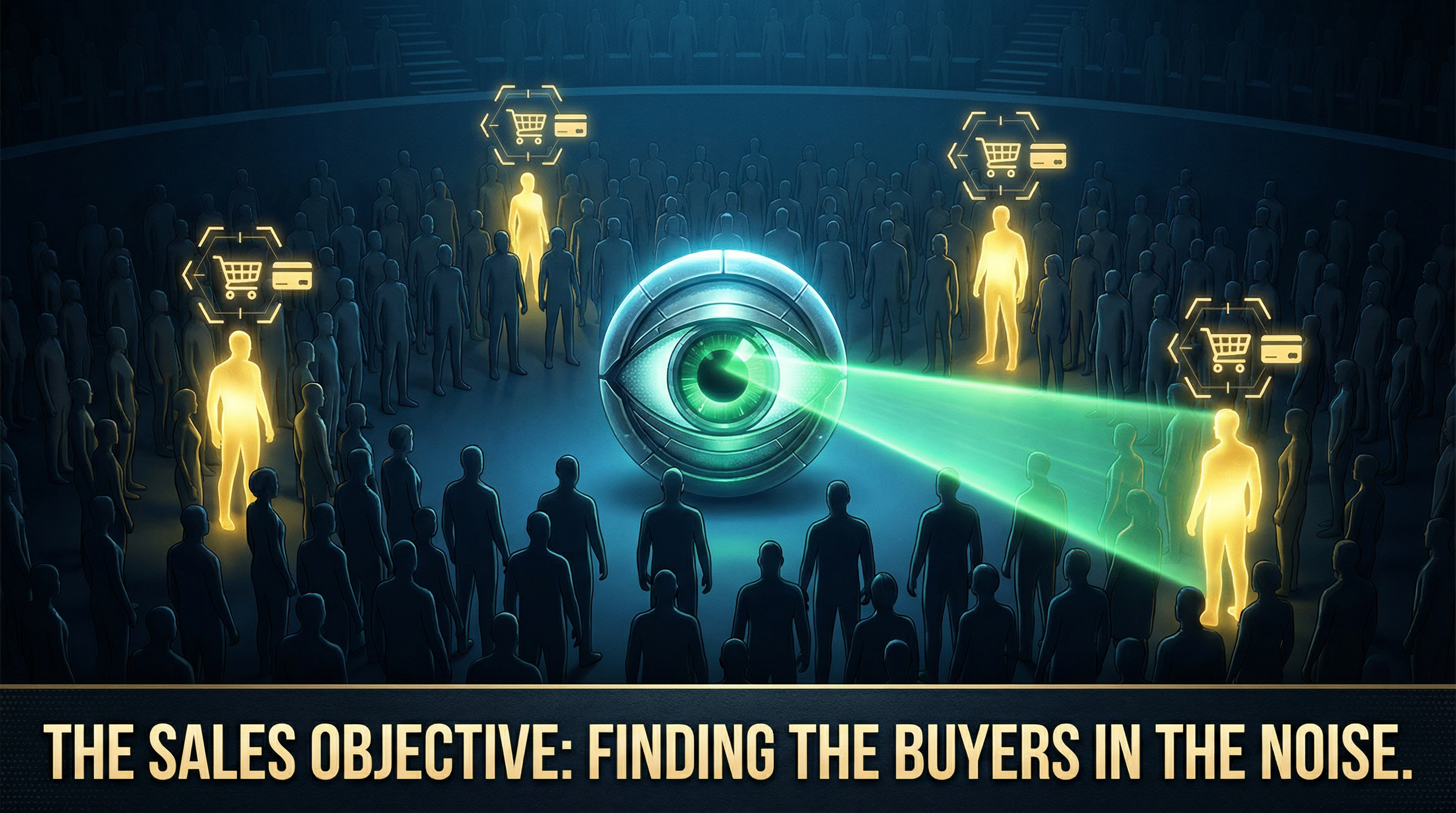
The Sales objective tells the algorithm: “Find people who are mathematically proven to pull out their credit cards and buy things online.”
This is where Meta’s AI flexes its true power. Meta knows exactly who the buyers are. It knows who abandons carts, who buys high-ticket items, and who impulse-buys from Instagram Reels at 2:00 AM. When you select the Sales objective, you are paying for access to that specific, highly valuable pool of users.
Why Advertisers Get Scared of the Sales Objective
Many beginners avoid the Sales objective because the Cost Per Click (CPC) and Cost Per Mille (CPM) are significantly higher than in a Traffic campaign.
If you run a Traffic campaign, you might pay $0.30 per click.
If you run a Sales campaign, you might pay $2.50 per click.
The beginner panics, turns off the Sales campaign, and goes back to Traffic. This is a fatal misunderstanding of the math.
Yes, the clicks in a Sales campaign are more expensive. That is because they are worth more. I would gladly pay $2.50 for a click from a proven buyer rather than $0.30 for a click from someone who has never bought anything online in their life.
You are not buying clicks. You are buying customers. The Sales objective is the only way to tell Meta to find them.
The Learning Phase: Feeding the Machine
Choosing the right objective is step one. Step two is giving the algorithm enough data to actually do its job.
When you launch a new campaign, it enters what Meta calls the “Learning Phase.” During this phase, performance will be highly volatile. The algorithm is actively testing different pockets of your audience to figure out who is actually going to convert based on the objective you selected.
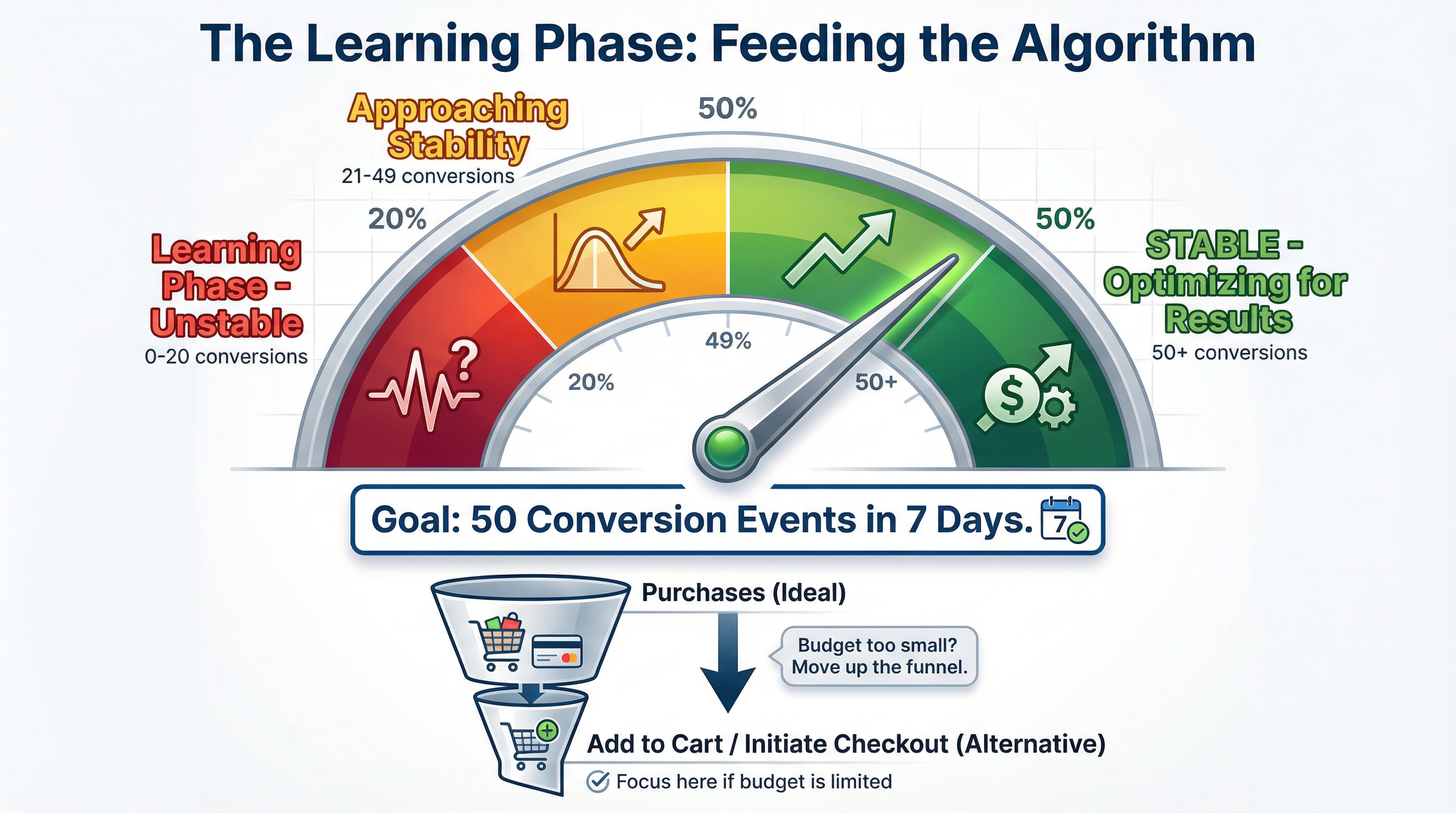
To successfully exit the Learning Phase and stabilize your results, Meta explicitly states that your Ad Set needs to generate 50 conversion events within a 7-day window.
If you chose the Sales objective, you need 50 purchases a week.
If you chose the Leads objective, you need 50 leads a week.
What if my budget is too small?
This is the most common hurdle for small businesses. If you are selling a $500 product and your daily budget is $20, you are never going to hit 50 purchases a week. The math simply doesn’t work. Your campaign will get stuck in “Learning Limited,” and your costs will skyrocket.
If you cannot afford the budget required to hit 50 purchases, you have to move your optimization event up the funnel.
Instead of optimizing for “Purchases,” change your conversion event to “Add to Cart” or “Initiate Checkout.” You will still use the Sales objective, but you are giving the algorithm an easier, more frequent action to optimize for. It is not as powerful as optimizing directly for purchases, but it is infinitely better than running a useless Traffic campaign.
Stop Paying for Empty Metrics
The days of tricking the Facebook algorithm are over. You cannot run a cheap Traffic campaign and hope those people magically decide to buy your product.
Meta’s AI is literal, ruthless, and incredibly effective—but only if you give it the right instructions.
If you want sales, ask for Sales. If you want leads, ask for Leads. Stop looking at your Cost Per Click, stop obsessing over how many Likes your ad got, and start aligning your campaign objective with the actual business outcome that pays your bills.
Get the objective right, and you have laid the foundation for a campaign that can actually scale. Get it wrong, and you are just making a donation to Mark Zuckerberg.
Are your Meta Ads getting clicks but no conversions? You might be sending the algorithm the wrong signals. I audit, restructure, and manage paid advertising campaigns for businesses that are ready to stop guessing and start scaling.
👉 Work with Naz Diocampo on Upwork

2 Comments
Great article. Choosing the wrong objective is one of the easiest ways to waste ad spend, especially for beginners who think more traffic automatically means more sales. The breakdown here makes that very clear.
You are absolutely right. Many advertisers choose an objective based on surface-level results, but traffic alone does not always lead to revenue. The right objective should always match the real business goal. I appreciate your feedback.