


Stop Treating Facebook Carousel Ads Like a Photo Dump (And What to Do Instead)
April 16, 2026
Google Ads for Flooring Stores: 3 Setup Fixes That Actually Work
April 29, 2026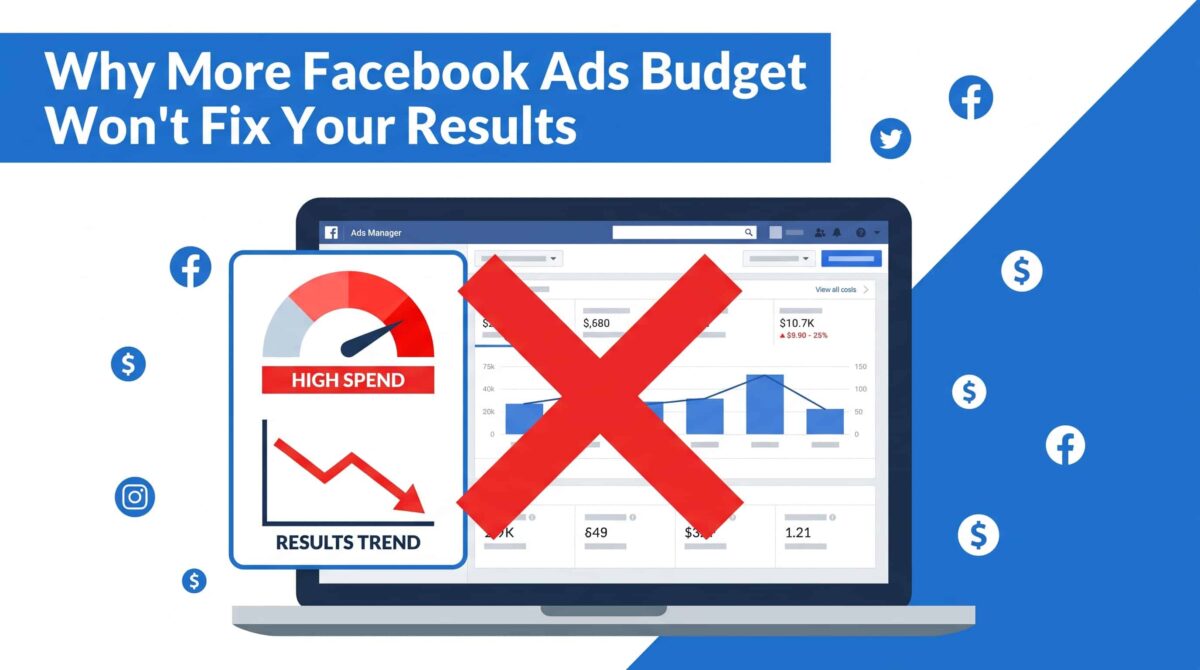
Let me say something that might be unpopular in a lot of marketing circles: throwing more money at your Facebook Ads is almost never the solution to underperformance.
I know that goes against the advice you’ve probably heard a dozen times. “Just increase your budget and let the algorithm do its thing.” And look — there’s a version of that advice that’s technically correct. But it’s missing the part that actually matters.
Here’s what nobody tells you upfront.
Meta’s Algorithm Has a Data Problem — And Your Budget Might Be Making It Worse
Facebook’s ad delivery system doesn’t just run your ads. It learns. It watches who clicks, who converts, who stays on your landing page, and who bounces. Over time, it uses that behavioral data to find more people who look like your best customers.
But that learning process requires fuel — and that fuel is conversions.
Meta needs roughly 50 optimization events per week per ad set to exit what’s called the learning phase. Below that number, the algorithm is essentially guessing. It’s casting a wide net and hoping for the best, because it doesn’t have enough signal to do anything smarter.
Here’s where budget enters the equation — but maybe not the way you think.
If your ad isn’t converting, increasing your budget doesn’t give Meta more data. It just gives Meta more budget to spend on an ad that isn’t working. You’re not accelerating learning. You’re accelerating waste.
The Sweet Spot Most Advertisers Ignore
So what does actually work?
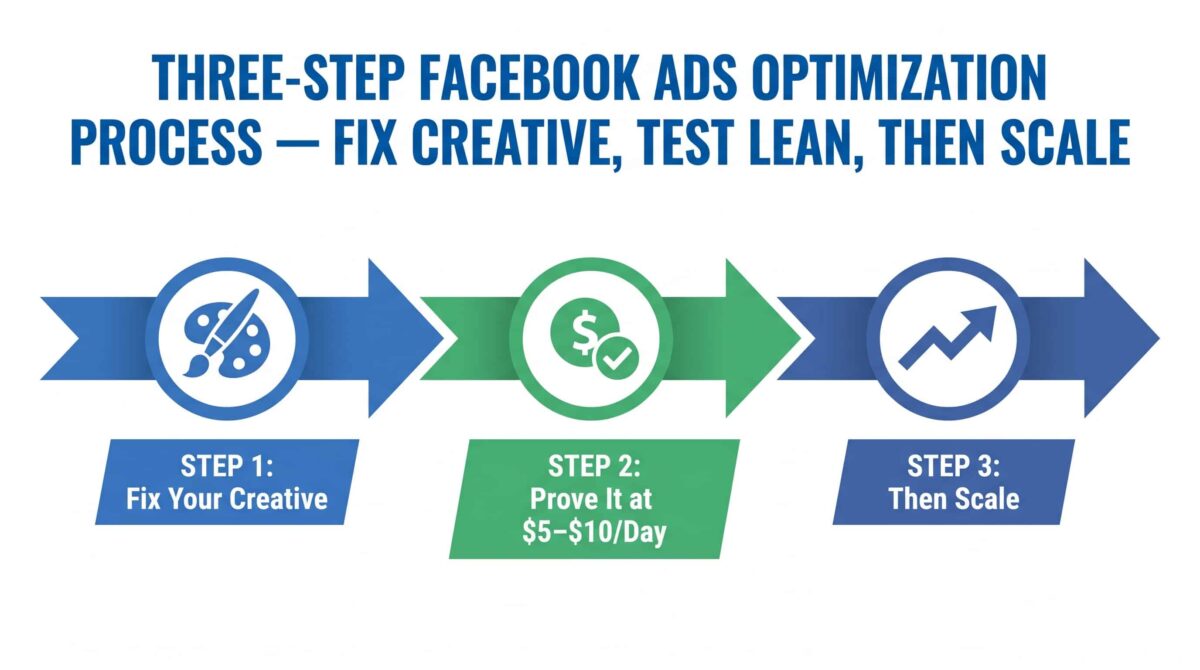
Start lean. The general consensus among practitioners — and it’s backed by Meta’s own guidance — is that $5 to $10 per day per ad set is the sweet spot for early-stage testing. That range is enough for Meta to gather meaningful data without burning through your budget before you’ve learned anything useful.
This doesn’t mean you stay at $10 a day forever. Once an ad set is converting consistently and has exited the learning phase, that’s when you scale — incrementally, not aggressively. Jumping your budget by 50% overnight can reset the learning phase entirely, which is the last thing you want when something’s finally working.
The principle: start lean, prove it works, then scale with intention.
The Real Driver of Facebook Ads Performance
Here’s the insight that separates mediocre Facebook advertisers from great ones.
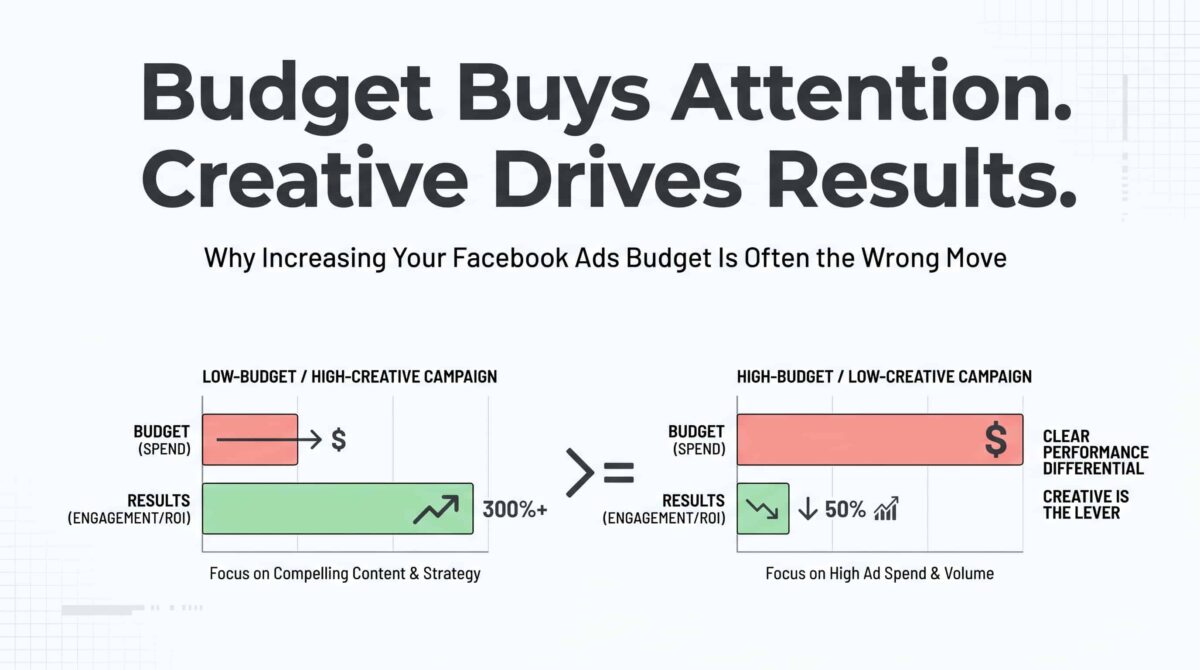
Budget buys attention. Creative turns it into results.
Your budget determines how many people see your ad. But your creative — the image or video, the headline, the copy, the hook — determines what those people do when they see it.
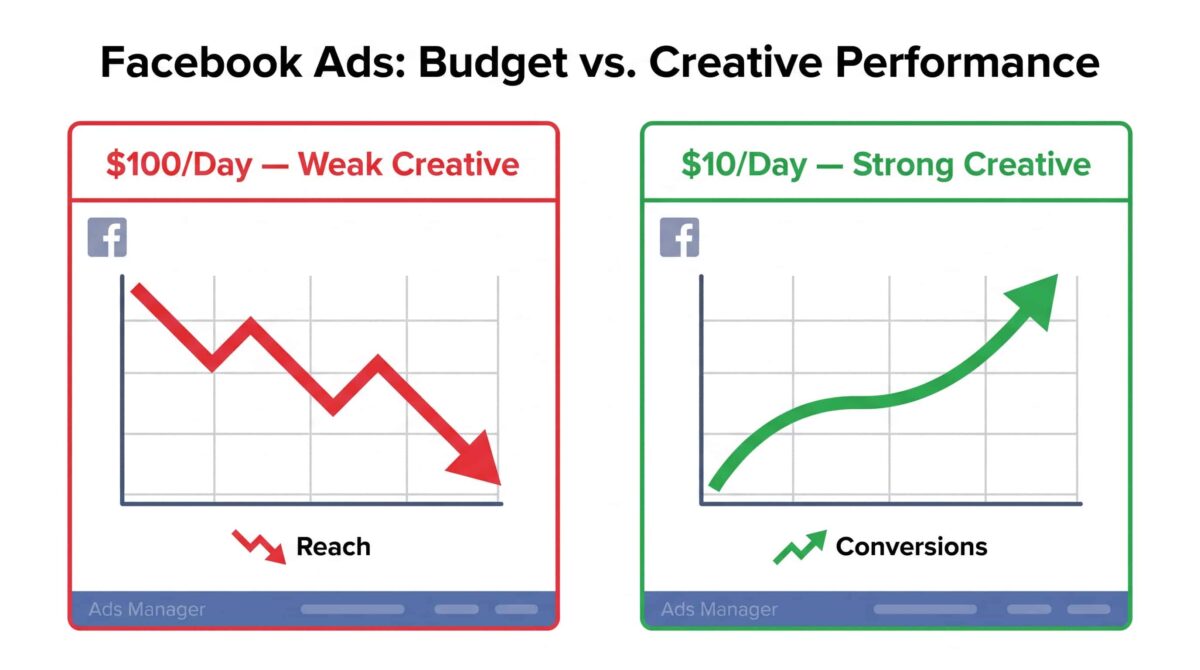
I’ve watched $10/day campaigns consistently outperform $100/day campaigns. Not because of better targeting. Not because of smarter bidding. Because the ad itself was doing its job. It stopped the scroll. It spoke to a real, specific pain point. It gave the viewer a reason to click.
And I’ve watched $100/day campaigns drain budgets for weeks because the ad was generic, the hook was weak, and the message didn’t connect with anyone in particular.
The difference isn’t always the spend. It’s almost always the creative.
What To Fix Before You Touch Your Budget
If your Facebook Ads aren’t performing, here’s the order of operations I’d recommend before you ever consider increasing your spend:
1. Audit your hook. The first three seconds of your ad — or the first line of your copy — determines whether anyone keeps watching or reading. If your hook is generic, nothing else matters.
2. Check your message-to-market match. Is your ad speaking to the specific problem your audience is experiencing right now? Vague benefit statements don’t convert. Specific, relatable pain points do.
3. Review your landing page. Meta can only do so much. If the click happens but the landing page doesn’t convert, that’s not a budget problem or a creative problem — that’s a funnel problem.
4. Check your conversion tracking. This one is critical and often overlooked. If Meta isn’t receiving accurate conversion data, it literally cannot optimize. Dirty data means the algorithm is flying blind — and no budget increase will fix that.
Once you’ve worked through that list — once your creative is solid, your tracking is clean, and your funnel converts — then you scale. Not before.
The Bottom Line
More budget amplifies what’s already there. If what’s there isn’t working, more budget just amplifies the problem faster.
Fix the creative. Clean the data. Prove the concept at a lean budget. Then scale.
That’s the order. And it works.
Managing Facebook Ads and want a second opinion on what’s actually holding your campaigns back? I work with clients on Upwork to audit, rebuild, and optimize paid ad campaigns across Meta and Google. 🔗 https://www.upwork.com/freelancers/nazdiocampoaimarketing

6 Comments
Great article. I liked how you pointed out that ad performance is not only about spend, but also about audience quality, message alignment, and conversion tracking. Many businesses overlook those parts.
Thank you, Valentina. That’s exactly the point I wanted to highlight. Budget matters, but it works best when the fundamentals are already in place.
Really good point here. A lot of people think spending more will solve everything, but if the targeting or ad creative is off, it just wastes more money. This explained that well.
Thanks, Jason. You’re absolutely right. More budget usually just amplifies the existing problems if the targeting, offer, or creative is not working properly in the first place.
Very true. Increasing the budget usually just increases the cost of bad strategy when the targeting, offer, or funnel is not working. This is an important reminder for advertisers who think budget is always the main problem.
That is exactly right. More budget does not solve weak fundamentals. It usually only magnifies the problem. Fixing the offer, targeting, creative, and funnel first is often the smarter move before scaling spend.